
Recently added item(s)
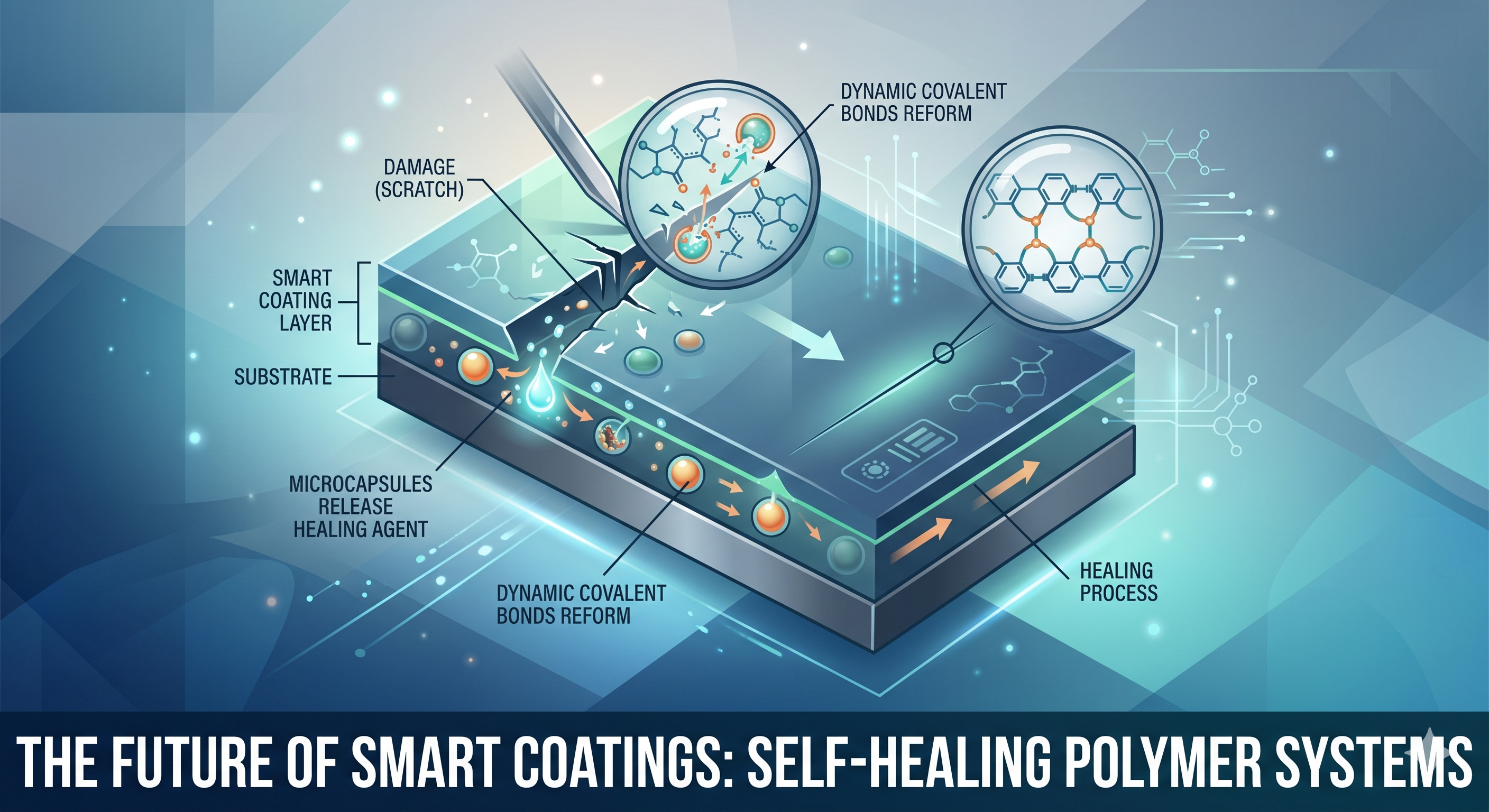
For decades, the battle against corrosion, wear, and mechanical fatigue has been a passive one. We painted bridges, coated pipelines, and lacquered cars, hoping these “dumb” barriers would hold out as long as possible. But once a scratch appeared, the clock started ticking toward structural failure. Today, we are entering a new era where materials are no longer passive.
Self-healing polymer systems are the vanguard of “Smart Coatings”—materials that can sense damage and repair themselves autonomously, much like human skin. This technology is not just about saving paint; it is about extending the lifespan of global infrastructure, reducing the environmental impact of maintenance, and ensuring safety in high-risk environments like aerospace and deep-sea exploration.
1. Beyond Passive Protection: The Dawn of Smart Coatings
Traditional coatings serve as a physical barrier. However, environmental stressors—UV radiation, temperature fluctuations, and physical impacts—inevitably create micro-cracks. These cracks are often invisible to the naked eye but serve as “highways” for moisture and corrosive ions to reach the underlying substrate.
Self-healing coatings change the paradigm from prevention to remediation. Instead of simply trying to resist damage, these systems accept that damage will occur and are engineered with the chemical “intelligence” to fix it. This transition is essential for the next generation of sustainable engineering, where the goal is “immortal” infrastructure that requires minimal human intervention.
2. The Architecture of Self-Healing: Extrinsic vs. Intrinsic Systems
In the world of polymer science, there are two primary ways to achieve self-healing: Extrinsic and Intrinsic systems. Each has its own chemistry and specific industrial use cases.
Extrinsic Systems: The “First Aid Kit” Approach
Extrinsic systems rely on healing agents that are pre-sequestered within the coating. When damage occurs, these agents are released to fill the void.
-
Microencapsulation: This is the most common method. Microscopic capsules (typically 10–100 micrometers in diameter) containing a liquid healing agent (like epoxy or linseed oil) are dispersed throughout the coating. When a crack ruptures the capsule, the agent flows into the crack and hardens upon contact with a catalyst or the atmosphere.
-
Vascular Networks: Inspired by the human circulatory system, this method uses a network of microscopic tubes or channels. This allows for multiple healing cycles in the same location, as the healing agent can be “pumped” or drawn by capillary action to the site of damage repeatedly.
Intrinsic Systems: The “Biological” Approach
Intrinsic systems do not use a separate healing agent. Instead, the polymer matrix itself is designed to be “reversible.”
-
Reversible Chemical Bonds: These polymers use dynamic covalent bonds (such as the Diels-Alder reaction) or non-covalent interactions (like hydrogen bonding or metal-ligand coordination). When the material is damaged, these bonds break. Under a specific trigger—often heat, UV light, or simply physical contact—the bonds reform, knitting the material back together at the molecular level.
3. The Mechanics of the “Smart” Response
What makes a coating “smart” is its ability to respond to a stimulus. Current research is focusing on three main triggers:
-
Mechanical Trigger: The physical force of a scratch ruptures a capsule or breaks a molecular bond, initiating the repair.
-
Chemical Trigger (pH Changes): In anti-corrosive coatings, the onset of corrosion often changes the local pH. Smart polymers can be designed to “open” and release corrosion inhibitors only when they detect these pH shifts.
-
Thermal Trigger: Many intrinsic polymers require a brief application of heat to mobilize the polymer chains so they can find their “partners” and rebond.
4. Industrial “Clinical” Case Studies and Recent Research
While self-healing coatings began in the laboratory, they are now being subjected to rigorous industrial “clinical” trials in the real world.
Aerospace: NASA and High-Altitude Protection
NASA has been a pioneer in testing self-healing polyurethanes for spacecraft. In the vacuum of space, micrometeoroid impacts are a constant threat. Research shows that self-healing ionomers can seal a puncture hole in milliseconds, preventing catastrophic decompression.
Automotive: The “Forever Clear-Coat”
High-end automotive manufacturers are now using self-healing clear-coats based on polycaprolactone (PCL). Recent studies demonstrate that swirl marks and light scratches—the kind that dull a car’s finish over time—can be repaired by simply leaving the car in the sun for 30 minutes.
Marine and Offshore: Fighting the Salt
Corrosion in marine environments costs the global economy billions. A 2024 study published in Progress in Organic Coatings highlighted a new “triple-action” coating for offshore wind turbines. It uses microcapsules containing both a healing resin and a “self-reporting” dye that turns red when the healing agent is spent, allowing maintenance crews to identify areas that need future attention.
5. Advantage vs. Risk Evaluation
The adoption of self-healing technology is a strategic decision that requires weighing incredible benefits against current technological hurdles.
Advantages
-
Extended Service Life: Coatings that used to last 5 years can now potentially last 15–20 years.
-
Reduced Maintenance Costs: Autonomous repair reduces the need for manual inspection and repainting, which is especially vital for hard-to-reach structures like bridges or underwater pipes.
-
Enhanced Safety: By stopping micro-cracks before they become structural fractures, self-healing systems prevent catastrophic failures in critical systems.
-
Sustainability: Less frequent repainting means lower consumption of raw materials and fewer VOC (Volatile Organic Compound) emissions.
Risks and Challenges
-
Cost of Synthesis: The chemical precursors for reversible bonds and the process of microencapsulation remain more expensive than traditional resin production.
-
Mechanical Trade-offs: In some cases, making a polymer “healable” (which requires molecular mobility) can make it softer or less resistant to heavy abrasion.
-
Environmental Stability: Some healing agents are sensitive to moisture or extreme temperatures during storage, which can limit the shelf-life of the liquid coating before it is applied.
-
Complexity of Scale-up: Transitioning from a 500ml lab sample to a 5,000-liter industrial batch without losing the “smart” functionality is a significant engineering challenge.
6. The Future: AI-Optimized and Bio-Synthetic Coatings
We are moving toward a future where “smart” isn’t enough; we want “intelligent” coatings.
AI-Driven Discovery: Machine learning models are currently being used to simulate millions of polymer combinations to find the perfect balance between hardness and healing speed. This is drastically reducing the “lab-to-market” time.
Bio-Synthetic Integration: Some researchers are experimenting with embedding bacteria (like Bacillus subtilis) into coatings. When a crack forms and water enters, the bacteria “wake up” and produce calcium carbonate (limestone), which fills the crack. This merges the worlds of biology and materials science into a truly living shield.
Conclusion
Self-healing polymer systems represent the ultimate evolution of material science. By moving from a “replace” culture to a “repair” culture, we are fundamentally changing our relationship with the built environment. While challenges in cost and manufacturing remain, the long-term economic and environmental benefits make the transition to smart coatings inevitable. The future is not just about a better coat of paint; it is about materials that have the resilience of life itself.