
Recently added item(s)
1. Introduction: The Invisible Guardian of Quality
In the world of high-tech manufacturing, we often focus on the solid materials we can see—the titanium for an implant, the carbon for a nanotube, or the gold for a diagnostic sensor. However, there is an invisible protagonist that plays a decisive role in the success of these materials: High-Purity Inert Gas.
Whether it is Argon, Nitrogen, or Helium, these gases act as a protective shroud during the production of fine powders. In processes like atomization, ball milling, or 3D printing, the presence of even a trace amount of oxygen or moisture can compromise the structural integrity and biological safety of the final product. This article explores why high-purity gases are the “unsung heroes” of powder production, especially within the context of medical and aerospace engineering.
2. What is an Inert Gas Atmosphere?
An “inert” gas is a substance that does not undergo chemical reactions under a set of given conditions. In powder production, these gases are used to create an “inert atmosphere” by displacing air (which contains 21% oxygen).
Why Oxygen is the Enemy
At the nanoscale, the surface-to-volume ratio of materials is incredibly high. This means that almost every atom is “exposed.” If oxygen is present during production:
-
Oxidation: A layer of metal oxide forms on the surface of the powder. For medical implants, this oxide layer can prevent proper osseointegration or lead to the release of toxic ions into the body.
-
Contamination: Oxygen and nitrogen (from air) can become trapped inside the powder particles, creating “gas pores” that make the final material brittle and prone to failure.
3. Critical Roles in Different Production Methods
A. Gas Atomization
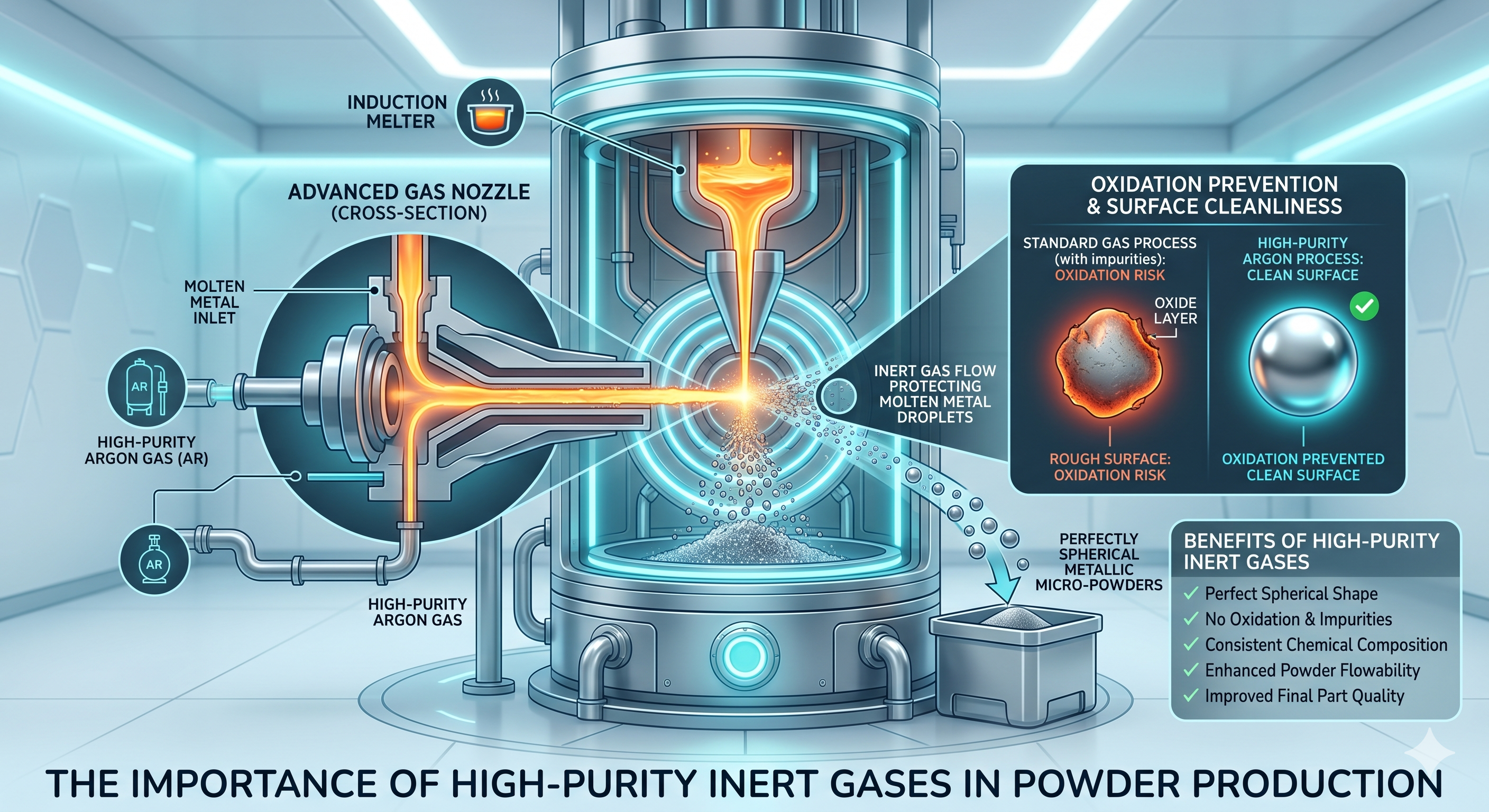
This is the primary method for producing high-quality metal powders. Molten metal is struck by a high-pressure jet of inert gas (usually Argon), which “breaks” the liquid metal into tiny, spherical droplets that solidify in mid-air.
-
The Purity Factor: If the Argon used is not of ultra-high purity (99.999% or higher), the droplets will oxidize instantly, resulting in irregular shapes and poor flowability, making them useless for precision 3D printing of prosthetics.
B. Ball Milling (Mechanochemical Synthesis)
As discussed in our comparison of Ball Milling vs. CVD, high-energy milling involves intense collisions. These collisions create “active sites” on the material surface. If the milling vial is not filled with high-purity Argon, these sites will react with air, causing the powder to degrade or, in some cases, catch fire (pyrophoricity).
C. Additive Manufacturing (3D Printing)
Modern medical implants are often “printed” using Selective Laser Melting (SLM). The entire printing chamber must be flooded with inert gas. High-purity gas ensures that the laser melts the powder without any “sooting” or chemical changes, resulting in a bio-compatible coating that is perfectly fused to the base metal.
4. Recent Research: The Impact of Gas Recirculation
Recent studies in 2024 and 2025 have focused on the sustainability of gas use. High-purity Argon is expensive and energy-intensive to produce.
-
Smart Filtration: New research is looking at “closed-loop” systems that can filter out microscopic impurities from used gas in real-time. This allows manufacturers to reuse up to 95% of their gas without compromising the quality of the medical powder.
-
Helium-Argon Blends: Clinical research into “porous implants” has shown that adding small amounts of Helium to the Argon shroud can improve heat distribution during production, leading to more uniform pore sizes that encourage faster bone growth.
5. Advantage vs. Risk Assessment: The Price of Purity
Using the highest grade of inert gas is a strategic decision that involves a balance of cost and performance.
| Feature | Advantage of High Purity | Risk of Low Purity / Contamination |
| Material Strength | Maximizes fatigue resistance; essential for load-bearing hip implants. | Brittleness: Internal oxidation creates micro-cracks that lead to sudden failure. |
| Biocompatibility | Ensures the surface remains chemically “pure” for cell attachment. | Inflammation: Metallic oxides can trigger an immune response and implant rejection. |
| Process Stability |
Predictable results across 1-ton production batches.
|
Explosion Risk: Fine powders (like Titanium or Aluminum) are highly flammable in air. |
| Surface Finish | Produces smooth, spherical powders that flow easily in machinery. | Sooting: Impurities can cause the powder to “clump,” blocking expensive 3D printers. |
6. Managing the “1 Gram to 1 Ton” Challenge
As manufacturers scale up from 1 gram to 1 ton of nanomaterial, the demand for high-purity gas grows exponentially.
-
Storage and Delivery: At the 1-ton scale, gas is no longer stored in small cylinders but in massive cryogenic tanks. Maintaining purity during the “boil-off” and transport through industrial piping is a major engineering challenge.
-
Monitoring: Industrial facilities now use “Trace Oxygen Analyzers” that can detect oxygen levels as low as 1 part per billion (ppb). If the purity drops even slightly, the system automatically shuts down to save the batch.
7. Global Regulatory View on Gas Quality
Regulators like the FDA do not just look at the final implant; they look at the entire “validated process.” This includes the purity of the gases used during production.
-
Certificates of Analysis (CoA): Manufacturers must provide documented proof that the Argon or Nitrogen used in their facility meets “Medical Grade” standards.
-
Safety of Nanomaterials: Ensuring an inert atmosphere is a key requirement in the Global Regulatory View for preventing the formation of “unintended nano-species” that could pose a toxicological risk to patients.
8. The Future: Selective Gas “Doping”
The next frontier in powder production is not just about keeping the gas pure, but intentionally doping it. Some researchers are experimenting with adding tiny, controlled amounts of Nitrogen to Argon during the production of certain alloys to “freeze” the crystal structure in a way that makes the material even stronger. This requires a level of gas control that was impossible a decade ago.
9. Conclusion: The Foundation of Reliable Medicine
In the complex journey of creating a medical implant—from characterization with SEM and TEM to industrial Scale-Up—the purity of the environment is the foundation of success. High-purity inert gases are more than just a “blanket”; they are a critical reagent that ensures our high-tech powders remain safe, strong, and ready to heal.
Without these invisible guardians, the precision of nanotechnology would be lost to the chaos of oxidation. As we continue to push the boundaries of 3D printing and regenerative medicine, the demand for “five-nines” (99.999%) purity will only grow, cementing the role of gas engineering as a cornerstone of modern healthcare.