
Recently added item(s)
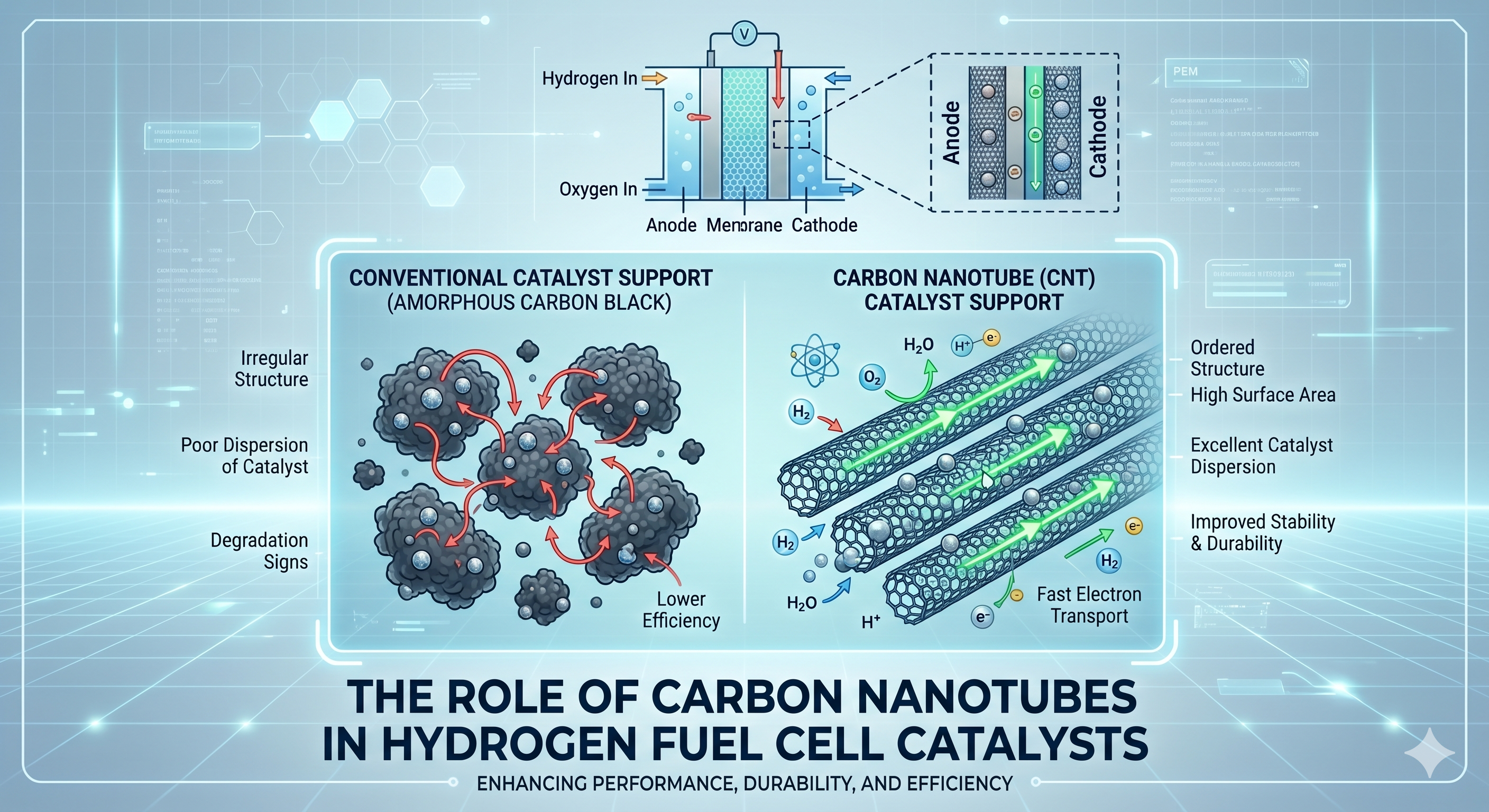
Imagine a world where your car emits nothing but pure, drinkable water, where massive power grids are balanced by silent, emission-free power plants, and where the primary fuel is the most abundant element in the universe: hydrogen. This isn’t science fiction; it is the promise of the hydrogen economy.
At the heart of this revolution is a device called the hydrogen fuel cell. While fuel cells have been around for over a century, their widespread adoption has been stymied by a fundamental bottleneck: the catalyst. Current catalyst technology relies heavily on platinum, a metal so rare and expensive that it makes the mass production of fuel cells economically unviable.
Enter Carbon Nanotubes (CNTs). These extraordinarily tiny, atomic-scale cylinders are not just stronger than steel and more conductive than copper; they might be the missing ingredient needed to make fuel cells durable, efficient, and cheap enough for everyone.
The Bottleneck at the Nano-Scale: Why Fuel Cells Need Help
To understand the revolutionary potential of CNTs, we first need to understand the crisis at the heart of the fuel cell’s anatomy.
Inside a Proton Exchange Membrane (PEM) fuel cell—the type most likely to power your future vehicle—a chemical marriage takes place. Hydrogen gas ($H_2$) enters one side (the anode), and oxygen ($O_2$) from the air enters the other (the cathode).
Their desire to unite is strong, but they cannot do it alone. They need a catalyst to break their existing atomic bonds. Current state-of-the-art catalysts use tiny nanoparticles of platinum, dispersed over a high-surface-area material, usually Carbon Black (a form of amorphous soot).
The Dual Problem: Cost and Durability
-
The Cost Problem: A catalyst needs to be distributed thinly to maximize its exposed surface area. However, the cathode reaction (Oxygen Reduction Reaction) is extremely slow and requires a massive amount of platinum to occur fast enough to power a vehicle. This makes the fuel cell stack the single most expensive component of a hydrogen car.
-
The Durability Problem: Carbon Black is not a happy home. Under the harsh operating conditions of a fuel cell—high acidity, high voltage, and thermal fluctuations—Carbon Black corrodes. As the carbon support deteriorates, the platinum nanoparticles lose their grip. They detach, clump together (agglomerate), or dissolve. This results in a rapid loss of catalyst surface area and a corresponding decay in the fuel cell’s power output.
Current fuel cells can degrade significantly within just a few thousand hours of operation, far short of the durability required for commercial vehicles. We don’t just need cheaper catalysts; we need a “better nest” for them to live in.
Enter the Superhero: What Are Carbon Nanotubes?
If Carbon Black is soot, Carbon Nanotubes are architectural masterpieces.
CNTs are sheets of graphene—a single layer of carbon atoms arranged in a hexagonal honeycomb lattice—rolled into perfect tubes. Depending on how they are rolled, they can be single-walled (SWCNTs) or multi-walled (MWCNTs), the latter resembling a set of nesting dolls.
Unique Properties for Energy Storage
-
Atomic Perfection: Their crystalline structure gives them extraordinary chemical inertness and resistance to corrosion, far superior to amorphous Carbon Black.
-
Superconductivity: Electrons fly through CNTs with almost zero resistance. In a catalyst, where the swift transport of electrons is crucial for the electrochemical reaction, this is a game-changer.
-
Massive Surface Area: Despite being almost invisibly thin, a single gram of CNTs can have a surface area equivalent to several tennis courts. This provides ample room to disperse catalyst particles.
The Engineering of Perfection: Giving CNTs Their Sticky Grip
In their natural state, CNTs are too perfect. Their surfaces are atomically smooth and hydrophobic (water-repelling). While this makes them chemically stable, it means platinum nanoparticles can’t stick to them. If you try to deposit platinum on raw CNTs, the metal just beads up like water on a freshly waxed car.
To make them suitable catalyst supports, scientists use a process called Functionalization.
“Roughing Up” the Smooth Tubes
Functionalization involves treating the CNTs with harsh chemicals (like nitric acid) or plasma to introduce “defects” or chemical groups onto their smooth surfaces. Imagine sanding a piece of smooth plastic before painting it. These defects—often oxygen-containing groups—act as anchors.
When platinum is then deposited, the atoms cling to these specific functional sites, creating well-dispersed, tiny nanoparticles that are chemically bonded to the incredibly strong nanotube structure. This process, developed over the last fifteen years, is key to creating catalysts that are both highly active and extremely durable.
Current Breakthroughs and “Industrial” Trials
The theoretical advantages of CNTs have long been known. However, research between 2024 and 2026 has focused intensely on translating these advantages into real-world performance, bridging the gap between a lab breakthrough and a factory pilot line. Since we cannot perform “clinical trials” on machines, we look to long-duration “Accelerated Stress Testing” (AST) performed by national laboratories and automotive consortiums.
Hybrid Nanostructures: The Norelco Model
A major trend in current research is creating hybrid catalyst supports. CNTs are excellent at conducting electrons, but their cylindrical shape can sometimes hinder the diffusion of hydrogen or oxygen gas to the catalyst sites.
Researchers are now marrying CNTs with other nanomaterials, such as Graphene or mesoporous carbon. In these structures, the CNTs act like electrical “superhighways,” quickly transporting electrons, while the other components provide a “porous network” that allows gas to reach every platinum particle. These hybrids often show activity and durability superior to either component used alone.
Single-Atom Catalysts (SACs) on CNTs
Perhaps the most exciting frontier is Single-Atom Catalysts. Instead of using platinum nanoparticles (which are clumps of hundreds of platinum atoms), scientists are finding ways to anchor individual platinum atoms directly onto functional sites on a CNT support.
This represents the ultimate limit of atom efficiency. If successful, it could slash the amount of platinum needed in a fuel cell cathode by 90% or more, potentially bringing the cost of a hydrogen fuel cell car down to the level of a conventional gasoline vehicle.
Real-World Durability Results
Results from long-term durability trials (which simulate the lifecycle of a car) have been very promising. The U.S. Department of Energy’s (DOE) targets are rigorous, demanding catalysts that can withstand tens of thousands of voltage cycles with minimal loss. catalysts supported on functionalized CNTs and CNT-hybrids have demonstrated 80% or higher capacity retention after standard stress tests, vastly outperforming Carbon Black-based systems which often lose over half their power in the same period.
Balanced Assessment: Advantages vs. Risks
While the potential is staggering, we must balance the technological promise with the economic and environmental realities.
The Clear Advantages
-
Vastly Superior Durability: CNT supports survive the harsh fuel cell environment, offering a pathway to catalysts that last the life of the vehicle.
-
High Power Density: Excellent electrical conductivity translates to more efficient catalyst utilization, meaning more power from a smaller cell.
-
Reduced Precious Metal Use: Their massive surface area allows for better dispersion, enabling high performance with less platinum.
The Critical Risks and Bottlenecks
-
Toxicity Concerns: This is the most significant risk. In certain forms, long, rigid multi-walled CNTs have an asbestos-like physical structure. If inhaled, they can potentially cause mesothelioma and other lung diseases. This risk must be managed at the manufacturing and recycling stages.
-
Cost of Functionalization: While the price of raw CNTs has dropped significantly, the multi-step chemical treatment required to functionalize them adds complexity and cost.
-
Scalability of Quality: Producing metric tons of CNTs with consistent length, diameter, and functionalization sites is an immense engineering challenge. A “bad batch” could derail an entire production line of fuel cells.
Conclusion: A Key to the Puzzle, But Not the Whole Puzzle
Carbon Nanotubes are not a silver bullet that will immediately make hydrogen fuel cells ubiquitous. They are, however, a critical piece of the structural puzzle.
They solve the durability crisis that has haunted carbon supports for decades. They offer a stable platform upon which the next generation of cost-saving breakthroughs—like Single-Atom Catalysts—can be built. By 2030, it is likely that Carbon Black supports will be seen as a legacy technology, replaced in high-performance automotive stacks by functionalized CNTs or CNT-hybrids.
The role of Carbon Nanotubes in hydrogen fuel cells is a masterclass in nanotechnology: leveraging the exotic properties of materials at the atomic scale to solve the macroeconomic problems of the macroscopic world.