
Recently added item(s)
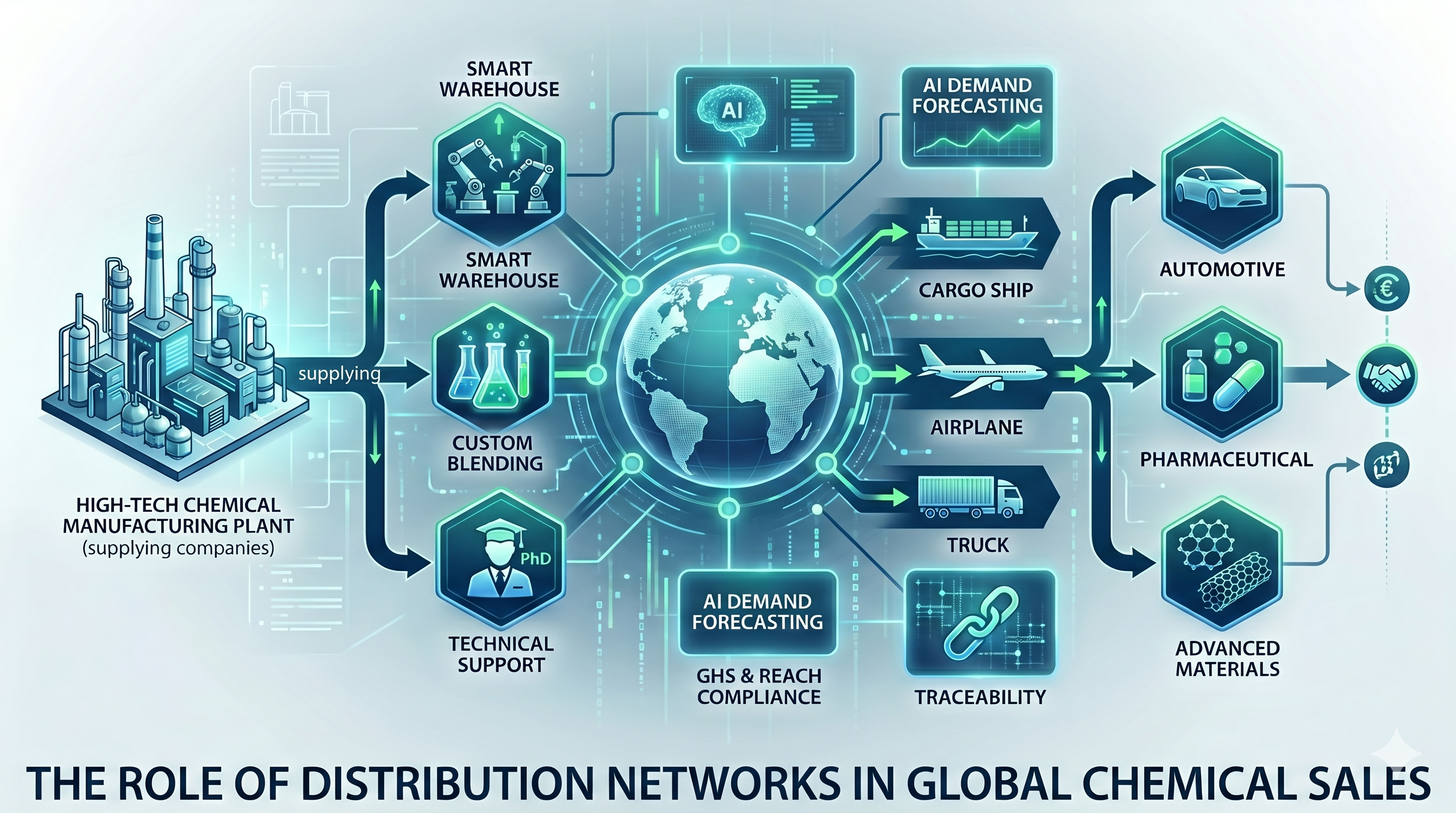
The global chemical industry is often described as the “industry of industries.” From the specialized coatings on a smartphone to the advanced nanomaterials like graphene used in aerospace, nearly every physical product in the modern world begins with a chemical reaction. However, the journey from a massive petrochemical refinery or a specialized laboratory to the end-user is rarely a straight line. It is facilitated by an intricate, highly regulated, and increasingly digitalized web: the global distribution network.
As we move further into 2026, the role of these networks has evolved. No longer just “middlemen” who move drums from point A to point B, chemical distributors have become strategic partners that provide technical expertise, regulatory compliance, and supply chain resilience. This article explores the multifaceted role of distribution networks in global chemical sales, balancing the economic advantages against the inherent risks of a volatile global market.
1. Bridging the Gap: The Structural Necessity of Distributors
In the chemical world, there is a fundamental mismatch between production and consumption. Major producers—the “Tier 1” giants—operate on a scale of massive volume. They thrive on efficiency, producing thousands of tons of basic chemicals or polymers in continuous processes. On the other end of the spectrum are the thousands of small and medium-sized enterprises (SMEs) that require specific, often high-purity materials in smaller quantities.
Distribution networks bridge this “fragmentation gap.” They purchase in bulk, manage the complex logistics of hazardous material transport, and break down those shipments into “less-than-truckload” (LTL) quantities for localized industries. For specialty materials, such as carbon nanotubes or micronized metal powders, the distributor acts as more than a warehouse; they are a vital link that ensures these sensitive materials reach innovators without losing their structural integrity.
2. From Logistics to Technical Partnership: Value-Added Services
Modern chemical distribution has undergone a “service-oriented” transformation. Strategic stockpiling is no longer just about storage; it’s about managing raw material volatility through technical insight.
-
Custom Blending and Formulation: Many distributors now offer “pre-mixing” services. Instead of a manufacturer buying five different chemicals, the distributor provides a proprietary blend tailored to the client’s specific production line.
-
Technical Support and R&D: For advanced materials like graphene sheets or functionalized nanotubes, distributors often employ PhD-level chemists. They assist customers in integrating these “wonder materials” into existing polymers or coatings, effectively acting as an outsourced R&D arm for the buyer.
-
Regulatory Navigators: With the tightening of global standards like REACH (Registration, Evaluation, Authorisation and Restriction of Chemicals) and GHS (Globally Harmonized System), compliance is a full-time job. Distributors take on the burden of Safety Data Sheet (SDS) management and local environmental permits, insulating the buyer from legal risks.
3. The Digital Revolution: AI and Autonomous Supply Chains
The integration of Artificial Intelligence (AI) and Machine Learning has turned traditional warehouses into “Smart Hubs.” In 2026, the use of automated workflows is no longer a luxury—it is a survival requirement.
Current industrial research into “Autonomous Chemical Logistics” highlights several key advancements:
-
Predictive Demand Forecasting: Using AI to analyze global market trends, weather patterns, and geopolitical shifts to predict when a specific raw material will spike in price or drop in availability.
-
IoT-Enabled Tracking: Sensors on chemical containers now provide real-time data on temperature, humidity, and vibration. For high-tech SUV manufacturers or aerospace firms using specialized resins, knowing that a material stayed within a 2°C margin during transit is critical for quality assurance.
-
Blockchain for Traceability: The “digital twin” of a chemical batch allows for a transparent ledger from the source of the raw mineral to the final industrial application, ensuring ethical sourcing and preventing the entry of counterfeit materials into the supply chain.
4. Global Market Dynamics: Regional Insights
The role of distribution varies significantly across the globe.
-
The Asia-Pacific Powerhouse: China and India remain the world’s largest chemical producers and consumers. Here, distribution networks are focused on rapid scaling and navigating complex inland logistics.
-
Europe’s “Green” Mandate: In the EU, distributors are the frontline of the “Green Chemistry” transition. They are responsible for vetting the sustainability credentials of suppliers and helping customers switch to bio-based or recycled chemical alternatives.
-
North American Resilience: Following the supply chain shocks of the early 2020s, North American networks have pivoted toward “near-shoring.” Distributors are building larger regional stockpiles of critical minerals and powders to insulate local manufacturing from trans-Pacific delays.
5. Advantage vs. Risk: A Strategic Evaluation
For any enterprise involved in chemical sales, utilizing a distribution network involves a calculated trade-off.
The Advantages
-
Market Reach: Producers can enter new geographical territories without building local infrastructure.
-
Financial Flexibility: Distributors often provide credit terms to smaller buyers, which the primary producers are unwilling to manage.
-
Inventory Management: By holding safety stock, distributors allow manufacturers to operate on a “Just-in-Time” basis, freeing up capital that would otherwise be tied up in raw materials.
The Risks
-
Margin Pressure: Each link in the distribution chain adds a layer of cost. For low-margin commodity chemicals, this can be a significant deterrent.
-
Loss of Customer Data: Producers often lose direct contact with the end-user, making it harder to gather feedback for product improvement.
-
Dependency Risk: If a primary distributor faces financial instability or a localized disaster, the entire supply chain for a specific region can collapse, as seen during recent global logistics crises.
6. The “Human-AI” Hybrid: The Future of Sales
While automation and AI assistants manage the “mechanics” of the sale—tracking, invoicing, and restocking—the human element remains irreplaceable for high-stakes strategic decisions. The future of chemical sales lies in the “Human-AI Hybrid” model.
Sales professionals are shifting away from being “order takers” to becoming “Strategic Consultants.” They use AI-generated data to advise clients on when to buy physical assets like silver or gold-integrated powders to hedge against inflation, or when to switch to a more impact-resistant tungsten-nickel alloy based on emerging manufacturing trends.
7. Sustainability and the “Circular” Distribution Model
The final, and perhaps most critical, role of modern distribution is facilitating the Circular Economy. Distribution networks are uniquely positioned to manage “Reverse Logistics.”
In 2026, a distributor doesn’t just deliver a chemical; they often take back the empty specialized packaging or even the chemical waste for recycling. This “Closed-Loop” system is becoming a major selling point for industrial clients who are under pressure to meet ESG (Environmental, Social, and Governance) targets. By consolidating the waste from hundreds of small users, the distributor can achieve the “economy of scale” necessary to make chemical recycling or neutralisation profitable.
8. Conclusion: The Backbone of Global Progress
The role of distribution networks in global chemical sales is an evolving masterpiece of engineering, economics, and diplomacy. As we have seen, it is no longer enough to simply move materials. The modern network must be a bastion of technical knowledge, a pioneer in AI-driven automation, and a leader in environmental stewardship.
For companies specializing in the frontier of science—from nanotechnology to advanced material supply—the choice of a distribution partner is the most important strategic decision they will make. It is the difference between a product that stays on the shelf and a product that changes the world.