
Recently added item(s)
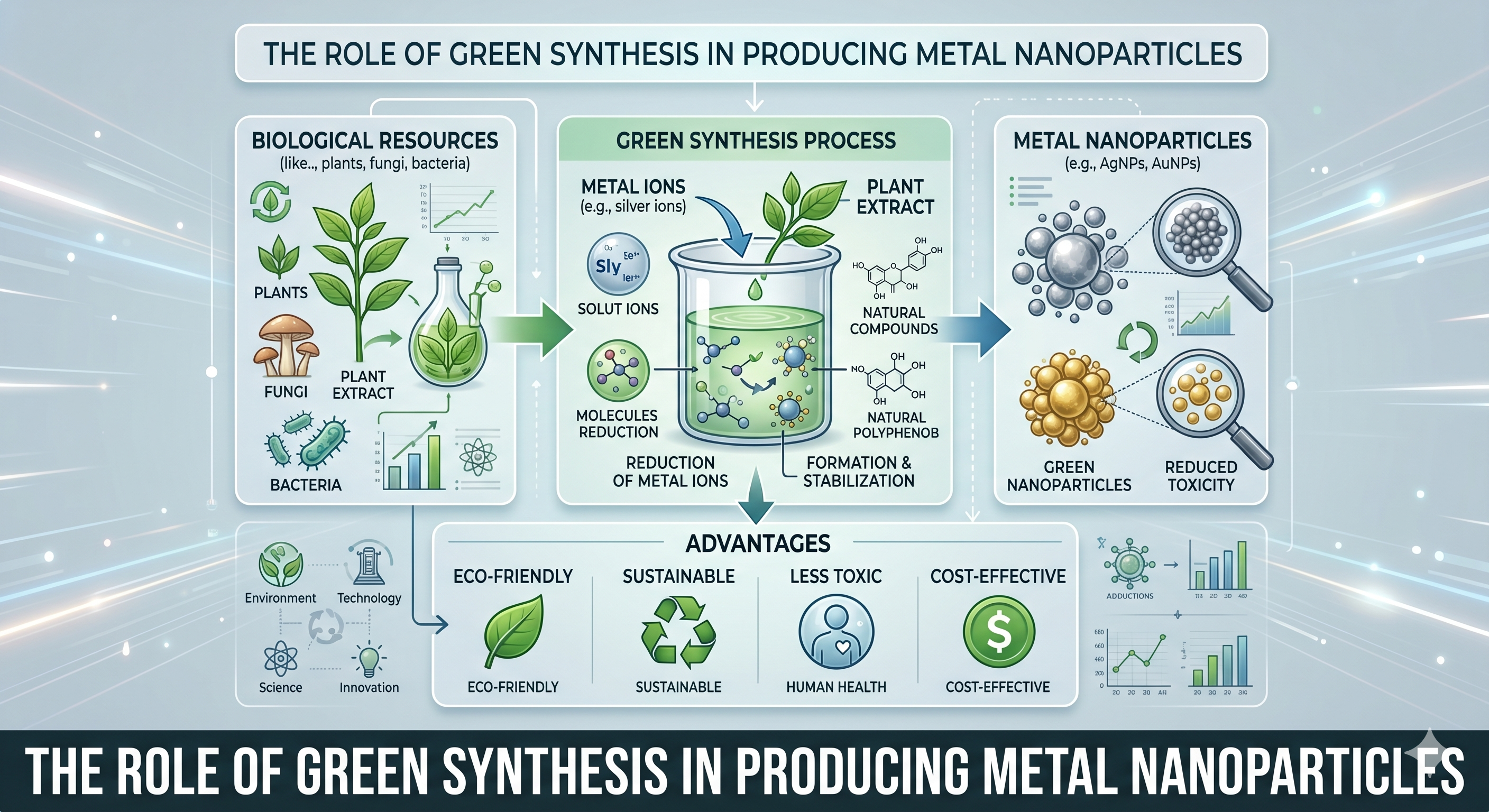
The shift toward sustainable and eco-friendly technologies is no longer a luxury; it is a global necessity. Chemistry and nanotechnology, historically associated with hazardous solvents and high energy consumption, are undergoing a profound transformation. At the heart of this “Green Chemistry” revolution lies a groundbreaking technique: Green Synthesis of Metal Nanoparticles. This biogenic route is dismantling traditional chemical paradigms, proving that we can produce advanced materials without sacrificing the planet or human health.
Traditional alchemists sought to turn base metals into gold; modern nanotechnologists seek to shrink bulk metals into nanoscale powerhouses. The method we choose to achieve this will define the sustainability of our future.
The Green Alchemy: Nature’s Role in Producing Metal Nanoparticles
What are Metal Nanoparticles and Why Do We Need Them?
To understand the significance of green synthesis, we must first understand the materials it produces. Metal nanoparticles (MNPs) are particles of bulk metals—such as gold (Au), silver (Ag), copper (Cu), or iron (Fe)—that have been shrunk to the nanoscale, typically measuring between 1 and 100 nanometers. At this size, a particle is thousands of times thinner than a human hair.
This shrinkage causes a radical shift in properties. Because of their incredibly high surface-area-to-volume ratio and quantum mechanics effects, MNPs exhibit unique optical, electrical, magnetic, and catalytic behavior not seen in their bulk counterparts. Silver nanoparticles, for instance, become potent broad-spectrum antibacterials, while gold nanoparticles can absorb specific light wavelengths to generate localized heat, a property used to destroy cancer cells. Today, MNPs are essential in electronics, diagnostics, environmental cleanup, cosmetics, and advanced medicine.
The Traditional Pathway: A Costly Journey
Before the advent of green chemistry, producing MNPs generally relied on physical or chemical “top-down” or “bottom-up” methods.
1. Physical Methods
Methods like laser ablation or milling break bulk metal apart. While they produce pure particles, they consume enormous amounts of energy and require specialized, costly machinery.
2. Chemical Methods
These are the most common industrial methods. They involve mixing a metal salt (like silver nitrate) with a chemical reducing agent (like sodium borohydride) and a stabilizing agent (like polyvinylpyrrolidone). The reducing agent donates electrons to the metal ions, turning them into neutral atoms that cluster into particles. The stabilizer prevents these particles from sticking back together (agglomerating) and crashing out of the solution.
The problem? Most of these chemical agents are highly toxic, flammable, or environmentally persistent. Disposing of the resulting chemical waste is expensive and ecologically damaging. These chemical “envelopes” surrounding the final nanoparticle also limit their safety for medical use in humans.
Nature’s Toolkit: How Green Synthesis Works
Green synthesis flips the traditional script by replacing hazardous chemical agents with biological entities or their components. It uses nature’s own biodiversity—plants, bacteria, fungi, yeast, and algae—to act as both reducing and stabilizing factories.
The Mechanism: Reducers and Capping Agents from Nature
The process is surprisingly simple, mimicking natural biochemical pathways. It is generally a single-step, bottom-up process carried out at ambient temperature and pressure, with water typically serving as the universal solvent.
1. Plant-Mediated Synthesis (The Most Popular Route)
Plants are rich in phytochemicals—bioactive compounds such as flavonoids, terpenoids, polyphenols, reducing sugars, and phenolic acids. To make silver nanoparticles, a researcher mixes a silver salt solution with a plant extract (e.g., green tea extract or Aloe vera leaf broth).
-
Role of Phytochemicals: These natural compounds possess functional groups (like thiol, amine, and carboxyl) that gladly donate electrons. They reduce the toxic metal ions into neutral metal atoms. These atoms then aggregate to form stable nanoparticles.
-
Role of Stabilization (Capping): Simultaneously, proteins and other organic molecules in the extract bind to the surface of the newly formed particles. This creates a “natural capping layer” or biological envelope. This layer prevents agglomeration, ensures the particles remain stable, and crucial for medicine, often enhances biocompatibility.
2. Microbial Factories (Bacteria and Fungi)
Microbes have evolved to survive in high-metal environments by producing intracellular or extracellular enzymes that reduce toxic metal ions into harmless nanoparticles. For instance, the fungus Fusarium oxysporum can extracellularly reduce silver nitrate into stable AgNPs. This biological route offers controlled synthesis but is slower than plant routes and requires sterile cultivation conditions.
Current Research Frontiers (2023–2026): Beyond the Beaker
The field is rapidly advancing from proof-of-concept laboratory studies to standardized, functional applications and advanced industrial scaling concepts. Research in the last three years has pivoted sharply toward standardization and “Waste-to-Nano” concepts.
1. Standardization and Machine Learning Integration
A persistent bottleneck in plant-based synthesis is geographic and seasonal variability. Green tea picked in spring in India contains different phytochemical ratios than green tea picked in autumn in Brazil. Recent groundbreaking research (2024–2025) is utilizing Artificial Intelligence (AI) and machine learning to analyze these chemical signatures. These algorithms can predict the exact MNP size and shape a specific batch of plant extract will produce, allowing for the standardization necessary for industrial and regulatory approval.
2. Agricultural Waste-Mediated Synthesis: A Circular Economy
To enhance sustainability, researchers are moving away from edible plants toward agricultural and food waste. Successful synthesis of MNPs has been reported using rice husks, banana peels, orange peels, and walnut shells. By transforming these waste stream liabilities into high-value MNP assets, green synthesis supports a truly circular economy. Gold nanoparticles synthesized using sugarcane bagasse, for example, have shown improved stability compared to chemically synthesized equivalents.
3. Automated Flow-Chemistry Synthesis
To scale up production beyond small laboratory batches, chemical engineers have adapted automated flow chemistry systems (2023). This approach allows plant extract and metal salts to mix continuously in microtubes, enabling real-time control over reaction conditions and significantly increasing output while maintaining high particle uniformity.
Biomedical and Clinical Applications: Medicine’s Green Ally
Green MNPs are particularly exciting for medicine because their biogenic capping layer makes them far less toxic to human cells compared to MNPs made with standard toxic surfactants. While advanced Phase III clinical trials exclusively utilizing “green-synthesized” MNPs are still sparse, pre-clinical (in vivo/animal models) and early-phase success is resounding.
1. Potent Antivirals and Antibacterials in Wound Healing
Green Silver Nanoparticles (AgNPs) have dominated antibacterial research. Because they are capped with natural biopolymers, they show enhanced efficacy against multi-drug resistant bacteria (superbugs).
-
Recent Study (2024): AgNPs synthesized using Aloe vera extract, incorporated into chitosan-based scaffolds, demonstrated accelerated wound closure in rat models. They exhibited potent antibacterial activity without inducing systemic toxicity in the rats’ major organs, indicating superior biocompatibility over chemical AgNPs. Green ZnO nanoparticles have shown similar regenerative success.
2. Oncology: Targeted Cancer Therapy
Green Gold Nanoparticles (AuNPs) are being pioneered for cancer treatment through two main strategies: drug delivery and photothermal therapy.
-
Drug Delivery: Green AuNPs have an organic cap that can easily be functionalized with specific antibodies or cancer drugs. Due to their improved compatibility, they survive longer in circulation and accumulate preferentially in tumors.
-
Photothermal Therapy: Gold nanoparticles absorb specific light wavelengths (near-infrared) and convert them into heat. Green AuNPs synthesized using lemongrass extract, when injected into tumors in mouse models and irradiated with light, effectively ablated the tumor tissue without damaging surrounding healthy cells, owing to their embedded biocompatible coating.
Vital Evaluation: Advantage–Risk Assessment
For green synthesis to achieve widespread industrial adoption, its benefits must be transparently weighed against its risks and engineering challenges.
| Advantages | Risks and Challenges |
| Eco-Friendly: Uses non-toxic water, benign reactants, and requires minimal energy (ambient conditions). No toxic waste disposal. | Variability and Standardization: Nature varies. Inconsistent plant extract profiles lead to batch-to-batch variability in MNP size, shape, and quality. |
| Biocompatibility: Natural organic capping layer often reduces cytotoxicity (toxicity to human cells) and immunogenicity, making them ideal for human biomedical use. | ** डाउनस्ट्रीम Purification:** Separating the finished nanoparticles from the leftover organic plant sludge can be complex, expensive, and time-consuming. |
| Cost-Effectiveness: Reactors (e.g., leaves, fruit waste) are abundant, renewable, and often essentially free. Does not require high energy consumption or costly machinery. | Kinetics and Time: Biological synthesis routes, particularly microbial, can be significantly slower (hours to days) than instantaneous chemical routes. |
| Safety: Eliminates handling hazardous flammable or corrosive chemical precursors in the laboratory and industrial setting. | Mechanism Complexity: The exact role and synergy of the dozens of phytochemicals in a single extract are complex and often not fully understood, making controlled synthesis difficult. |
The Future Landscape: Bridging the Scale Gap
The future of green synthesis is bright but requires engineering maturity. We are moving beyond the “look what plant X can do” phase to standardized, functional engineering. The next crucial step is bridging the laboratory-to-industry gap.
Scaling green synthesis from a 100ml laboratory beaker to a 10,000-liter industrial tank requires automating the extraction and mixing processes and implementing robust standardized purification steps. Governments and regulatory bodies (like the FDA or EMA) must establish clear guidelines for testing the safety of these biological coatings.
However, the trajectory is clear: Green synthesis of metal nanoparticles is nature’s own alchemy, proving that advanced science and environmental stewardship can coexist. By adopting this biogenic route, we ensure that the technologies of tomorrow are built responsibly, leaving a greener, safer world for generations to come.