
Recently added item(s)
For decades, the golden rule of skincare has been universal and unwavering: wear sunscreen. Dermatologists, oncologists, and skincare enthusiasts alike champion daily sun protection as the most effective way to prevent premature aging and, more importantly, skin cancer. However, the formulation of sunscreens has historically been a tale of compromise. Consumers were forced to choose between chemical sunscreens, which blend easily into the skin but can cause irritation and environmental harm, and traditional mineral sunscreens, which are gentle and safe but leave behind a thick, chalky white residue affectionately known as the “lifeguard nose.”
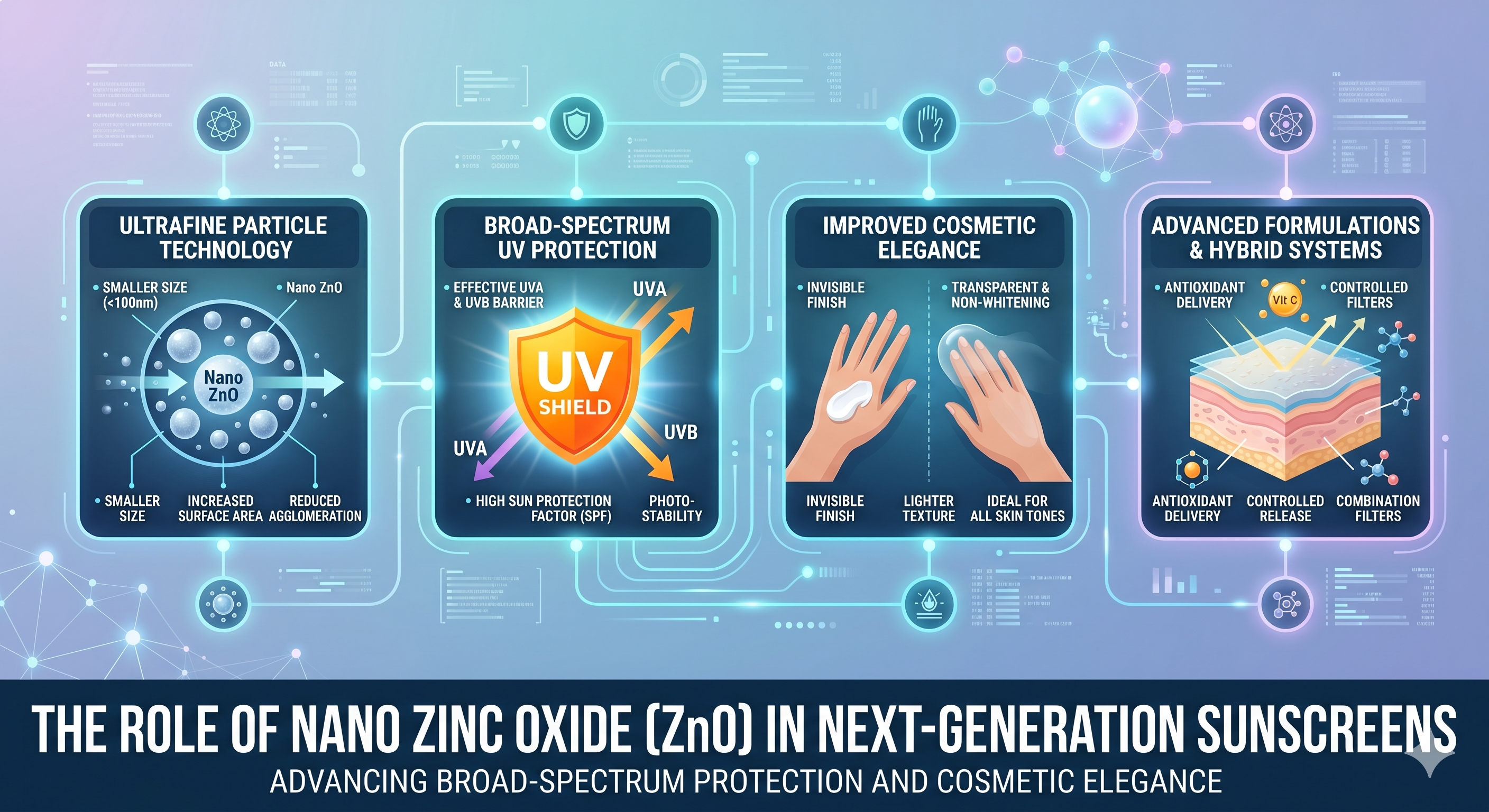
Today, the landscape of sun protection is undergoing a massive transformation. Thanks to breakthroughs in nanotechnology, cosmetic chemists have found a way to bridge the gap between efficacy, safety, and cosmetic elegance. The hero of this skincare revolution is Nano Zinc Oxide (ZnO).
In this comprehensive guide, we will explore the science behind nano zinc oxide, delve into current clinical research, evaluate the advantages and risks, and understand why this microscopic mineral is shaping the future of next-generation sunscreens.
The Evolution of Sun Protection: From Chalky Pastes to Invisible Shields
To appreciate the innovation of nano zinc oxide, we must first understand how traditional sunscreens work. Sunscreens generally fall into two categories based on their active ingredients: chemical (organic) filters and physical (inorganic) filters.
Chemical filters, such as oxybenzone and avobenzone, absorb ultraviolet (UV) rays and convert them into heat, which is then released from the skin. While cosmetically elegant and easy to apply, some chemical filters have been scrutinized for potential endocrine disruption, skin sensitization, and devastating effects on marine ecosystems, particularly coral reefs.
Physical filters, primarily Titanium Dioxide (TiO2) and Zinc Oxide (ZnO), work by sitting on top of the skin. Historically, it was believed they worked solely by reflecting and scattering UV rays like a mirror. While they do scatter some light, modern science shows they also absorb UV rays much like chemical filters. Zinc oxide is widely considered the holy grail of physical filters because it provides broad-spectrum protection, meaning it effectively blocks both UVA rays (which cause aging and wrinkles) and UVB rays (which cause sunburn).
The problem? Bulk zinc oxide particles are large. They scatter visible light, creating an unsightly white cast on the skin, especially on deeper skin tones. This aesthetic drawback has historically deterred people from using mineral sunscreens daily. Enter nanotechnology.
What is Nano Zinc Oxide? The Science Made Simple
Nanotechnology involves manipulating matter on an atomic and molecular scale. A nanometer is incredibly small—one billionth of a meter. To put this into perspective, a single strand of human hair is roughly 80,000 to 100,000 nanometers thick.
In the context of skincare, “nano” refers to particles that measure between 1 and 100 nanometers in diameter. By taking bulk zinc oxide and milling it down to the nanoscale, scientists fundamentally alter how the mineral interacts with light.
Visible light has a wavelength ranging from about 400 to 700 nanometers. Traditional bulk zinc oxide particles are larger than these wavelengths, which means they intercept and scatter visible light back to our eyes, appearing white. Nano zinc oxide particles, however, are significantly smaller than the wavelength of visible light. Because they are so small, visible light simply passes through them without being scattered. This renders the nano ZnO completely transparent on the skin.
Crucially, while nano ZnO is transparent to visible light, it is still perfectly sized to intercept, absorb, and scatter the shorter wavelengths of UVA and UVB radiation. The result is a sunscreen that offers the unparalleled, gentle protection of a physical mineral filter with the sheer, invisible finish of a chemical sunscreen.
Current Research and Clinical Studies: Is It Safe?
The introduction of any new technology onto or into the human body rightfully sparks questions regarding safety. When nano zinc oxide first entered the market, the primary concern was straightforward: if these particles are so incredibly small, can they penetrate the skin, enter the bloodstream, and cause systemic toxicity?
Over the past decade, extensive clinical and dermatological studies have been conducted to answer this exact question. The global scientific consensus is overwhelmingly reassuring.
1. The Skin Barrier Remains Intact
The human skin is a formidable barrier. The outermost layer, the stratum corneum, consists of dead skin cells tightly packed together like bricks and mortar. Multiple clinical studies utilizing advanced imaging techniques, such as multiphoton microscopy and tape-stripping methods, have shown that nano zinc oxide particles do not penetrate past the stratum corneum.
A landmark study published in the Journal of Investigative Dermatology demonstrated that even after repeated applications of nano ZnO sunscreens on human volunteers, the nanoparticles remained strictly on the skin’s surface and within the outer dead layers. Trace amounts of zinc found in the blood were attributed to the natural dissolution of zinc ions (which the human body naturally needs and regulates), not the penetration of intact nanoparticles. Regulatory bodies like the US Food and Drug Administration (FDA), the Australian Therapeutic Goods Administration (TGA), and the European Commission’s Scientific Committee on Consumer Safety (SCCS) have all reviewed the clinical data and concluded that nano zinc oxide is safe for use in topical sunscreens.
2. The Issue of Reactive Oxygen Species (ROS)
Another area of clinical research focuses on photocatalytic activity. When zinc oxide is exposed to UV light, it can generate Reactive Oxygen Species (ROS)—free radicals that can cause oxidative stress and damage surrounding cells. To combat this, modern cosmetic chemists “coat” the nano zinc oxide particles with inert substances like silica, alumina, or dimethicone. Clinical formulations using coated nano ZnO show virtually no ROS generation, ensuring that the UV energy absorbed by the sunscreen does not inadvertently harm the skin it is meant to protect.
Advantage vs. Risk Assessment
To make an informed decision about using next-generation sunscreens, we must weigh the benefits against the potential risks.
The Advantages
-
True Broad-Spectrum Protection: Nano ZnO is one of the very few ingredients available globally that provides extensive, photostable protection against the entire UV spectrum (UVA1, UVA2, and UVB).
-
Cosmetic Elegance: It completely eliminates the notorious white cast. This inclusivity is vital, as it encourages people of all skin tones, particularly those with darker complexions, to use sunscreen daily without altering their skin’s natural appearance.
-
Excellent for Sensitive Skin: Unlike chemical filters that can cause allergic reactions, contact dermatitis, or stinging, zinc oxide is inherently soothing. It is naturally anti-inflammatory, making it the ideal choice for individuals with sensitive skin, rosacea, eczema, or acne-prone skin.
-
Photostability: Nano ZnO does not degrade when exposed to sunlight. Once applied, it maintains its protective capabilities for a long duration, unlike some chemical filters (like avobenzone) that break down and lose efficacy upon UV exposure.
The Risks and Safety Considerations
-
Inhalation Risks: While topical application is entirely safe, the inhalation of nanoparticles poses a significant health risk. If inhaled, nano zinc oxide can travel deep into the lungs and potentially enter the bloodstream, causing respiratory inflammation and toxicity. For this reason, dermatologists and regulatory agencies strongly advise against using spray sunscreens containing nano ZnO. It is always safer to use lotions, creams, or sticks.
-
Formulation Stability: If the sunscreen is poorly formulated and the nanoparticles clump together (agglomeration), it can result in uneven coverage on the skin, leaving areas vulnerable to UV damage. High-quality formulation and proper dispersion techniques are critical.
-
Potential for Free Radical Generation: As mentioned earlier, uncoated nano ZnO can generate free radicals when exposed to the sun. Consumers should look for high-quality brands that use coated nanoparticles to mitigate this risk.
The Environmental Debate: Is Nano ZnO Truly Reef-Safe?
The term “reef-safe” has become a powerful marketing tool in the cosmetics industry, largely driven by research showing that chemical filters like oxybenzone and octinoxate cause coral bleaching and damage the DNA of marine life. Consequently, mineral sunscreens containing zinc oxide are heavily promoted as the eco-friendly alternative.
However, the environmental reality is more nuanced. While bulk (non-nano) zinc oxide is widely considered safe for marine environments, the impact of nano zinc oxide is a topic of ongoing scientific debate.
Because of their microscopic size and high surface reactivity, uncoated nano zinc oxide particles can be toxic to certain types of phytoplankton and microscopic marine organisms, which form the base of the ocean’s food web. When coated nanoparticles are washed off into the ocean, the coating can eventually degrade, exposing the reactive zinc core.
While nano ZnO is undeniably less harmful to coral reefs than traditional chemical filters, environmentally conscious consumers often seek out “non-nano” mineral sunscreens when swimming in delicate aquatic ecosystems. However, for everyday urban wear, nano ZnO remains an incredibly safe and vastly superior environmental choice compared to traditional petrochemical UV filters.
The Future of Next-Generation Sunscreens
The integration of nano zinc oxide is just the beginning. The future of sun protection lies in “smart” sunscreens. Researchers are currently developing hybrid formulations that combine coated nano ZnO with potent antioxidants—like Vitamin C, Niacinamide, and Green Tea Extract. These next-generation products do not just block UV rays; they actively repair environmental damage, neutralize free radicals, and improve skin barrier function simultaneously.
Furthermore, advances in green chemistry are focusing on developing biodegradable, bio-based coatings for nanoparticles that will completely neutralize any marine toxicity, finally ending the compromise between flawless skincare and environmental stewardship.
Conclusion
The invention and refinement of nano zinc oxide have permanently revolutionized the sunscreen industry. By shrinking this powerful mineral to the nanoscale, scientists have cured the mineral sunscreen of its greatest flaw—the chalky white cast—while retaining its unmatched safety profile, broad-spectrum efficacy, and skin-soothing properties.
Clinical studies continue to validate its safety on the skin, proving that when formulated correctly, these microscopic particles offer maximum protection without penetrating the body’s natural barriers. While consumers should avoid spray versions to prevent inhalation risks and remain mindful of marine ecosystems, nano zinc oxide undeniably represents the pinnacle of modern photoprotection. It provides a sheer, invisible shield that encourages daily use across all skin types and tones, bringing us one step closer to eradicating preventable sun damage and skin cancer.