Recently added item(s)
In the global effort to ensure food security and minimize waste, the frontline is often thinner than a human hair. We are talking about the polymer films that wrap our meat, shield our snacks, and preserve our dairy. For decades, the industry relied on thick, multi-layered plastics to keep food fresh, but as the world pivots toward sustainability and higher safety standards, a new hero has emerged from the earth itself: Nanoclay.
Nanoclay-reinforced polymers represent a quantum leap in packaging science. By integrating microscopic clay particles into traditional plastics, scientists have created “nano-composites” that act as near-impenetrable barriers against the elements that spoil our food. This isn’t just an incremental improvement; it is a fundamental shift in how we protect what we eat.
The Problem: The Invisible Enemies of Freshness
To appreciate the role of nanoclay, we must first understand what we are fighting. Food spoilage is primarily driven by three external factors:
-
Oxygen (O_2): The primary culprit for oxidation, which turns fats rancid, browns fruit, and allows aerobic bacteria to thrive.
-
Moisture (Water Vapor): Leads to the loss of crispness in dry foods or the dehydration of fresh produce, while also facilitating mold growth.
-
Carbon Dioxide (CO_2): Essential for maintaining the “fizz” in beverages and controlling the atmosphere in modified atmosphere packaging (MAP).
Standard plastics like Polyethylene (PE) or Polypropylene (PP) are excellent at being flexible and cheap, but they are surprisingly “leaky” at the molecular level. Gas molecules can essentially dance through the gaps between polymer chains, reaching the food and beginning the process of decay.
The “Tortuous Path”: How Nanoclay Blocks the Way
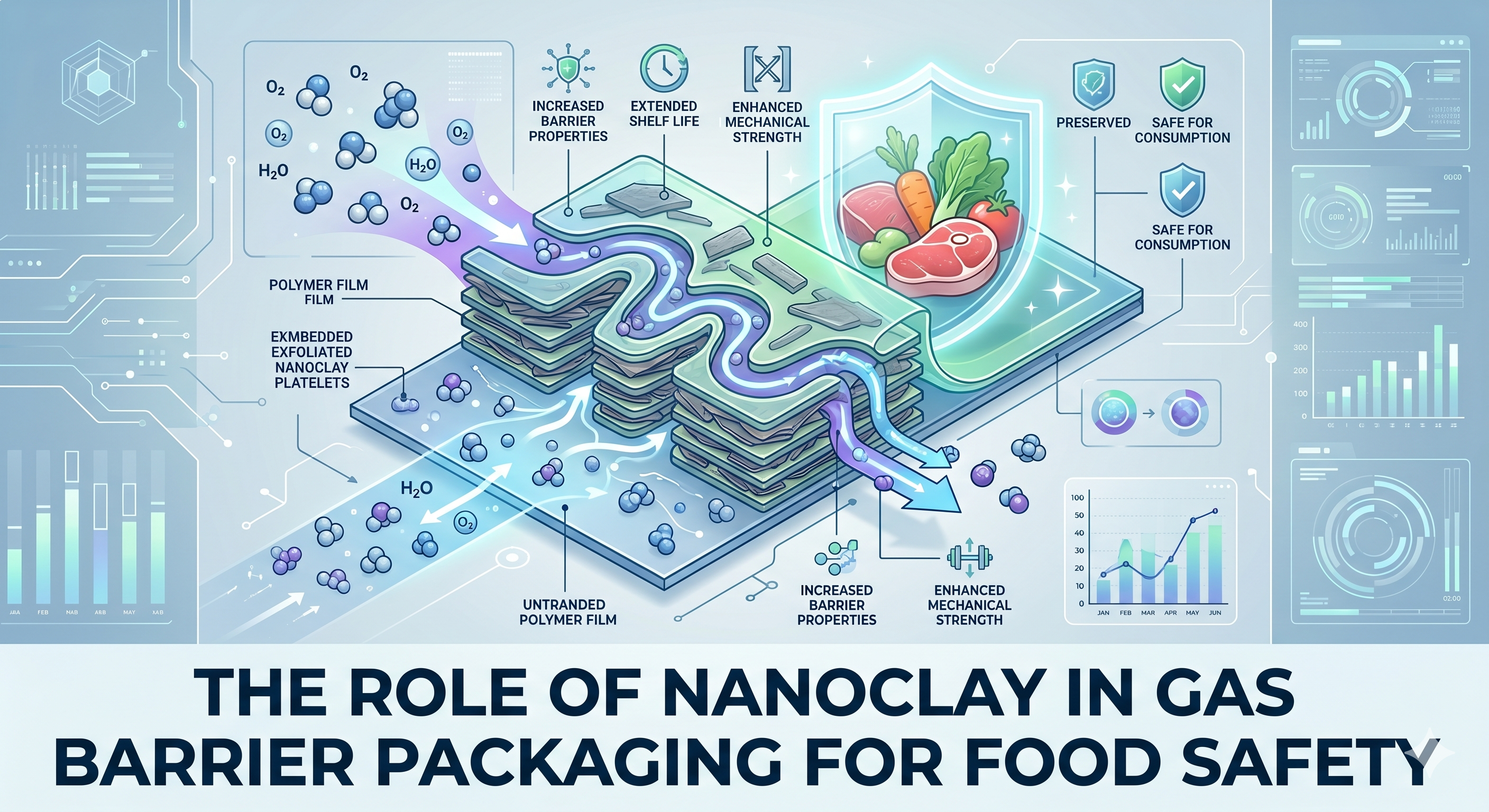
The secret to nanoclay’s success lies in its geometry. The most commonly used nanoclay in food packaging is Montmorillonite (MMT), a natural clay mineral derived from volcanic ash. These clay particles are plate-like structures (platelets) that are only one nanometer thick but several hundred nanometers wide.
When these platelets are properly dispersed within a plastic film, they create what scientists call the “Tortuous Path.”
Imagine a gas molecule trying to pass through a standard plastic film as a person walking through an empty field. It’s a straight, fast shot. Now, imagine that same field filled with thousands of massive, flat walls placed randomly. The person now has to navigate around every single wall, turning left, then right, then back again. This significantly increases the distance the molecule must travel and the time it takes to get through.
By forcing oxygen and moisture to take this long, winding route, nanoclay can reduce gas permeability by as much as 50% to 90%, even when the clay makes up less than 5% of the total material weight.
Beyond the Barrier: Enhanced Structural Integrity
Nanoclay doesn’t just stop gas; it reinforces the “skeleton” of the packaging. Because these nanoparticles have an incredibly high surface area, they bond tightly with the polymer chains. This results in:
-
Increased Thermal Stability: The packaging can withstand higher temperatures during processing or in microwave applications without warping or releasing chemicals.
-
Mechanical Strength: Thinner films can be used to achieve the same strength as thicker, traditional plastics. This process, known as “lightweighting,” significantly reduces the total amount of plastic entering the waste stream.
-
UV Shielding: Natural nanoclays have inherent properties that help block ultraviolet light, providing an extra layer of protection against light-induced nutrient degradation.
Current Research Frontiers (2025-2026)
The latest research in 2025 and early 2026 has shifted from simply “making the barrier” to “making the barrier smart and sustainable.”
1. The Rise of Bio-Nanocomposites
A major trend is the integration of nanoclay into biodegradable polymers like Polylactic Acid (PLA) or Polyhydroxyalkanoates (PHA). Traditionally, bio-plastics have had poor barrier properties, making them unsuitable for long-term food storage. However, recent studies published in Green Chemistry & Engineering show that adding modified MMT nanoclays to PLA creates a fully compostable film that rivals the oxygen barrier of petroleum-based plastics.
2. Active and Intelligent Layers
Researchers are now “functionalizing” nanoclays. By “loading” the spaces between clay layers with antimicrobial agents (like silver ions or essential oils), the nanoclay acts as a controlled-release system. This doesn’t just keep the bad stuff out; it actively fights bacteria inside the package, potentially doubling the shelf life of fresh proteins.
3. Nano-Sensing
Experimental packaging is now using nanoclay layers that change color or electrical conductivity if oxygen levels rise above a certain threshold, providing a visual “sensor” for consumers to know if a product is still safe to eat.
Clinical Perspectives: Is Nanoclay Safe to Eat?
Safety is the paramount concern in food contact materials. The primary clinical and regulatory question is: Do nanoparticles migrate from the plastic into the food?
Extensive migration studies conducted by the European Food Safety Authority (EFSA) and the FDA have focused on this. The “worst-case scenario” tests—where packaging is exposed to high heat and acidic food simulants—show that when nanoclays are properly “exfoliated” (evenly spread) and chemically bonded to the polymer, migration is virtually non-existent.
However, clinical researchers are still investigating the long-term effects of “nano-sized” mineral consumption. While MMT is a natural mineral often used in pharmaceuticals (like anti-diarrheal meds), the concern is that the nano-scale size might allow particles to pass through the intestinal wall in ways larger particles cannot. Current data suggests that at the concentrations used in packaging (1–5%), the risk to the consumer is negligible compared to the health benefits of preventing foodborne illnesses and mold.
Advantage-Risk Assessment
To provide a clear picture for manufacturers and consumers, let’s look at the balance of benefits and potential drawbacks.
| Feature | Advantage | Risk / Challenge |
| Shelf Life | Extends freshness by up to 200%, reducing food waste. | Improper mixing can lead to “clumps” that actually weaken the barrier. |
| Sustainability | Enables thinner packaging and improves bio-plastic performance. | Adding minerals to plastic can complicate traditional mechanical recycling streams. |
| Cost | Reduces the need for expensive multi-layer “foil” laminates. | The initial cost of high-purity, organo-modified nanoclay is higher than raw plastic. |
| Safety | Prevents bacterial growth and chemical oxidation of oils. | Requires strict regulatory oversight to ensure zero migration into food. |
| Transparency | Unlike foil, nanoclay-reinforced films remain clear so consumers can see the product. | Excessive clay loading (above 10%) can lead to a slight “haze” or tint. |
The Sustainability Paradox: The Recycling Question
One of the most debated topics in 2026 is the “circularity” of nanoclay. Because the clay is inorganic (mineral) and the plastic is organic, they don’t always separate easily during recycling. While the industry is moving toward “mono-material” packaging (making the whole thing from one type of plastic plus nanoclay), recyclers are still developing the infrastructure to handle these advanced composites.
The counter-argument is that the environmental “win” of preventing food waste—which is a massive contributor to methane emissions in landfills—far outweighs the current difficulties in recycling the film.
The Future: A World of “Invisible Armor”
As we move toward the end of the decade, the goal is “Invisible Armor.” This means packaging that is completely transparent, fully biodegradable, and capable of keeping a steak fresh for weeks without preservatives. Nanoclay is the key ingredient making this possible.
By mimicking the structures found in nature—like the iridescent, high-strength layers of a seashell—material scientists are building the next generation of food protection. It is a testament to human ingenuity that we have taken the most basic material on Earth—clay—and refined it into a high-tech solution for one of our most pressing global challenges.
Conclusion
Nanoclay in gas barrier packaging is no longer a “future technology”; it is a current reality that is quietly saving millions of tons of food from the trash. While we must remain vigilant regarding migration safety and recycling infrastructure, the benefits of enhanced shelf life, reduced plastic usage, and improved food safety make it a cornerstone of modern nanotechnology. The next time you open a bag of coffee or a tray of fresh pasta that looks as good as the day it was made, remember the invisible “tortuous path” of nanoclay keeping the oxygen at bay.