
Recently added item(s)
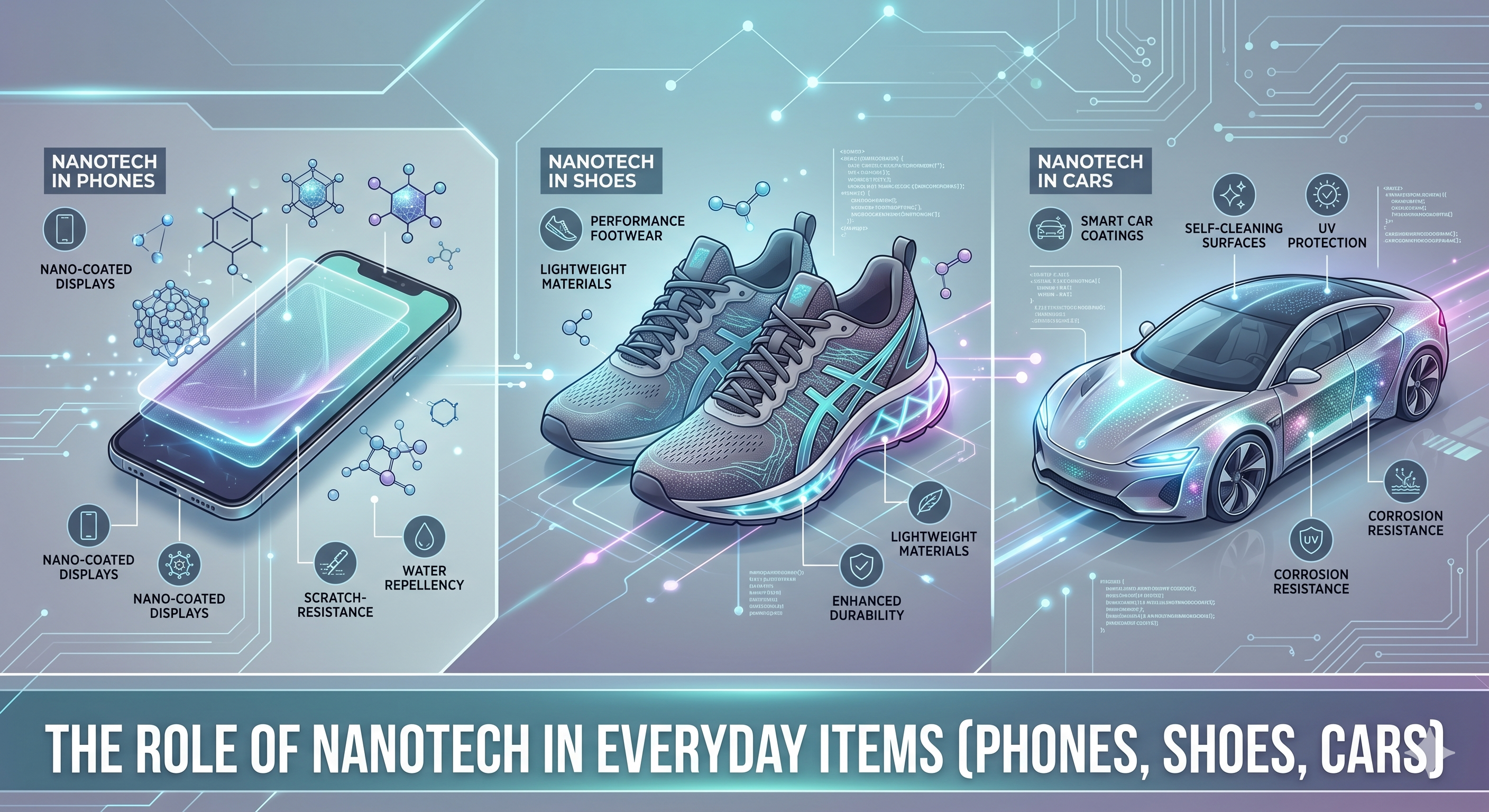
When we think of scientific revolutions, we often imagine towering rockets, sprawling particle accelerators, or supercomputers the size of warehouses. Yet, one of the most profound technological shifts of the 21st century is taking place at a scale completely invisible to the naked eye. This is the revolution of nanotechnology—the engineering of functional systems at the molecular, atomic, or even supramolecular level. Defined simply, it deals with structures measuring between 1 and 100 nanometers. To put that into perspective, a human hair is about 80,000 nanometers wide.
While it sounds futuristic, the truth is that nanotechnology is already here, integrated into the fabric of our daily lives. If you have checked your email on your smartphone this morning, laced up a pair of running shoes, or driven to work, you have encountered and benefited from nanotechnology. By exploiting the unique properties that emerge at the nanoscale—such as increased mechanical strength, enhanced chemical reactivity, or optimized electrical conductivity—manufacturers are transforming mundane consumer goods into high-performance tools. This blog explores how three pillars of the modern lifestyle—phones, shoes, and cars—have been quietly re-engineered by the invisible hand of nanotech.
1. Smartphones: Miniaturization and the Quest for the ‘Never-Ending’ Battery
The smartphone is perhaps the clearest example of the ‘invisible revolution.’ Our demand for thinner, faster, and more energy-efficient devices pushes manufacturing boundaries, leading directly to the adoption of nanomaterials in almost every component.
Vivid Displays and Scratch-Resistant Glass: Modern screens are marvels of nanophotonics. OLED (Organic Light-Emitting Diode) displays, known for their deep blacks and flexibility, consist of numerous nanometer-thin layers of organic polymers. Quantum dots (QDs)—nanoscale semiconductor particles—are increasingly used in commercial displays to enhance color spectrum and brightness. Unlike traditional phosphors, QD displays emit pure, specific colors based on the particle size, resulting in breathtaking colors on tablets and smartphones. Protecting these precious displays are advanced glasses, like the “ceramic shield” found on many high-end devices, which are created by infusing the glass matrix with nano-ceramic crystals, making the material significantly harder and more scratch-resistant than conventional glass.
Invisible Water Barriers: The standard metric of waterproofness has been redefined by nanocoatings. Rather than rely solely on rubber seals, some manufacturers apply ultra-thin, super-hydrophobic nanocoatings to the device’s internal and external surfaces. Companies like Liquipel, P2i, and HzO have developed patented processes that apply a liquid-repellent coating 1,000 times thinner than a human hair. These coatings act on the molecular level to increase the surface energy of water droplets, forcing them into a spherical shape that simply rolls off sensitive electronics, saving millions of devices annually from moisture damage.
Current Research: The Fast-Charging Frontier: Battery anxiety remains the modern user’s constant companion. The theoretical wonder-material, graphene—a single layer of carbon atoms—promises to revolutionize power storage. Current research is moving graphene out of the lab and into industrial production. At CES 2026, Japanese startup 3DC showcased a breakthrough: a “3D graphene MesoSponge” nanomaterial. Instead of using flat sheets, this sponge forms a porous network allowing electrons to move more freely inside battery electrodes. By embedding this nanoscale structure directly into the battery’s core, 3DC aims to dramatically improve charging efficiency and reduce degradation over repeated cycles, moving us closer to smartphones that charge in minutes, not hours. Hyundai has already backed this research, indicating its near-future integration into consumer markets.
2. Athletic Shoes: Engineering the Perfect Stride
The performance footwear industry has shifted from relying solely on biomechanical design to incorporating material science at the molecular level. Whether you are an elite athlete or a casual jogger, nanotechnology is optimizing your stride, comfort, and safety.
Midsole Power: Nanofoams and Energy Return: The midsole is the soul of a running shoe, responsible for both cushioning and energy return. Modern running shoes utilize advanced foams with nanostructures or infused with nanomaterials to slow down compression set—the material ‘packing out’ over time.
Research published in April 2026 validated the use of graphene-infused poly(ethylene-co-vinyl acetate) (EVA) nanofoams in shoe prototypes. The empirical performance studies proved that integrating graphene nanoplatelets at just 0.1 to 0.2 phr (parts per hundred resin) resulted in industrial prototypes with a dual advantage: they were simultaneously softer (better cushioning) based on compression tests and displayed 30% higher axial stiffness. This dual property is exceptionally useful, as softness absorbs impact while stiffness facilitates propulsion during running, improving overall running economy. Furthermore, the prototypes with graphene showed a 40% improvement in abrasion properties, significantly extending the lifcycle of the shoes.
Upper-Level Comfort: Waterproofing and Antimicrobials: Shoe uppers are also getting a nanotech makeover. To maintain breathability while providing superior water repellency, manufacturers are increasingly using nanofiber membranes. These textiles feature pores large enough to allow sweat vapor to escape but small enough to block liquid water droplets.
In terms of hygiene, the application of nanosilver particles to footwear textiles is a widespread commercial practice. Silver is a natural antimicrobial agent. By embedding silver at the nanoscale into the fibers, manufacturers create shoes with long-lasting defense against odor-causing bacteria, which can be an immense benefit for athletic gear.
The Grip of the Wonder Material: The first and most notable commercial example of graphene in footwear came from inov-8, in collaboration with the National Graphene Institute at The University of Manchester. Traditional running shoe rubber forced a compromise: sticky rubber gripped well but wore down quickly, while hard rubber lasted longer but lacked traction. The G-Grip graphene-infused rubber smashed these limits. inov-8’s commercial range, including the ROCLITE and TRAILFLY series, uses this technology. Empirical reviews by trail runners have validated the claim, showing tread looking intact even after more than 600 miles of use—an immense advantage in durability compared to Vibram or other standard outsoles.
3. Automotive Industry: A Nanotech Shield Against the Elements
The automotive industry uses nanotechnology not just for performance, but also for protection, hygiene, and enhanced driver safety. From the factory floor to the luxury detailing shop, cars are enveloped in nanotech.
Nano-Ceramic Coatings: Ultimate Paint Preservation: Traditional car waxing is becoming obsolete, replaced by nano-ceramic coatings. These are liquid polymers primarily composed of Silicon Dioxide (SiO2) or Titanium Dioxide (TiO2). Unlike wax, which sits on top of the paint, SiO2 nanoparticles form a chemical bond with the factory clear coat, filling microscopic pores at the molecular level.
This cured coating forms a dense, durable, glass-like film that offers exceptional protection against weather, UV radiation, dirt, dust, and even mild chemical stains (like acidic bird droppings). They are characterized by supreme hydrophobicity; a मुंबई or Bangalore rain shower sheds 90% of water immediately, carrying away surface contaminants in a ‘self-cleaning’ effect. High-quality professional coatings can last between 2 and 5 years, which significantly maintains the car’s resale value by preventing oxidation and fading. Graphene coatings are the newest addition to this market, offering enhanced thermal resistance and anti-static properties.
Driver Safety: Clear Vision and Antibacterial Interiors: Beyond the bodywork, nanocoatings are transforming driver visibility. When applied to windshields, hydrophobic coatings ensure that water beads and runs off instantly, improving visibility by up to 34% during heavy rainfall and poor night lighting. Inside the car, the push for hygiene has led to antimicrobial surfaces. Factory or aftermarket application of silver nanoparticles or titanium dioxide to steering wheels, dashboards, and upholstery creates interiors that actively kill bacteria and viruses, a particularly vital feature in shared mobility vehicles.
Research and Innovation: Self-Healing Coatings: Perhaps the most intriguing future application is self-healing clear coats. While Toyota has offered a “self-restoring clear coat” that heals minor swirl marks, current detailing technology is moving toward more robust, aftermarket solutions activated by simple environmental heat.
Commercially available high-performance additives are now creating high-gloss clear coats activated by ambient room temperature, or accelerated by heat exceeding 50C (such as sunlight, hot water, or a heat gun). Products like SUPERCLEAR or CarDip’s Reflow+ clear coats allow slight scratches—the bane of automatic car washes—to actively ‘heal’ as the nano-sized particles reflow to repair the damaged luster.
Summary of Advantages and Risks: A Balanced Assessment
The integration of nanotechnology into everyday consumer goods offers transformative advantages, but it is accompanied by essential safety and sustainability assessments.
Advantages:
-
Enhanced Performance: Smartphones with QD displays and ceramic-shield glass, shoes with graphene-gripped soles and nanofoam midsoles, and cars with hydrophobic coatings deliver durability and functionality once considered theoretical.
-
Energy Efficiency: Faster-charging graphene batteries and lightweight materials reduce our overall energy consumption and carbon footprint over the product’s lifecycle.
-
Product Longevity: Antimicrobial textiles and durable nanocoatings maintain products in prime condition for longer, potentially reducing the global waste generated by frequent replacement.
Risks and Challenges:
-
Toxicity Concerns: While generally considered low risk for general textiles due to release being in ionic form into artificial sweat rather than particulate form, the risk of dermal contact with silver nanoparticles still requires careful evaluation. Some studies have noted case examples, such as burn victims developing hepatotoxicity and grayish skin discoloration (argyria) when exposed to high amounts of silver in wound dressings, although this is far extreme compared to everyday casual wear.
-
Environmental Impact: The release of engineered nanoparticles from consumer goods (via the wash cycle, tire wear, or end-of-life disposal) into ecosystems is a significant concern. The OECD and Joint Research Centre released updated guidance in December 2025 specifically to provide specialized standardized safety testing to help identify these adverse effects and ensure that current and new nanomaterials are safe.
-
Regulatory Gaps: Differences in how legally different countries define “nanomaterial” complicate harmonized global safety assessment and regulation. Standardization of tools to quantify nanoparticles in complex matrices (like food or cosmetics) remains a challenge.
Conclusion
Nanotechnology is not a speculative future; it is the invisible engine driving the evolution of our phones, shoes, and cars. By engineering materials atom by atom, manufacturers are breaking traditional compromises in durability, performance, and weight, transforming mundane items into high-tech tools that maintain their SHOWROOM shine or elite athletic edge for years. As research advances—pushed by innovations like 3D graphene MesoSponges for power or reflow-activated self-healing clear coats—the role of nanotech in our everyday lives will only grow. The revolution may be invisible, but its results are ubiquitous, tangible, and profound.