
Recently added item(s)
Nanotechnology has moved from the realm of theoretical physics into the heart of modern medicine. By manipulating matter at the scale of 1 to 100 nanometers, scientists have unlocked the ability to deliver drugs directly to cancer cells, create ultra-sensitive diagnostic tools, and engineer tissues that mimic human biology. However, the very properties that make nanomaterials revolutionary—their high surface area, reactivity, and ability to cross biological barriers—also raise significant safety concerns.
As we integrate these “tiny giants” into healthcare, the global community faces a critical question: How do we regulate materials that behave differently than any chemicals we have ever managed? This article explores the delicate balance between innovation and safety from a global regulatory perspective.
2. Why Nanomaterials Require Unique Oversight
In traditional toxicology, the “dose makes the poison.” However, with nanomaterials, the rules of the game change. Two particles made of the same substance (e.g., gold) can have entirely different safety profiles based on their size, shape, surface charge, or coating.
The Biological Barrier Challenge
Because of their miniscule size, nanomaterials can cross the blood-brain barrier, penetrate the placenta, and enter individual cells with ease. While this is an advantage for treating brain tumors, it poses a risk if “off-target” accumulation occurs in healthy organs like the liver, spleen, or kidneys. Regulators must therefore look beyond simple chemical composition and evaluate the “physicochemical identity” of each nano-product.
3. Current Global Regulatory Landscapes
Regulatory bodies worldwide are currently racing to keep pace with nanomedicine. While there is no single international treaty governing nano-safety, several major regions have established frameworks:
-
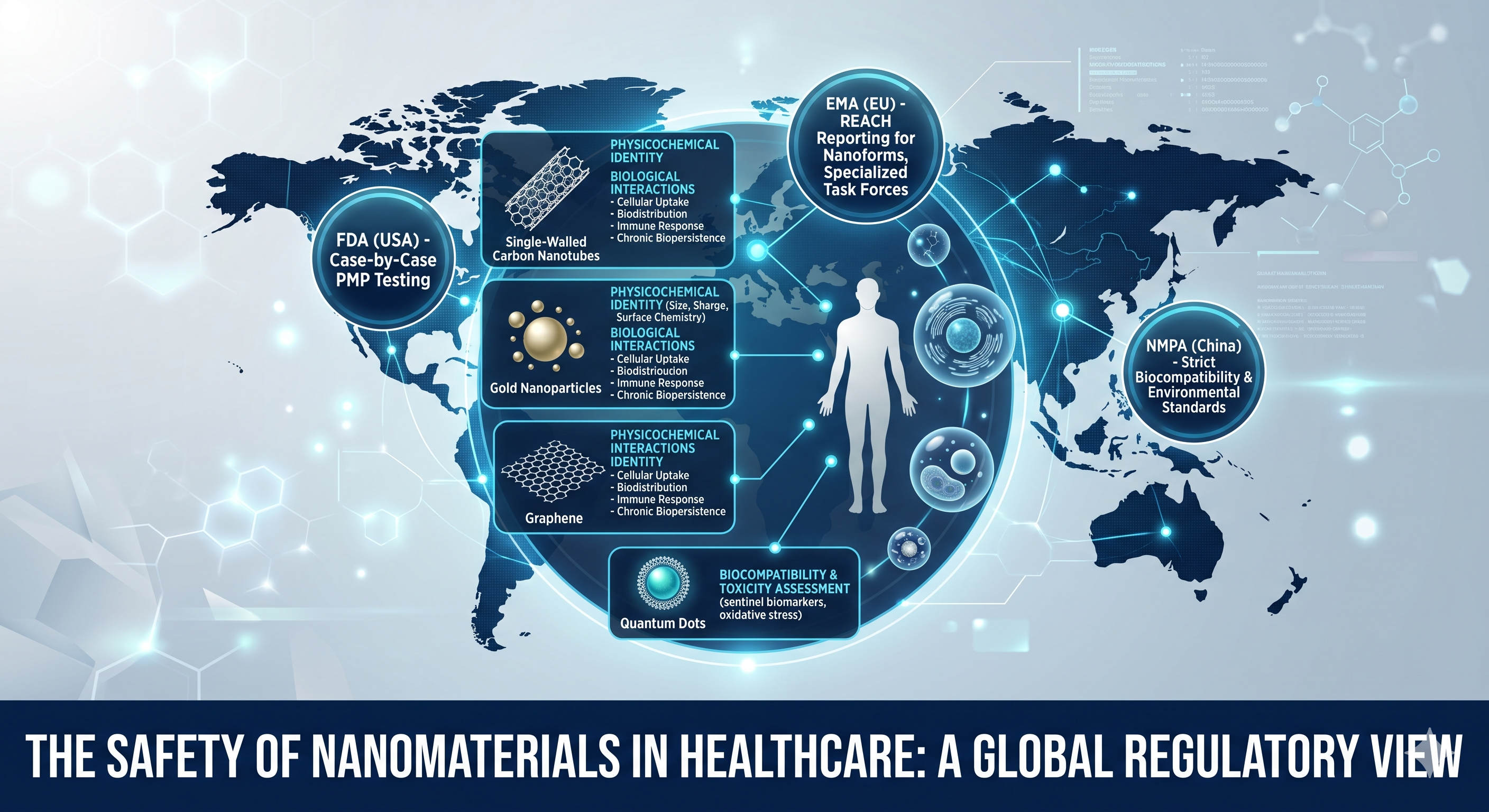
United States (FDA): The Food and Drug Administration does not have a separate “nano-only” category. Instead, it regulates products based on their intended use (drug, device, or biologic) while applying rigorous, case-by-case “nano-specific” testing requirements during the Pre-Market Approval (PMA) process.
-
European Union (EMA & REACH): The EU has been a pioneer in nano-regulation. Under the REACH (Registration, Evaluation, Authorisation, and Restriction of Chemicals) regulation, specific reporting requirements for “nanoforms” of substances are mandatory. The European Medicines Agency (EMA) has also established specialized task forces to evaluate nanomedicines.
-
China (NMPA): As a leader in nanotechnology research, China has implemented strict national standards for the laboratory safety and clinical evaluation of nanomaterials, focusing heavily on biocompatibility and environmental impact.
4. Recent Research and Clinical Safety Insights
Recent clinical studies (2025-2026) have shifted focus from “acute toxicity” (immediate harm) to “chronic biopersistence” (how long particles stay in the body).
The Protein Corona Effect
When a nanoparticle enters the bloodstream, it is immediately “shrouded” by a layer of proteins, known as a protein corona. This corona effectively gives the nanoparticle a “biological identity” that determines how the immune system perceives it. Recent research indicates that regulating the surface chemistry to control this corona is the key to preventing immune rejection and inflammation.
Targeted Clinical Trials
Ongoing trials for carbon nanotube-based scaffolds and quantum dot diagnostics are now utilizing “sentinel biomarkers”. These are specific biological indicators that tell doctors if a nanomaterial is causing “oxidative stress” at a cellular level long before physical symptoms appear.
5. Advantage vs. Risk Assessment: The Regulatory Scale
Regulators use a risk-benefit analysis to determine if a nanomedicine should reach the market.
| Potential Advantages | Associated Regulatory Risks |
|
Precision Targeting: Reduces side effects by delivering drugs only to diseased cells.
|
Toxicity of Carriers: The material used to deliver the drug (e.g., carbon nanotubes) may have its own toxic profile. |
| Enhanced Diagnostics: Earlier detection of pathogens like sepsis or cancer. | False Positives: High sensitivity may lead to detecting viral fragments that aren’t clinically relevant. |
| Tissue Regeneration: Scaffolds that help regrow bone or nerve tissue. | Migration: Risk of nanofibers breaking free and migrating to the lungs or heart. |
| Reduced Dosage: Lower amounts of medication are needed due to high efficiency. | Environmental Impact: Accumulation of non-biodegradable nanomaterials in water systems after excretion. |
6. The Challenges of Standardizing “Nano-Safety”
One of the biggest hurdles for global regulators is the lack of standardized testing. A test that works for a liquid drug might not work for a nanoparticle suspension.
The Need for Reference Materials
To regulate effectively, the world needs “Golden Standards”—certified reference nanomaterials that labs can use to calibrate their equipment. Without these, a safety study conducted in Japan might yield different results than one conducted in the UK, leading to regulatory bottlenecks.
7. Future Trends: AI and In-Silico Modeling
The future of nano-regulation lies in In-Silico Toxicology. Using Artificial Intelligence (AI), regulators are beginning to predict the safety of a nanomaterial before it is even created in a lab. By inputting the size, shape, and charge of a hypothetical particle, AI models can simulate how it will interact with human cell membranes, potentially reducing the need for animal testing and accelerating the approval of safe innovations.
8. Conclusion: A Collaborative Path Forward
The safety of nanomaterials in healthcare is not a static destination but a continuous journey of discovery. As nanotechnology becomes more “active” and “smart,” our regulatory frameworks must remain adaptive, transparent, and globally harmonized.
The goal of a global regulatory view is not to stifle innovation with red tape, but to provide a clear, safe “highway” for life-saving technologies to reach patients. By prioritizing rigorous physicochemical characterization and long-term monitoring, we can ensure that the “nano-revolution” remains a triumph for human health.