
Recently added item(s)
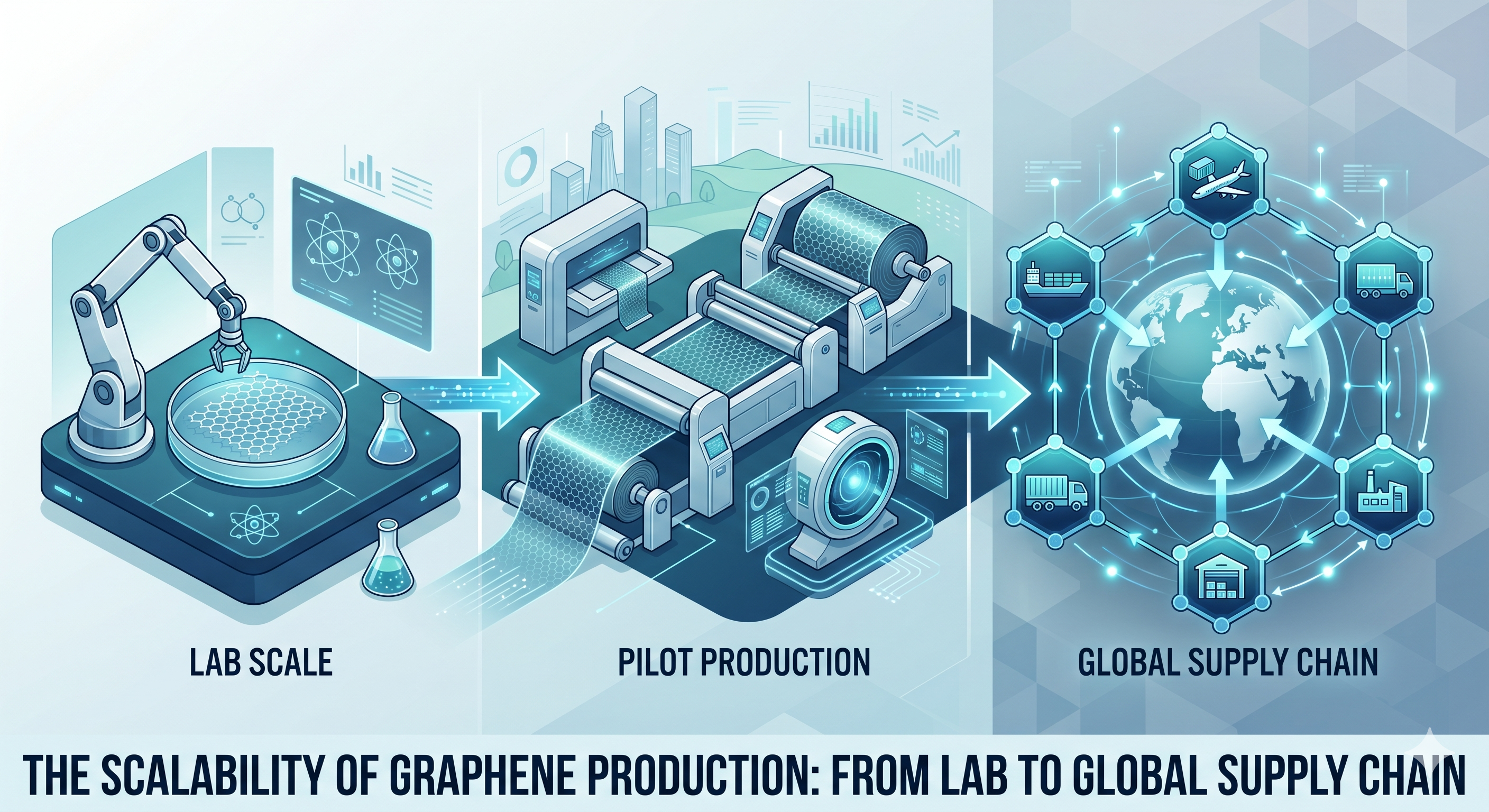
For over two decades, graphene has been hailed as the “wonder material” that would revolutionize everything from quantum computing to water filtration. However, for a long time, there was a significant gap between the extraordinary properties observed in a laboratory and the reality of industrial application. The challenge wasn’t just making graphene; it was making it at scale, with consistent quality, and at a price point that makes economic sense.
As we move through 2026, we are witnessing a pivotal shift. The transition from “gram-scale” lab experiments to “ton-scale” global supply chains is finally happening. This article explores the current state of graphene production, the technological breakthroughs driving scalability, and the risks and rewards of integrating this nanomaterial into the global economy.
The Production Spectrum: How We Make Graphene Today
To understand scalability, we must first look at the primary methods used to produce graphene. Not all graphene is created equal; the production method determines the quality, the price, and the ultimate application.
1. Chemical Vapor Deposition (CVD)
CVD is the gold standard for producing high-quality, large-area graphene films, primarily for electronics and sensors. In this process, carbon-rich gases are heated in a vacuum chamber until they decompose and deposit a single layer of carbon atoms onto a metal substrate (usually copper or nickel).
-
Scalability Status: High for specialized applications. Roll-to-roll (R2R) CVD systems, similar to industrial printing presses, have made it possible to produce meters of graphene film. However, transferring that film from the metal foil to the final product remains a delicate and expensive bottleneck.
2. Liquid Phase Exfoliation (LPE)
This is the workhorse of the “bulk” graphene industry. Graphite—the same material found in pencils—is placed in a solvent and subjected to high-shear mixing or ultrasound. This forces the layers of carbon apart, resulting in Graphene Nanoplatelets (GNPs).
-
Scalability Status: Very High. This method is easily scalable using standard chemical engineering equipment. It is the primary source for graphene used in coatings, composites, and concrete.
3. Flash Joule Heating (FJH)
A relatively recent breakthrough from Rice University, this method involves passing a high-voltage electric current through any carbon-rich material (including plastic waste, coal, or food scraps) for a fraction of a second. The heat reaches 3,000 Kelvin, turning the carbon into “turbostratic” graphene, which is much easier to separate than traditional graphite.
-
Scalability Status: Rising. Because it can use waste as a feedstock, this method is being rapidly commercialized for sustainable, low-cost graphene production.
Bridging the “Valley of Death”: Recent Research and Industrial Trials
In the nanotechnology world, the “Valley of Death” refers to the space between a successful lab prototype and a commercially viable product. Recent industrial trials in 2024 and 2025 have provided the data needed to bridge this gap.
Industrial Field Trials in Construction
One of the most successful “clinical” trials of graphene’s scalability has been in the construction sector. In 2025, large-scale trials in the UK and Turkey utilized graphene-enhanced concrete in highway infrastructure. By adding less than 0.1% graphene by weight, engineers observed a 30% increase in compressive strength. This allowed for a reduction in the total amount of concrete needed, effectively lowering the carbon footprint of the project.
Energy Storage and the EV Supply Chain
Battery manufacturers have moved from lab tests to pilot production lines. Graphene-silicon anodes are now being integrated into high-performance electric vehicle (EV) batteries. These trials have shown that graphene can help manage the thermal expansion of silicon, leading to batteries that charge faster and last through more cycles than standard lithium-ion cells.
Advanced Coatings and Corrosion Resistance
As discussed in previous industrial contexts, graphene-based coatings have moved into the maritime and aerospace sectors. Ongoing trials on cargo ship hulls have demonstrated that graphene-enhanced epoxies can reduce drag by maintaining a smoother surface over time, leading to significant fuel savings.
Advantage-Risk Assessment: The Realities of Scale
Scaling a nanomaterial requires a cold, hard look at the pros and cons.
The Advantages
-
Performance Leap: Graphene offers a significant “performance-to-weight” ratio. Small additions can lead to massive improvements in strength, conductivity, or barrier properties.
-
Sustainability Potential: Methods like Flash Joule Heating allow us to turn carbon waste into a value-added product, supporting a circular economy.
-
Material Decoupling: Graphene can often replace scarce or expensive materials (like silver in conductive inks or cobalt in batteries), reducing dependence on fragile mineral supply chains.
The Risks and Challenges
-
Quality Control (The “Black Powder” Problem): Because there is no single “graphene,” the market is flooded with materials labeled as graphene that are actually just thin graphite. This lack of standardization can lead to inconsistent performance in industrial applications.
-
The Galvanic Risk: In metallic applications, if the graphene is not properly dispersed, it can act as a cathode and accelerate the corrosion of the metal it was meant to protect.
-
Environmental and Health Safety (EHS): While graphene is carbon, the long-term effects of inhaling airborne nanoplatelets are still being studied. Large-scale factories must implement rigorous air filtration and handling protocols to ensure worker safety.
-
Cost vs. ROI: While the price of graphene has dropped from thousands of dollars per gram to hundreds of dollars per kilogram, it still represents a significant upfront cost. Companies must prove that the longevity and performance of the product justify the initial investment.
The Global Supply Chain: From Niche to Necessity
The globalization of graphene production is being led by a few key regions. China currently leads in raw volume, particularly in graphite mining and LPE production. Meanwhile, Europe and North America focus on high-purity CVD graphene and specialized functionalization—the process of “tuning” graphene’s surface to bond with other materials.
The Role of Standardization
To reach true global scale, the industry has turned to ISO standards. ISO/TS 80004-13 provides a clear definition of what constitutes graphene (1 to 10 layers of carbon). This standardization is the bedrock of the supply chain; it allows a buyer in Istanbul to purchase graphene from a producer in Sinop or Gerze with the confidence that the material will perform as expected.
AI in Production
In 2026, the leading graphene production facilities are no longer just chemical plants; they are AI-driven hubs. Machine learning algorithms monitor the exfoliation process in real-time, adjusting pressure and temperature to ensure that every batch of graphene has the exact same thickness and flake size. This “Industry 4.0” approach has reduced waste by nearly 40% in some facilities.
Conclusion: The Future is Layered
The story of graphene’s scalability is no longer a question of “if,” but “how fast.” We have moved past the initial hype and are now in the era of pragmatic engineering. By mastering the production methods—from CVD for our sensors to Liquid Phase Exfoliation for our infrastructure—the industry is creating a robust, multi-layered supply chain.
For businesses and engineers, the message is clear: Graphene is ready for the assembly line. While the risks of cost and quality control remain, the data from global trials suggests that the rewards—lighter, stronger, and more sustainable products—are well worth the effort of integration.