
Recently added item(s)
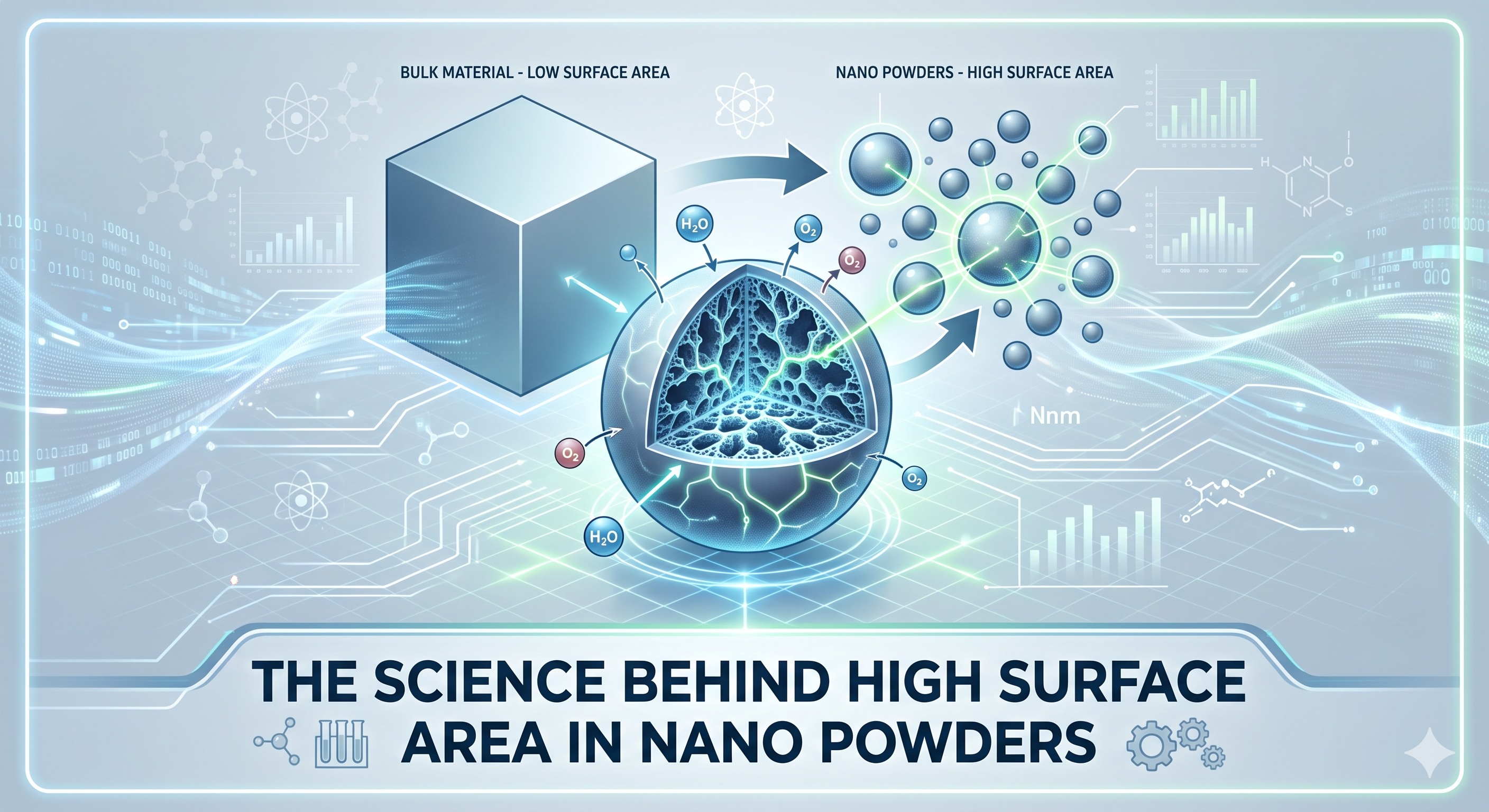
The world of materials science is currently undergoing a profound revolution, and paradoxically, the driving force behind this massive shift is incredibly small. Nanotechnology—the manipulation of matter on an atomic and molecular scale—has transitioned from a theoretical concept into a cornerstone of modern manufacturing, medicine, and energy storage. At the very heart of this technological leap are nano powders. Ranging typically from 1 to 100 nanometers in size, these ultra-fine particles are redefining what is physically and chemically possible.
However, the true secret of nano powders does not lie solely in their microscopic size. The magic happens because of a fundamental geometric principle: the surface area to volume ratio. When we engineer materials at the nanoscale, we unlock an unprecedented amount of surface area, transforming inert substances into highly reactive, exceptionally strong, and extraordinarily versatile tools. In this comprehensive guide, we will explore the science behind high surface area in nano powders, examining current research, breakthrough clinical studies, industrial applications, and a vital advantage-risk assessment.
The Geometry of Miniaturization: Understanding Surface Area
To truly grasp the power of nano powders, we must first understand the physics of shrinking. Why does a material behave differently when it is broken down into nanoparticles?
Imagine a solid block of a given material, such as a one-centimeter cube. This cube has six distinct faces, each with an area of one square centimeter, giving it a total surface area of six square centimeters. Now, imagine taking a cutting tool and slicing that cube right down the middle in all three directions. You now have eight smaller cubes. The total volume of the material has not changed at all; it still takes up the exact same amount of space. However, by cutting the cube, you have exposed new surfaces that were previously hidden inside the solid block.
If you continue this process—using advanced industrial methods like high-energy ball milling to reduce the material down to 44 microns, and then further down into the nanometer scale—the results are staggering. By the time that original one-centimeter cube is reduced to particles measuring just a few nanometers in diameter, its total surface area expands from the size of a postage stamp to the size of an entire football field.
In the realm of chemistry and physics, practically all interactions—whether it is a chemical reaction, heat transfer, or electrical conductivity—occur at the surface of a material. Therefore, when you exponentially increase the surface area without increasing the mass, you create a material that is hyper-reactive, hyper-conductive, and highly efficient.
Chemical and Physical Transformations at the Nanoscale
The dramatic increase in surface area fundamentally alters the thermodynamic and chemical properties of the material. Because a large percentage of the atoms in a nanoparticle are located on the surface rather than secured safely within the interior crystal lattice, these surface atoms have “dangling bonds.” They are essentially unsaturated and highly eager to interact with other atoms and molecules in their environment.
This eager atomic state leads to several fascinating phenomena:
-
Depressed Melting Points: One of the most critical industrial discoveries regarding nano powders is that they melt at significantly lower temperatures than their bulk counterparts. Because surface atoms require less energy to move out of their rigid solid states, the overall melting point of the powder drops. This is incredibly advantageous in industrial manufacturing processes like sintering, where metal powders and ceramics can be fused together at lower temperatures, saving vast amounts of energy and preventing the degradation of the material’s underlying structure.
-
Enhanced Catalysis: Catalysts are substances that speed up chemical reactions without being consumed themselves. Because catalysis happens entirely on the surface, nano powders act as the ultimate catalysts. Even materials that are chemically inert in their bulk form (like gold) become highly active catalysts when reduced to nano powders, facilitating complex chemical syntheses.
-
Thermal and Electrical Conductivity: High surface area allows for superior pathways for electron mobility and phonon scattering, making nano powders essential additives in modern electronics and thermal management systems.
Current Research and Industrial Innovations
Today’s cutting-edge research is heavily focused on harnessing these properties to solve modern engineering and energy challenges.
Advanced Metal Powders and Carbides
Researchers are currently making massive strides in the synthesis of specialized metal powders and carbides, such as boron carbide. By engineering these powders to have exceptionally high surface areas, manufacturers can create advanced ceramics and composite materials that boast diamond-like hardness while remaining incredibly lightweight. These materials are becoming indispensable in aerospace engineering, advanced ballistics, and cutting tools. Developing exact recipes for compounds like cobalt aluminate at the nanoscale is allowing for vibrant, highly stable industrial pigments and advanced magnetic materials.
The Graphene Revolution and Battery Chemistry
No discussion of high surface area nanomaterials is complete without mentioning graphene. While inherently a two-dimensional material, when processed into nano-powder formats (such as reduced graphene oxide powders), it presents a theoretical surface area that is virtually unmatched in the materials science world.
Current research heavily links high surface area nano powders to the future of the automotive industry, specifically in electric vehicles (EVs). Battery chemistries, particularly Lithium Iron Phosphate (LFP) and Nickel Manganese Cobalt (NMC) batteries, rely fundamentally on the surface area of their cathode and anode powders. By utilizing nano-engineered powders, battery manufacturers are increasing the interface area between the electrodes and the electrolyte. This allows for significantly faster lithium-ion intercalation (the movement of ions in and out of the electrode). The practical real-world result? Electric vehicles that can charge in a fraction of the time, run cooler, and offer vastly extended driving ranges without increasing the physical size of the battery pack.
Clinical Studies and Biomedical Applications
The impact of high surface area nano powders is not limited to heavy industry and energy; it is also facilitating miracles in modern medicine. Because biological interactions happen at the cellular and molecular levels, nanomaterials are perfectly sized to interact with the human body.
Bioactive Glass in Bone Regeneration
One of the most exciting clinical applications involves nano-engineered bioactive glass (often referred to as bioglass). Bioactive glass is a surface-reactive biomaterial that can bond to living bone tissues. In recent clinical studies, researchers have found that shifting from micro-sized bioactive glass powders to nano-sized powders completely alters the healing paradigm.
Because of the massive surface area, nano bioactive glass reacts with bodily fluids at an accelerated rate. It rapidly releases critical ions like calcium and phosphate, which trigger the body’s natural cellular response to form hydroxyapatite—the primary mineral component of human bone. Clinical trials in orthopedics and dentistry have shown that these high surface area powders significantly accelerate bone healing, enhance osteointegration around implants, and possess inherent antibacterial properties, drastically reducing the risk of post-operative infections.
Targeted Drug Delivery Systems
In the realm of oncology and chronic disease management, clinical researchers are utilizing high surface area nano powders as microscopic delivery vehicles. Porous nano powders can be engineered to “soak up” pharmaceutical drugs within their immense internal surface areas. Once injected into the bloodstream, these nanoparticles can be designed to release their payload only when they encounter specific environmental triggers, such as the slightly more acidic environment of a tumor. This targeted approach maximizes the efficacy of the drug while minimizing the devastating side effects typically associated with systemic treatments like chemotherapy.
Advantage-Risk Assessment: The Double-Edged Sword
As with any transformative technology, the use of high surface area nano powders requires a careful evaluation of both their immense benefits and their inherent risks.
The Advantages
-
Unmatched Efficiency: Whether it is a catalytic converter in a car, an industrial chemical synthesis, or a hydrogen fuel cell, the high surface area allows for maximum output using a minimum amount of raw material.
-
Superior Material Properties: Integrating nano powders into polymers, metals, and concrete can exponentially increase tensile strength, flexibility, and durability, paving the way for lighter, stronger construction materials.
-
Medical Breakthroughs: From rapid bone regeneration using bioactive glass to pinpoint accuracy in localized drug delivery, nano powders are fundamentally improving patient outcomes in complex clinical scenarios.
-
Energy Optimization: Lower sintering temperatures and enhanced battery chemistries (LFP/NMC) lead to massive energy savings in both the manufacturing and operation of next-generation technologies.
The Risks and Challenges
-
Thermal Oxidation and Spontaneous Combustion: The exact trait that makes nano powders useful—their hyper-reactivity—also makes them dangerous to handle. Highly reactive metal powders, when exposed to ambient oxygen, can undergo rapid thermal oxidation. Without strict environmental controls, this high surface area reactivity can lead to spontaneous combustion or explosive dust clouds during the manufacturing process.
-
Toxicity and Biological Penetration: While great for targeted drug delivery, unintentional exposure is a major health concern. Due to their minute size, airborne nano powders can easily be inhaled, penetrating deep into the lungs and even crossing the blood-brain barrier. The long-term toxicological effects of chronic exposure to synthetic nanoparticles are still the subject of ongoing health and safety research.
-
Environmental Accumulation: Nano powders can easily wash into water systems. Their high surface area can allow them to absorb environmental toxins, acting as transport mechanisms for pollutants, or they can interact unpredictably with aquatic micro-ecosystems.
-
Manufacturing Complexities: Preventing these hyper-active powders from clumping together (agglomerating) to reduce their own surface energy requires advanced stabilization techniques, making the synthesis and storage processes complex and expensive.
Conclusion
The science behind high surface area in nano powders represents a true frontier in modern engineering and chemistry. By understanding and manipulating the mathematical realities of miniaturization, we are transforming traditional materials into advanced problem-solvers. From the specialized synthesis of metal carbides and graphene to the miraculous healing properties of bioactive glass in clinical settings, the applications are as vast as the newly created surface areas themselves.
However, as we continue to push the boundaries of materials science, the responsibility lies with manufacturers, scientists, and industry leaders to respect the raw power of these microscopic materials. By balancing the drive for innovation with rigorous safety protocols, we can safely harness the magic of the nanoscale to build a stronger, healthier, and more energy-efficient future.