
Recently added item(s)
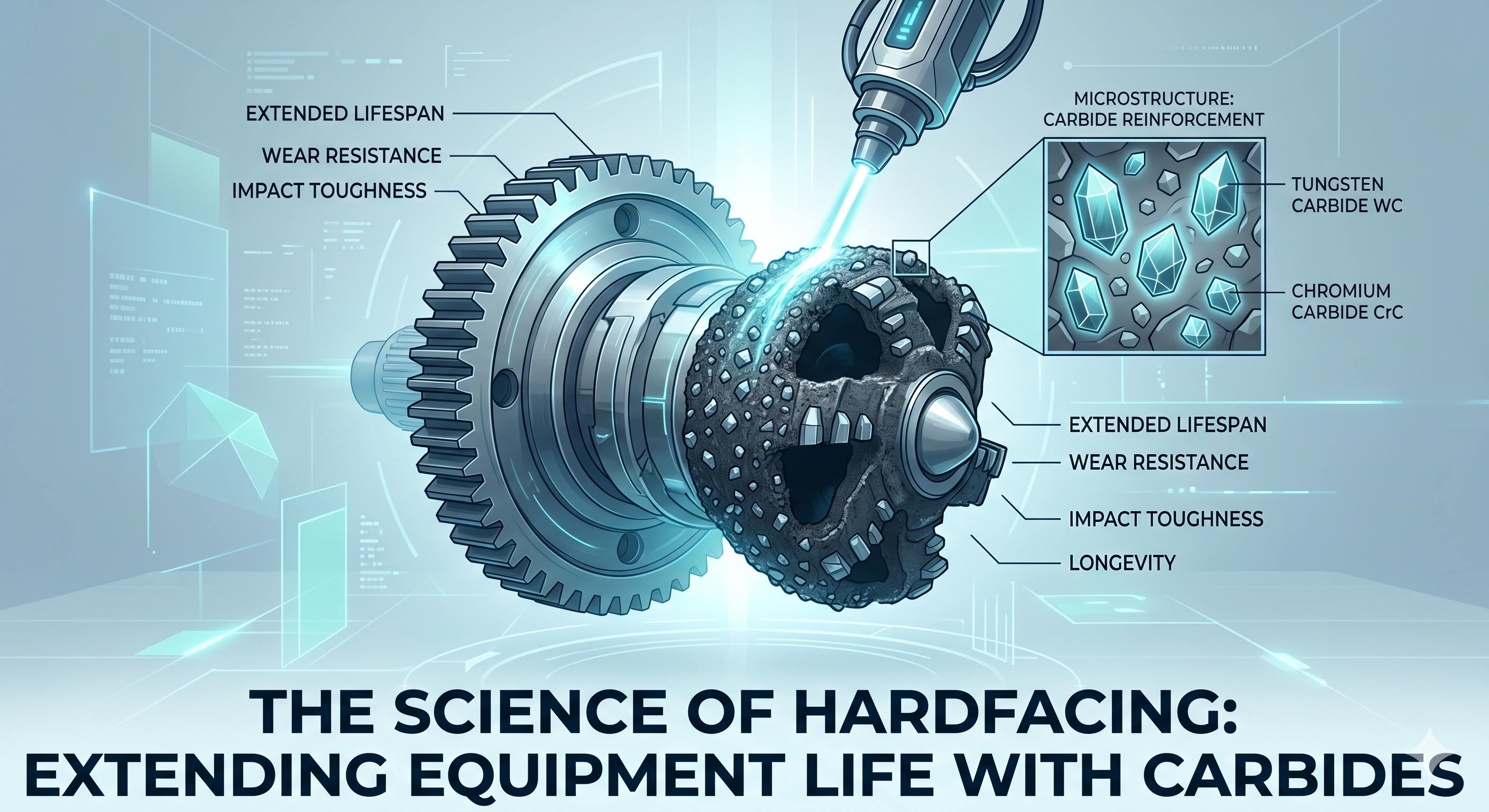
In the heavy-duty world of mining, agriculture, and power generation, “normal” wear and tear is anything but normal. It is a relentless, multi-billion-dollar battle against abrasion, impact, and corrosion. When a multi-million-dollar excavator bucket or a high-pressure grinding roll (HPGR) fails due to surface degradation, the costs aren’t just in the replacement parts—they are in the downtime, the lost labor, and the stalled production.
This is where the science of Hardfacing (also known as hardsurfacing) becomes the ultimate industrial strategic weapon. Hardfacing is the process of welding a layer of wear-resistant material—usually a specialized alloy containing hard carbides—onto the surface of a softer, tougher base metal. It is essentially giving industrial equipment a “suit of armor” that can be repaired and replenished.
In this deep dive, we explore the molecular science of carbides, the latest breakthroughs in laser-cladding technology, and how the industrial landscape of 2026 is moving toward “Smart Surface Engineering.”
The Metallurgy of the “Shield”: Matrix vs. Grit
To understand hardfacing, you must think of it as a composite. If you were to look at a hardfacing weld under a microscope, you would see a “Matrix” (the glue) holding onto “Carbide Grits” (the armor).
1. The Matrix (The “Tough” Phase)
Usually composed of Iron, Nickel, or Cobalt-based alloys, the matrix provides the necessary toughness. It absorbs the shock of heavy impacts, preventing the hard layer from shattering like glass when it hits a rock.
2. The Carbides (The “Hard” Phase)
Carbides are compounds formed when a metal (like Tungsten, Chromium, or Vanadium) bonds with Carbon. They are incredibly hard—often reaching 1500 to 2500 on the Vickers hardness scale, while standard structural steel sits around 200.
-
Chromium Carbides (CrC): The most common for general abrasion. They form “hexagonal” crystals that act as microscopic barriers against sand and soil.
-
Tungsten Carbides (WC): The “Gold Standard” for extreme wear. These are nearly as hard as diamonds and are used in the most aggressive environments, like oil drilling and deep-sea mining.
-
Complex Carbides: Modern 2026 alloys often combine multiple elements (Niobium, Boron, Vanadium) to create a multi-modal defense, where different sizes of carbides fill every microscopic gap in the matrix.
Modern Techniques: The Precision Revolution
In the past, hardfacing was a “dirty” job done with a manual welding rod. Today, it has evolved into a high-precision digital process.
Laser Cladding (Directed Energy Deposition)
The most significant trend in 2025-2026 is the shift toward Laser Cladding. Instead of using a traditional arc, a high-power laser creates a tiny, controlled melt pool on the surface. Carbide nano-powders are then injected directly into that pool.
-
Why it matters: Traditional welding “dilutes” the hard layer with the soft base metal. Laser cladding has almost zero dilution, meaning you get 100% of the carbide performance in a much thinner, lighter layer.
Plasma Transferred Arc (PTA)
PTA remains the powerhouse for heavy industrial parts. It produces a high-energy plasma stream that allows for very thick deposits of tungsten carbide. It is the preferred method for the grinding rollers used in the cement and mining industries, where the “armor” needs to be several centimeters thick.
Current Research: Nanotechnology and High-Entropy Alloys
We are currently witnessing a “Nanotechnology Renaissance” in surface engineering. Researchers are no longer just dumping large chunks of carbide into a weld.
1. Nanocomposite Hardfacing (2025 Studies)
Recent research published in Materials & Design has focused on Nanostructured Hardfacing. By using carbide particles smaller than 100 nanometers, scientists have found that they can prevent “crack propagation.” In traditional hardfacing, a crack in one large carbide crystal can split the whole weld. In a nanocomposite, the billions of tiny particles act as “speed bumps,” forcing the crack to change direction until it loses energy and stops.
2. High-Entropy Alloy (HEA) Matrices
Standard hardfacing uses iron-based matrices. However, 2026 “field trials” in the offshore wind industry are testing HEA matrices. These are alloys made of five or more elements in equal parts. HEAs are naturally resistant to corrosion and maintain their hardness even when the equipment heats up to 600°C due to friction.
3. AI-Optimized Bead Geometry
In late 2025, several tech-forward industrial firms integrated AI into their automated hardfacing robots. The AI uses high-speed cameras to monitor the “bead” in real-time, adjusting the heat and powder flow to ensure the carbide distribution is perfectly even. This has reduced material waste by 15% and increased equipment life by an additional 20%.
Advantage vs. Risk Assessment
Hardfacing is an investment, and like any investment, it requires a clear-eyed evaluation of the trade-offs.
The Advantages
-
Massive Life Extension: Hardfaced components typically last 3 to 10 times longer than untreated parts.
-
Cost Savings: Instead of buying a new $50,000 part, you can spend $5,000 to “reface” the old one.
-
Reduced Energy Consumption: A sharp, hard-faced cutting edge cuts through soil and rock more efficiently, reducing the fuel consumption of the machine by up to 10%.
-
Use of “Economy” Base Metals: You don’t need to make the whole machine out of expensive high-alloy steel. You can use cheap carbon steel for the bulk and only put the “expensive” carbides where the wear actually happens.
The Risks and Challenges
-
Spalling and Delamination: If the “thermal expansion” of the hard layer doesn’t match the base metal, the armor can “pop off” during a sudden temperature change. This is the #1 cause of hardfacing failure.
-
The “Heat Affected Zone” (HAZ): The intense heat of welding can actually weaken the steel underneath the hard layer. Without proper pre-heating and post-heating protocols, the part might break in the middle even if the surface is perfect.
-
Difficulty of Machining: Once you hardface something with Tungsten Carbide, you can’t “fix” it with a standard drill or file. Any final shaping must be done with specialized diamond grinding wheels.
Application Spotlight: Where Carbides Save the Day
| Industry | Component | Primary Carbide Used | Benefit |
| Agriculture | Tillage Tools / Plows | Chromium Carbide | Maintains sharp edges in abrasive soil. |
| Mining | Crusher Liners | Tungsten Carbide | Withstands 24/7 bombardment of hard rock. |
| Recycling | Shredder Blades | Complex (Nb/V) Carbides | Resists “impact fatigue” from metal scrap. |
| Dredging | Pump Impellers | Nickel-Chrome-Boron | Combines erosion resistance with salt-water corrosion protection. |
The Future: The “Jarvis” of Hardfacing
As we look toward 2027, the concept of “Self-Monitoring Surfaces” is taking shape. Researchers are experimenting with embedding “sensor particles” into the hardfacing layer. When the carbide layer wears down to a critical level, the particles change the electrical resistance of the surface, sending a signal to the company’s AI maintenance system.
Instead of waiting for a machine to break, the machine will literally “tell you” when its armor is getting thin. This is the move from preventative maintenance to predictive material science.
Conclusion
Hardfacing is not just “welding more metal.” It is a sophisticated exercise in material science that balances the brute hardness of carbides with the structural toughness of metals. By understanding the molecular dance between the matrix and the grit, industrial owners can transform their equipment from “consumable goods” into “long-term assets.”
In the 2026 economy, where resource efficiency and sustainability are paramount, extending the life of our physical infrastructure isn’t just good business—it’s a necessity. The science of carbides is the “slick” and “safe” bridge to that more efficient future.