
Recently added item(s)
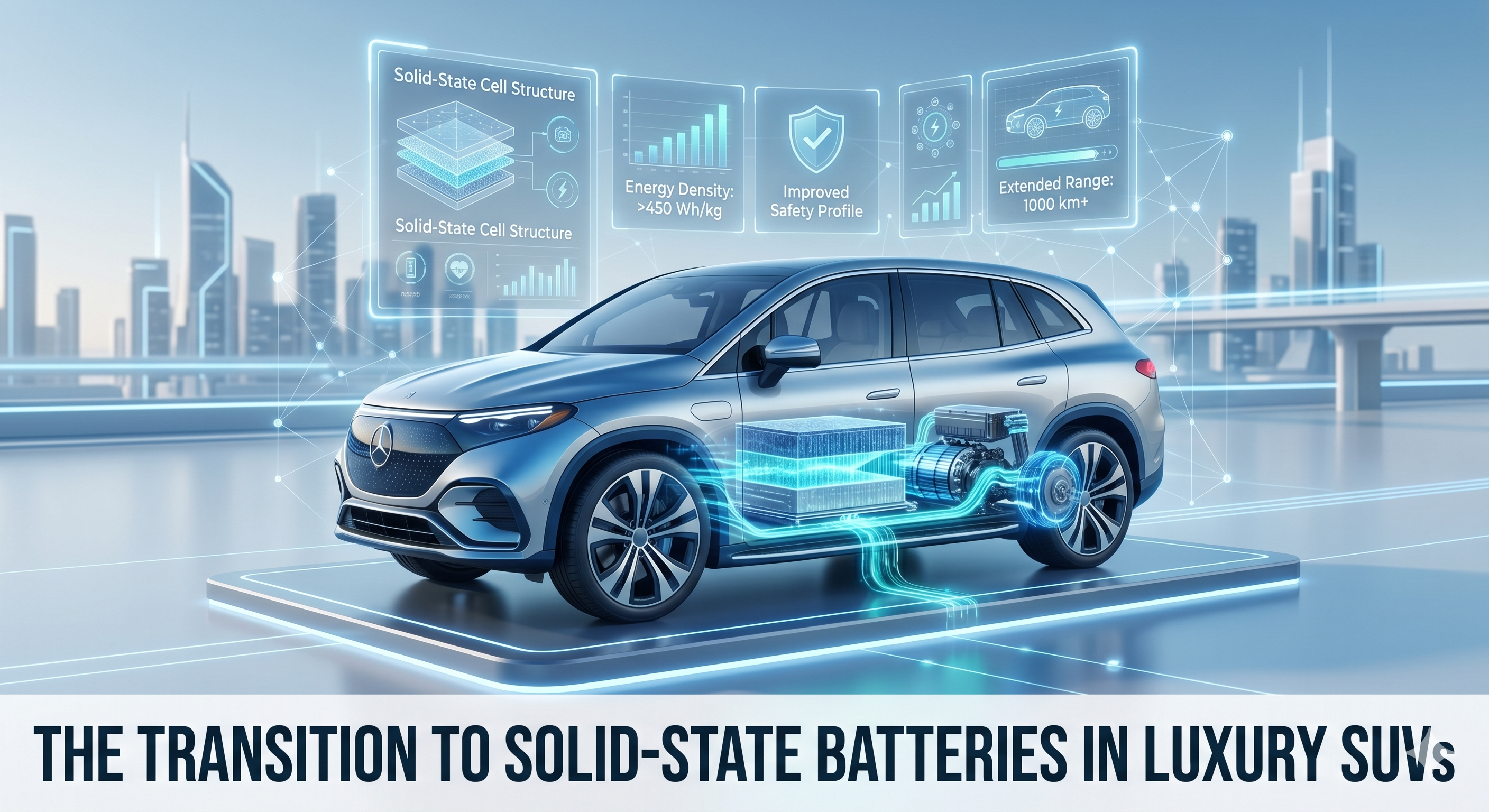
For the last decade, the electric vehicle (EV) narrative has been dominated by the incremental improvements of lithium-ion technology. While these liquid-electrolyte batteries have successfully moved us away from fossil fuels, they have always carried a set of inherent compromises: weight, charging speed, and the lingering concern of thermal stability. As we move through 2026, the industry is reaching a tipping point. The “Holy Grail” of energy storage—the Solid-State Battery (SSB)—is no longer a laboratory curiosity. It is the defining feature of the next generation of luxury SUVs.
Luxury SUVs represent the most challenging and lucrative segment for electrification. Owners expect a 1,000-kilometer range, the ability to tow heavy loads, and a charging experience that mimics the five-minute “splash and dash” of a petrol station. To meet these demands without turning the vehicle into a three-ton behemoth, manufacturers are ditching the liquid for the solid.
Understanding the “Solid” Difference: A Nano-Scale Shift
To appreciate the transition, we must look at the anatomy of the battery. A traditional lithium-ion battery uses a liquid electrolyte to shuttle ions between the anode and cathode. This liquid is flammable and requires bulky cooling systems and heavy protective casings.
A Solid-State Battery replaces this liquid with a solid ceramic, glass, or polymer electrolyte. At the nano-scale, this change is revolutionary.
-
Eliminating the Separator: In liquid batteries, a physical separator is needed to keep the anode and cathode from touching. In SSBs, the solid electrolyte acts as both the conductor and the separator, allowing for a much tighter, more compact design.
-
The Silicon-Anode Breakthrough: Traditional batteries use graphite anodes. SSBs allow for the use of lithium-metal or high-content silicon anodes. These materials can hold significantly more lithium ions, but they tend to expand and “breathe” during charging. In a liquid environment, this leads to degradation; in a solid-state environment engineered with nano-cushions, this expansion can be managed.
Why the Luxury SUV is the Perfect First Adopter
While mass-market hatchbacks focus on cost-cutting, the luxury SUV segment (think Range Rover, BMW iX, or the high-end Mercedes-Benz EQ series) provides the necessary price margin to absorb the initial high costs of SSB production.
1. Weight vs. Performance
A luxury SUV is naturally heavy due to its size, premium soundproofing, and advanced suspension systems. Using current liquid-electrolyte batteries to achieve a 1,000 km range would require a battery pack weighing over 800 kg. By transitioning to SSBs, which offer energy densities exceeding 450–500 Wh/kg, manufacturers can provide the same range with a battery pack that is 40% lighter and significantly smaller. This weight reduction cascades through the vehicle, improving handling, braking, and overall efficiency.
2. Interior Packaging and Design
Luxury is defined by space. In traditional EVs, the “skateboard” battery pack dictates a high floor. Solid-state cells are thinner and can be shaped into unconventional volumes. This allows designers to lower the center of gravity while reclaiming cabin space for more legroom, rotating seats, or larger infotainment systems without increasing the exterior height of the vehicle.
Current Research and Industrial “Clinical” Milestones (2025–2026)
As of mid-2026, several key players have moved from “A-samples” to “B-samples”—vehicle-ready batteries undergoing rigorous real-world testing.
-
The Sulfide-Based Electrolyte Lead: Recent industrial trials have favored sulfide-based solid electrolytes due to their high ionic conductivity, which rivals liquid electrolytes. Research papers published in early 2026 show that these materials can maintain 80% capacity even after 2,000 fast-charge cycles, effectively outlasting the vehicle itself.
-
The QuantumScape Factor: Their multi-layer cell technology has successfully demonstrated “Zero-Pressure” operation in luxury prototypes. Historically, SSBs required massive mechanical pressure to keep the layers in contact. The move to zero-pressure designs significantly reduces the weight of the battery casing.
-
Samsung SDI’s Pilot Line: In the first quarter of 2026, Samsung SDI initiated pilot production of all-solid-state cells specifically for the ultra-luxury market. Their “Anode-less” technology uses a silver-carbon (Ag-C) nano-composite layer, which prevents the formation of dendrites—tiny needle-like structures that can cause short circuits.
The Nano-Materials Solving the “Dendrite” Problem
The biggest technical hurdle for SSBs has always been Dendrite Growth. When lithium ions move during fast charging, they can sometimes pile up and form spikes that pierce the solid electrolyte.
The solution in 2026 involves Nanotechnology Interlayers. Researchers are now applying atomic-layer deposition (ALD) to create a “nano-buffer” between the anode and the electrolyte. This layer, often just a few atoms thick, ensures that lithium is deposited smoothly and evenly. Furthermore, incorporating Graphene Nanotubes into the solid matrix provides a flexible framework that maintains contact between the materials even as they expand and contract during thermal cycles.
Advantage-Risk Evaluation: The Balanced View
The transition to solid-state is not without its “growing pains.” For a business owner or a tech-savvy consumer, understanding the trade-offs is vital.
The Advantages
-
Extreme Safety: Because there is no flammable liquid electrolyte, the risk of “thermal runaway” (battery fires) is virtually eliminated. This removes the need for heavy fire-suppression structures within the chassis.
-
Ultra-Fast Charging: SSBs can handle much higher current densities. We are looking at 10% to 80% charging in under 8 minutes without damaging the battery chemistry.
-
Operating Range: Unlike liquid batteries, which lose significant efficiency in freezing or scorching temperatures, solid-state electrolytes are thermally stable from -40°C to 100°C.
The Risks and Challenges
-
Manufacturing Complexity: Building SSBs requires “Dry Room” environments with near-zero humidity and specialized vacuum-stacking machines. Scaling this to millions of units remains the primary bottleneck in 2026.
-
Interface Resistance: If the solid layers aren’t perfectly bonded at the nano-level, the flow of ions slows down. Solving this “interfacial impedance” requires high-precision manufacturing that increases initial vehicle costs.
-
Supply Chain for Raw Materials: While SSBs use less cobalt, they require high-purity lithium and specialized ceramics or sulfides, creating new dependencies in the global supply chain.
The Sustainability Angle: A Cleaner Lifecycle
Beyond performance, the transition to solid-state is an environmental win. Because SSBs are more energy-dense, they require less raw material per kilowatt-hour. Furthermore, the absence of liquid electrolytes makes the recycling process significantly simpler and safer. In 2026, new “Direct Recycling” methods are being piloted, where the solid electrolyte can be separated and “refreshed” at the nano-level rather than being melted down, reducing the energy footprint of battery second-life programs.
Future Outlook: 2027 and Beyond
The luxury SUV market is the “proving ground.” As the manufacturing processes for solid-state batteries mature and costs drop through the “Learning Curve,” this technology will migrate to premium sedans and eventually mass-market vehicles by 2030.
For the luxury owner in 2026, the choice is becoming clear: the transition to solid-state is the final step in making the electric SUV truly superior to its internal combustion ancestors. It offers the performance of a sports car, the range of a diesel, and the safety of a fortress.
Conclusion
The era of the “liquid battery” is entering its twilight in the high-end automotive sector. The fusion of nanotechnology and solid-state chemistry has unlocked a level of performance that was unthinkable just five years ago. As luxury SUVs lead the charge, they are setting a new standard for what a vehicle can—and should—be. The transition is no longer a question of “if,” but of how quickly the world can scale this atomic-scale innovation.