
Recently added item(s)
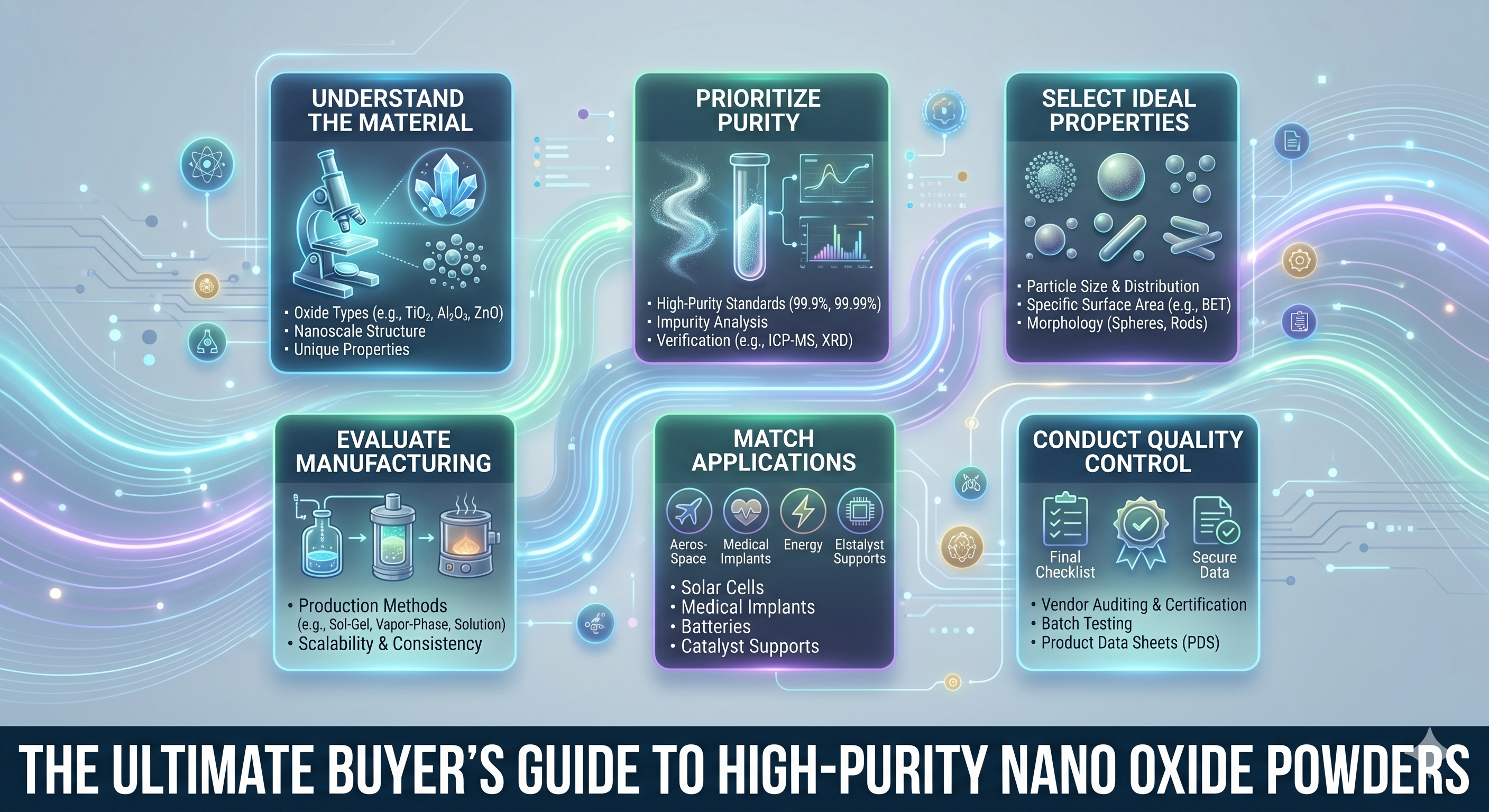
We are currently witnessing a materials science revolution. From the sleek screens of our smartphones to advanced medical devices and self-cleaning surfaces, the defining factor is often something the human eye cannot see: high-purity nano oxide powders. These materials, engineered at the atomic scale, possess extraordinary physical and chemical properties that are fundamentally changing industrial and scientific paradigms.
However, the leap from the lab bench to industrial application is perilous. The complexity of synthesizing these materials, combined with a rapidly expanding market of suppliers, makes purchasing high-purity nano oxide powders a significant challenge. This is not just a standard procurement decision; it is a critical variable that defines product quality, safety, and operational efficiency. This guide serves as your comprehensive blueprint for navigating the intricate world of high-purity metal oxides, bridging the gap between scientific theory and pragmatic purchasing.
Decoding the Science: What Are High-Purity Nano Oxide Powders?
To understand why these powders are revolutionary, we must first understand the implications of the nanoscale.
The Power of Surface Area
A nanometer (nm) is one-billionth of a meter. For a particle to be classified as “nano,” it must typically have at least one dimension less than 100 nm. When you take a bulk material, like titanium or aluminum, and reduce its constituent particles to this scale, the percentage of atoms located on the surface increases exponentially relative to the atoms inside.
Think of a sphere versus the same volume of material crushed into fine dust. The surface area of the dust is orders of magnitude larger. In scientific terms, this creates an enormous “specific surface area” (SSA). Since chemical reactions happen on surfaces, this makes nano oxide powders extremely reactive, catalytic, and responsive to optical or electrical stimuli.
Purity as a Performance Benchmark
The “High-Purity” designation is equally critical. We are not talking about standard 99% purity. In the world of nano oxides, “high-purity” often refers to levels of 99.9%, 99.99%, and sometimes 99.999% (often labeled as N3, N4, and N5, respectively).
Purity is not merely a marketing metric; it defines the crystallinity and defect density of the material. In bulk materials, defects might weaken a structure; in nanomaterials, impurities introduce extraneous atoms that fundamentally alter quantum behaviors, cause electron scattering, ruin optical transparency, or induce toxicological responses in medical applications. True high-purity material behaves predictably and unlocks the theoretical maximums of the specific oxide.
Key High-Purity Nano Oxides Shaping the Market
While dozens exist, several oxide powders dominate the current landscape due to their versatile and disruptive applications. A smart buyer must understand the core properties of each.
1. Titanium Dioxide (TiO2) – The Light Warrior
Titanium Dioxide is arguably the most recognizable nano oxide.
-
Key Property: Strong UV-light absorption.
-
Applications:
-
Cosmetics: When shrunk to the nanoscale, bulk white TiO2 becomes optically transparent while remaining a potent UV filter. This is why high-purity TiO2 is a staple in premium, transparent sunscreens, replacing older chemical UV absorbers like oxybenzone.
-
Self-Cleaning Surfaces: It exhibits strong photocatalytic behavior. Activated by light, TiO2 produces reactive oxygen species that decompose organic pollution, bacteria, and viruses. This technology is used in self-cleaning windows, tiles, and anti-microbial coatings.
-
2. Zinc Oxide (ZnO) – The Multifunctional Powerhouse
Similar to TiO2, ZnO is widely known but has unique electrical and anti-microbial features.
-
Key Property: UV absorption and anti-microbial activity.
-
Applications:
-
Advanced Sunscreens and Textiles: Like TiO2, nano ZnO provides transparent UV protection. High-purity material is essential to avoid skin irritation from residual chemicals.
-
Electronics: It acts as a semiconductor and is used in gas sensors, varistors, and translucent conducting electrodes. Purity is non-negotiable here; even 0.01% impurity can kill transistor performance.
-
3. Aluminum Oxide (Al2O3) – The Reinforcement Specialist
Aluminum Oxide, or Alumina, is all about hardness and stability.
-
Key Property: Extreme hardness, wear resistance, and chemical stability.
-
Applications:
-
Composites: Adding high-purity Al2O3 to plastics, ceramics, and even metals creates composite materials with dramatically increased tensile strength, scratch resistance, and stiffness. It is used in automotive components and aerospace coatings.
-
Catalyst Supports: Its stable surface area makes it a preferred material for carrying other reactive catalysts in industrial chemical processes.
-
4. Silicon Dioxide (SiO2) – The Versatile Filler
Often called Silica, nano SiO2 is a structural chameleon.
-
Key Property: High specific surface area and optical clarity.
-
Applications:
-
Electronics: It is used as a critical insulator and gap filler in microchips. Purity (often 99.999%) is paramount here to ensure no electrical leakage.
-
Consumer Goods: It modifies viscosity in coatings and improves abrasion resistance in rubbers and plastics. High-purity silica ensures uniform mixing and product stability.
-
A Critical Advantage–Risk Assessment
Before making a procurement decision, a structured assessment of the technological advantages versus the operational and regulatory risks is required. High-purity nanomaterials are powerful tools, but they come with unique responsibilities.
The Clear Advantages
-
Product Innovation: Unlocks functionalities (transparency, strength, electrical properties) impossible with bulk materials.
-
Increased Efficiency: Smaller material amounts often achieve better results, reducing overall material consumption.
-
Improved Performance: Faster reaction rates (catalysis), more precise sensors, stronger composites.
-
Competitive Differentiation: Utilizing verified high-purity nanomaterials allows you to market products with superior, verifiable specifications.
The Operational and Scientific Risks
-
Cost and Scalability: Synthesis is energy-intensive and expensive. Scaling from pilot lab synthesis to reliable industrial metric tons, while maintaining N5 purity, is a colossal engineering challenge and a cost barrier.
-
Stability (Agglomeration): The same surface energy that makes them reactive also makes them inherently unstable. Nano oxide particles tend to stick together, forming larger clumps (agglomeration). Poorly dispersed material loses its unique nano properties, essentially turning back into expensive micron-sized bulk material.
-
Manufacturing Variability: Subtle changes in synthesis temperature, precursor chemical batches, or mixing can alter particle size, shape (morphology), and crystalline phase, leading to unpredictable product results.
-
Shelf Life: Purity can degrade over time as particles absorb moisture, CO2, or other ambient gases from the atmosphere.
Toxicity, Clinical Research, and Safety Risks
This is the most critical area and is undergoing extensive clinical and toxicological research. Nanomaterials are so small they can behave like gases.
-
Inhalation Risk (OSHA Warning): The primary safety risk is the inhalation of free, dry powder. Nanoparticles can penetrate deep into the respiratory system, bypassing natural filtration, potentially entering the bloodstream or inducing severe pulmonary inflammation, fibrosis, or carcinogenic responses.
-
Toxicological Uncertainty: Current clinical research aims to understand how nanoparticles interact with cellular systems. While most standard metal oxides are chemically inert, their nano-scale behavior is different. Research shows that certain nano oxides, like TiO2, have high potential for toxicity due to ROS (reactive oxygen species) generation. International occupational health guidelines emphasize rigorous containment (such as gloveboxes and wet handling) and specialized filtration (like HEPA filtration) when working with any metal nanoparticle powder.
-
Recovery Challenges: If the particles are used as catalysts or in consumer goods like food, they must be rigorously separated from the final product to ensure no metal contamination.
Understanding Manufacturing Methods: A Critical Purchasing Factor
A buyer cannot evaluate quality without understanding how the material was made. Synthesis methods dictate morphology, size distribution, crystal phase, and purity.
Simplified Descriptions
-
Sol-Gel (Wet Method): A chemical “cooking” process. Chemicals are dissolved in a solution (sol) and then guided to form a solid gel. This method offers excellent control over purity and size but is slower and harder to scale industrially. It produces uniform, spherical particles.
-
Vapor Phase (Dry Method): Metal precursors are turned into gas and then allowed to react and condense back into solids. Examples include Vapor-Liquid-Solid (VLS) growth. VLS allows for highly complex shapes like nanowires and rods but uses higher energy and is technically demanding.
-
Sputtering and Physical Methods: More energetic methods that “blast” atoms off a target. They allow for creating very pure, thin films but may use aggressive conditions that alter particle structure.
-
Laser Ablation: A highly precise, energetic method often used to create specialized or complex composite particles with extremely narrow size distributions. It is precise but currently prohibitively expensive for large-scale industrial procurement.
How to Evaluate Quality: A Checklist for the Intelligent Buyer
Purity is not a self-declared attribute; it requires scientific verification. As a buyer, you must demand comprehensive documentation. This section outlines the analytical checklist.
1. The Purity Certificate (The Basics)
Demand an ICP-MS (Inductively Coupled Plasma Mass Spectrometry) or ICP-OES report. This is the only method that can reliably measure impurities down to parts per billion (ppb). Standard EDS/EDX testing is insufficient for verifying N3 or N5 purity.
2. Particle Size and Distribution (D50/D90)
A specification of “50 nm” is useless. You need a full distribution curve. Demand reports like DLS (Dynamic Light Scattering) or, better yet, TEM (Transmission Electron Microscopy) images. This proves if the material is actually nano and whether it is uniform or heavily agglomerated.
3. Surface Area (BET Measurement)
Since SSA is the defining characteristic, demand a BET (Brunauer-Emmett-Teller) surface area measurement. High surface area is essential for catalysts and composites, as it proves high activity and porosity.
4. Crystal Structure (XRD Fingerprint)
Xirconia (ZrO2), for example, has different crystalline phases (monoclinic, cubic, tetragonal), each with different properties. XRD (X-Ray Diffraction) testing provides a “fingerprint” proving the specific crystalline phase and quality.
5. Packaging and Safety (SDS)
Nano oxides are often pyrophoric (can ignite in air) and are inhalation hazards. Demand a comprehensive, region-compliant Safety Data Sheet (SDS). Ensure the material is packaged in inert conditions (often under nitrogen or argon) to prevent oxidation and environmental degradation.
Summary and Conclusion
High-purity nano oxide powders are arguably the most powerful technological tools of the 21st century. By shrinking familiar materials to the atomic scale, scientists are unlocking theoretical performance maximums that were once science fiction. These materials are creating stronger composites, more precise sensors, faster computers, and sustainable green technologies.
However, purchasing these magic ingredients requires intelligence. High purity defines crystallinity and behavior, but it introduces complex challenges in manufacturing consistency, stability against agglomeration, and serious health risks from powder handling. A successful procurement strategy requires a rigorous approach. You must move beyond standard price/volume calculations to demand comprehensive, multi-step analytical verification of purity (ICP-MS), particle size (TEM/DLS), specific surface area (BET), and crystal phase (XRD).
As a buyer, you are not merely purchasing material; you are managing a complex scientific variable. By prioritizing high, verifiable purity, choosing the correct manufacturing method for your specific application, and enforcing strict containment protocols, you can responsibly harness the transformative power of the nanoscale to build the next generation of superior, sustainable products.