
Recently added item(s)
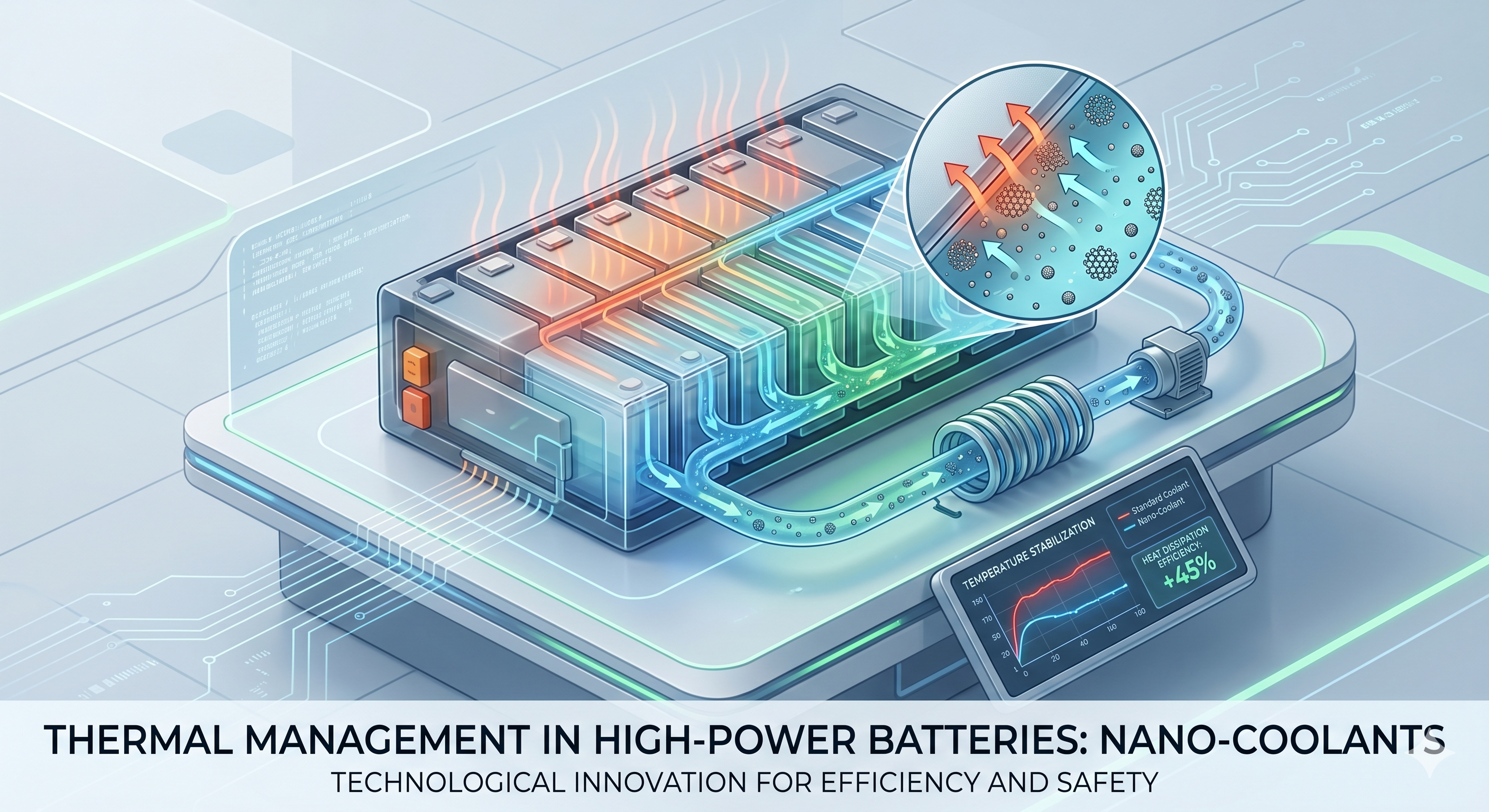
The 21st-century energy landscape is being rewritten by the lithium-ion battery. From the sleek electric vehicles (EVs) silent on our streets to the massive grid-scale storage systems stabilizing renewable energy, these electrochemical powerhouses are indispensable. But as we demand more power—faster charging, longer range, and higher performance—we encounter a formidable, ancient adversary: Heat.
Managing the temperature of high-power batteries is not merely an optimization problem; it is the critical bottleneck preventing the next generation of energy storage. If a battery operates too cold, its efficiency plummets. If it operates too hot, it degrades rapidly, loses capacity, and, in worst-case scenarios, can enter a catastrophic state known as thermal runaway. Traditional cooling methods are reaching their physical limits. The future requires a paradigm shift, and it arrives at the atomic scale: Nano-Coolants.
The Heat Dilemma: Why Batteries Sweat
To understand why we need nano-coolants, we must understand the battery’s Goldilocks zone. Lithium-ion batteries generally prefer to operate between 15°C and 35°C. When you plug your EV into a 350kW fast charger, or when a grid battery releases megawatts to stabilize the power lines, the internal resistance within the battery cells generates immense amounts of heat (known as Joule heating).
1. Accelerated Degradation
Operating a battery consistently above 45°C acts like a speed-dial for its aging process. Chemical reactions within the cell begin to break down the electrode materials and the electrolyte. A critical structure called the Solid Electrolyte Interphase (SEI), which protects the anode, starts to decompose and reform, consuming active lithium and permanently reducing the battery’s capacity. In simple terms: hot batteries die young.
2. Thermal Runaway: The Ultimatum
This is the nightmare scenario for battery engineers. When a cell overheats uncontrollably, it can trigger exothermic reactions within itself. The heat from one reaction accelerates another, causing the temperature to spike by hundreds of degrees per second. This cell vents flammable gases and catches fire, spreading the intense heat to neighboring cells in a domino effect that can destroy an entire vehicle or storage facility. Preventing this propagation is the paramount goal of any Battery Thermal Management System (BTMS).
The Evolution of BTMS: Beyond Fans and Tubes
The first line of defense in early EVs was air cooling. It is cheap and lightweight but suffers from poor efficiency. Air is a terrible conductor of heat. It is like trying to cool a steaming steak by blowing on it from across the room.
The current industry standard is liquid cooling (typically a water-ethylene glycol mixture). The fluid is pumped through tubes or cooling plates sandwiched between battery modules. Liquid is hundreds of times more effective than air. However, modern high-power batteries generate so much heat at localized “hotspots” that even liquid cooling plates struggle to move the heat fast enough. Increasing the flow rate of the coolant requires larger pumps, consumes more vehicle energy, and adds weight—a viscous cycle of diminishing returns.
We have maximized the efficiency of the system architecture. We must now maximize the efficiency of the fluid itself.
Nano-Coolants: What Are They and How Do They Work?
A nano-coolant, or nanofluid, is not just a fancy chemical; it is an engineered colloidal suspension. It starts with a base fluid (like water or glycol) and adds a carefully calculated concentration of nanoparticles (particles measured in nanometers, typically less than 100 nm).
The genius lies in combining the properties of fluids and solids. Fluids have poor thermal conductivity but are easy to pump. Many solids (like metals or carbon) are fantastic at conducting heat. By suspending nano-solids within a fluid, we create a hybrid material that retains the low viscosity of the fluid while gaining the superior thermal properties of the solids.
The Magic Mechanisms:
-
Thermal Conductivity Enhancement: This is the primary driver. The high surface area-to-volume ratio of nanoparticles allows them to absorb and release heat extremely rapidly. They act as molecular heat highways within the fluid.
-
Brownian Motion: Nanoparticles are so small that they are constantly being knocked around by the collisions of the surrounding base fluid molecules. This constant, chaotic dancing (Brownian motion) enhances micro-mixing within the fluid, further boosting convective heat transfer without needing a stronger pump.
Materials of the Future: What’s Inside a Nanofluid?
Researchers are actively exploring various nanoparticle types, each offering a different balance of performance, stability, and cost:
-
Metal Oxides (Al2O3, CuO, TiO2): These are popular initial candidates. They are relatively inexpensive, chemically stable, and non-toxic. Aluminium oxide (Alumina) is the most studied workhorse, showing significant conductivity gains even at low concentrations (1–4%).
-
Carbon Nanomaterials (Graphene, CNTs): These are the superstars. Carbon Nanotubes (CNTs) and Graphene possess some of the highest thermal conductivities known to science. Adding even a tiny fraction of graphene can increase heat transfer by over 50%. However, their dark color makes them messy, and they are expensive and challenging to stabilize in dispersion.
-
Metallic Nanoparticles (Cu, Ag): Pure metals offer extreme conductivity but come with a major drawback for electronics: they are electrically conductive, risking short circuits if they leak. They are also prone to oxidation and clumping.
-
Hybrid Nanofluids: The current cutting-edge involves combining two different nanoparticles (e.g., Alumina-coated CNTs). This allows engineers to harness the benefits of both while offsetting their weaknesses, creating optimized materials specifically for battery environments.
“Clinical Trials” and Industrial Pilots: When Engineering Meets Reality
In engineering, “clinical trials” are industrial pilots, and the “patients” are prototype battery packs subjected to extreme abuse. While you cannot buy a nano-coolant car at a dealership today (May 2026), the tech is transitioning rapidly from labs to pre-production testing.
1. The Immersion Cooling Frontier
The traditional approach of pumping coolant through tubes is becoming obsolete for extreme power. The next trend is immersion cooling, where the entire battery module—the actual cells, tabs, and connectors—is submerged in a special non-conductive (dielectric) fluid.
Nanofluids are the natural partners for immersion systems. Research partnerships between major battery manufacturers (like CATL, LG Energy) and chemical giants (like BASF, Shell) are testing nanofluid immersion systems in specialized test rigs that simulate 15-minute 0-80% charging cycles at 45°C ambient temperatures. The results are promising, showing a reduction in maximum cell temperature of up to 10°C compared to conventional dielectric oils, while simultaneously improving temperature uniformity across the pack.
2. Stability Trials
The primary barrier to commercialization is not if nanofluids work, but how long they work. A battery coolant must remain stable for the 10-15 year lifespan of a vehicle. Current industrial trials are focusing on “agglomeration” (the tendency of particles to clump together) under real-world vibration, temperature cycling (-20°C to 60°C), and chemical exposure. Specialized surfactants (soap-like chemical bridges) are being optimized to keep the particles suspended indefinitely. The leading trials in 2026 are focused on alumina-water-glycol mixtures, which are showing stability exceeding 5,000 thermal cycles.
Advantage vs. Risk: A Detailed Evaluation
Advantages
-
Drastically Higher Performance: Enhanced heat transfer allows for significantly faster charging speeds (approaching the 10-minute 80% mark) without damaging the battery.
-
Uniformity: Nanofluids can erase localized “hotspots” within a pack, ensuring all cells degrade at the same rate, extending the total lifespan of the battery.
-
Safety: Immersion systems using dielectric nanofluids can potentially extinguish the start of a thermal event instantly by engulfing the affected cell.
-
System Compactness: Better cooling means the external radiators and pumps can be smaller, saving precious weight and space in a vehicle.
Risks and Challenges
-
Stability (Settling/Agglomeration): If particles clump together, they become mud. They can block narrow coolant channels, creating a massive thermal dam that causes the exact failure they were meant to prevent.
-
Increased Viscosity: Suspending solids in a liquid inevitably makes it thicker (more viscous). This means the pump has to work harder to push the fluid. If the viscosity increases too much, it erases the efficiency gains from the heat transfer.
-
Erosion and Corrosion: Nanoparticles are like billions of tiny sandblasters. They can erode the internal walls of cooling plates and pumps, leading to premature leaks.
-
Cost: Engineering specialized nanoparticles and their stabilizing agents is complex and expensive.
-
Environmental and Toxicity Concerns: While Alumina is safe, the environmental impact of producing or disposing of complex materials like graphene or metallic nanoparticles at a multi-million-unit scale is still under debate and regulation.
Conclusion: The Nano-Scale Guard
Thermal management is the defining challenge of the electrified world. While standard liquid cooling has served us well, the demands of the future are extreme. We are demanding that batteries perform like internal combustion engines—fueling in minutes, not hours.
To meet this challenge, we must deploy solutions that work at the same scale as the electrochemical reactions themselves. Nano-coolants are not science fiction; they are a necessary engineering evolution. Through sophisticated material science, we are turning simple fluids into intelligent heat-management systems. While significant hurdles remain regarding long-term stability and cost, the rapid progress in industrial pilots suggests that within this decade, our most powerful batteries will be kept cool and safe by a billion invisible atomic-scale guards.