
Recently added item(s)
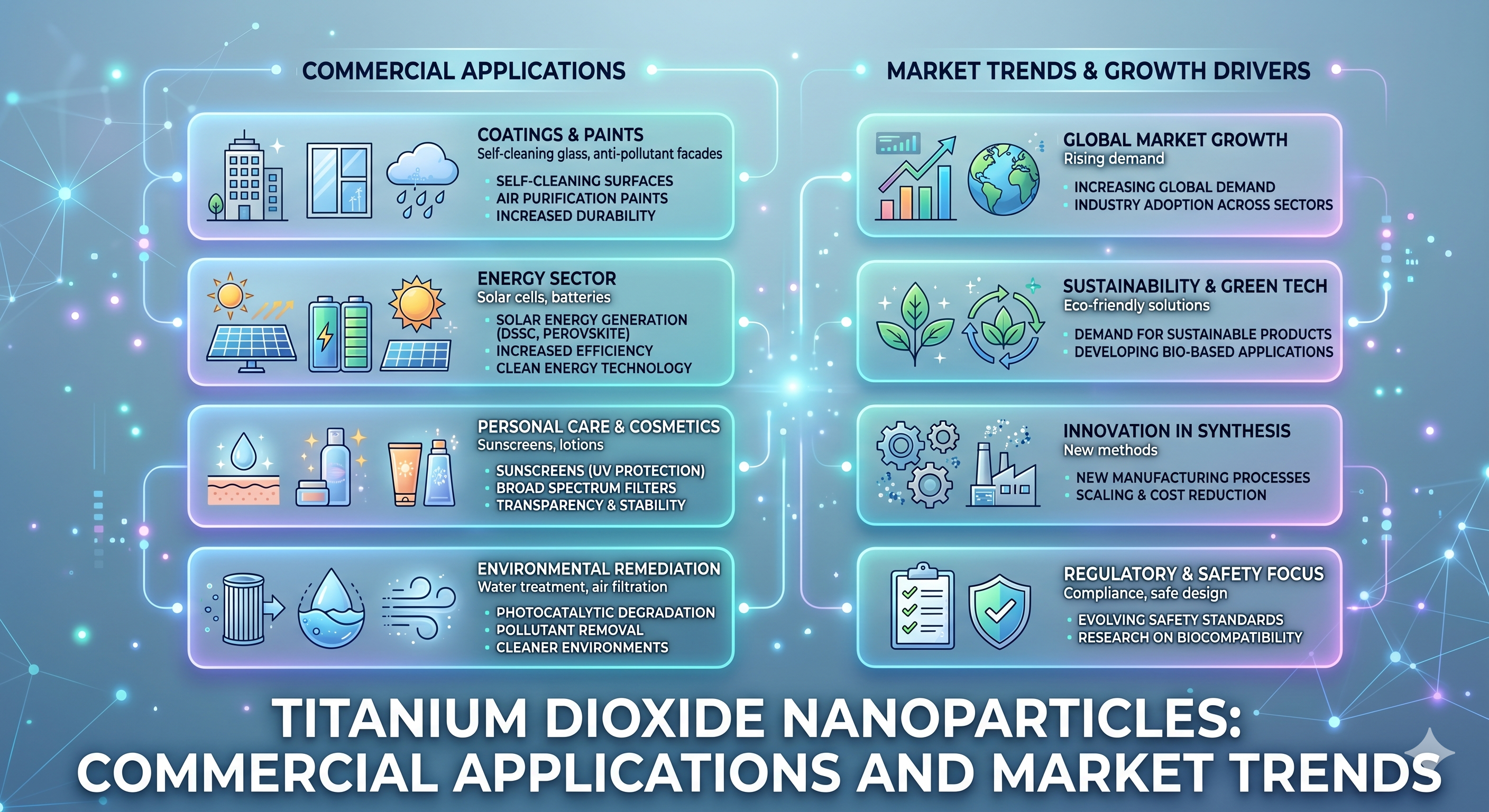
Have you ever wondered what makes your super-white paint so bright, your high-performance sunscreen so transparent yet effective, or the glass facade of a skyscraper stay pristine without constant washing? The answer, increasingly, lies in a material you cannot see, but whose impact is monumental: Titanium Dioxide Nanoparticles. While bulk titanium dioxide (TiO₂) has been a staple of the pigment industry for a century, its nanoscale form—particles 100,000 times smaller than the width of a human hair—is unleashing revolutionary functionalities, driving a multibillion-dollar global market while simultaneously sparking crucial scientific debates about safety.
This blog post will take you on a comprehensive journey into the world of titanium dioxide nanoparticles (TiO₂ NPs). We will explore the unique scientific properties that make them so versatile, their diverse commercial applications across industries, the powerful market trends fueling their growth, and a balanced evaluation of their remarkable benefits versus their inherent risks.
What Makes Titanium Dioxide Nanoparticles Unique? The Science of the Nano-Scale
To understand why TiO₂ NPs are changing the industrial landscape, we first need to grasp the fundamental shift that occurs at the nanoscale. Traditional titanium dioxide is used primarily as a white pigment (known as E171 in food) due to its exceptional ability to scatter visible light, providing opacity and brightness.
When this material is engineered down to the nanoscale (typically less than 100 nanometers), its interaction with light and its chemical reactivity are dramatically transformed:
-
UV Absorption Instead of Scattering: While micro-sized TiO₂ scatters visible light, nano-sized TiO₂ becomes transparent to visible light but exhibits an incredibly potent ability to absorb ultraviolet (UV) radiation. This is a critical distinction that unlocked its use in high-performance, transparent sunscreens and UV-protective coatings.
-
Photocatalysis: Light-Powered Chemical Warfare: Perhaps the most game-changing property of TiO₂ NPs is photocatalysis. When exposed to UV light (or increasingly, tailored to respond to visible light), TiO₂ acts as a catalyst. It uses light energy to create “electron-hole pairs” on its massive surface. These pairs interact with water and oxygen to generate reactive oxygen species (ROS)—powerful oxidative agents that can break down virtually all organic matter, including pollutants, dirt, bacteria, and viruses.
-
Superhydrophilicity: After exposure to light, TiO₂ surfaces become superhydrophilic. Instead of water beading up, it spreads into a micro-thin, uniform sheet. This property, combined with photocatalytic degradation, is the secret behind self-cleaning surfaces: dirt is degraded, and then a thin sheet of water (like rain) slips beneath it to wash it away, leaving no streaks.
Major Commercial Applications: The Nano Revolution in Action
The unique combination of UV blocking, photocatalysis, and self-cleaning has made TiO₂ NPs an essential component in a dizzying array of premium products and industrial processes.
A. Smart Coatings & Architecture: Buildings that Clean and Breathe
The construction and coatings industry is the largest market segment for TiO₂ NPs.
-
Self-Cleaning Glass and Facades: Skyscrapers and modern homes are increasingly coated with TiO₂ films. Rain keeps these surfaces clean without requiring detergent or manual labor, dramatically reducing maintenance costs and water usage. A famous example is the Jubilee Church in Rome, which uses a TiO₂-infused cement to maintain its brilliant white facade against urban pollution.
-
Air-Purifying Pavements and Paints: Cities are experimenting with TiO₂-coated roads and building surfaces to actively combat air pollution. These surfaces use sunlight to decompose nitrogen oxides (NOx) and volatile organic compounds (VOCs)—major components of urban smog—directly converting them into harmless nitrates or water. A single coated facade can sometimes purify the air surrounding it, equivalent to several trees.
B. Personal Care: Invisible Protection and Enhanced Aesthetics
TiO₂ NPs have transformed the landscape of sun protection and premium cosmetics.
-
Premium Sunscreens: Unlike traditional physical sunscreens that leave a thick, white, chalky residue, nano-TiO₂ sunscreens provide broad-spectrum UVA and UVB protection in a formulation that is completely transparent on the skin. This transparency dramatically increases consumer acceptance and daily usage, which is crucial for preventing skin cancer.
-
Cosmetics: They are used as non-comedogenic UV filters in premium foundations, moisturizers, and lip balms, offering anti-aging and protective benefits.
C. Energy: The Green Powerhouse
TiO₂ NPs are at the core of several next-generation clean energy technologies.
-
Dye-Sensitized Solar Cells (DSSCs): These are low-cost, flexible solar cells inspired by photosynthesis. TiO₂ NPs form a porous, mesoscopic film that serves as the electrode where a dye captures light energy. Ongoing research into optimizing the morphology and surface area of TiO₂ NPs is directly driving increases in the efficiency of these promising cells.
-
Perovskite Solar Cells: TiO₂ often serves as an essential electron-transporting layer in these ultra-high-efficiency solar cells. Its stability and bandgap are critical for ensuring maximum power conversion.
D. Environmental Remediation: Water and Air Purification
The powerful oxidative ability of photocatalytic TiO₂ NPs is being harnessed for environmental cleaning.
-
Water Purification: TiO₂ NPs can decompose persistent organic pollutants, pesticides, dyes, and pharmaceutical residues that traditional water treatment systems fail to remove. Crucially, they can also deactivate pathogenic bacteria and viruses without requiring harsh chemical disinfectants like chlorine. Advanced systems use TiO₂-coated membranes or floating beads that are activated by sunlight or UV lamps.
E. The Food Controversy: From E171 to Nano-Risk
While micro-sized TiO₂ has been a common whitening agent (E171) in candies, sauces, and pastries for decades, a small fraction (often up to 10-20%) of this food-grade additive exists in the nano-range. This has sparked intense controversy and research into the risks of ingesting nano-fractions in food, which we will detail in the safety assessment section.
Current Global Market Trends and Growth Drivers
The global market for TiO₂ nanomaterials is experiencing robust growth, separate from the traditional pigment market. According to recent market intelligence reports, the global market for titanium dioxide nanomaterials, valued at approximately USD 1.7-2.0 billion in 2023, is projected to expand at a Compound Annual Growth Rate (CAGR) of 6.5-7.7% between 2024 and 2032, reaching values well over USD 3.5 billion.
Key Drivers of Growth:
-
Urbanization and Smart Cities: Demand for sustainable construction, self-cleaning facades, and urban air-purification solutions is a primary driver.
-
Clean Energy Transition: The rapid scale-up of solar energy technologies, particularly perovskite and DSSCs, creates significant demand for specialty TiO₂ nanostructures.
-
Premium Personal Care: The cosmetic industry continues to innovate, requiring higher-purity and tailored TiO₂ NP grades for transparent, high-SPF formulations.
-
Environmental Water Solutions: Growing global concern about water scarcity and persistent pollutants is accelerating the adoption of photocatalytic water treatment technologies.
Key Market Segments:
-
By Application: Paints & Coatings dominate, followed by Personal Care and Energy.
-
By Morphology: Spherical particles remain the most common, but demand for customized TiO₂ nanotubes, nanowires, and porous films is growing, particularly in energy and catalysis.
-
Key Players: Major chemical companies and specialized nanomaterial manufacturers like Huntsman Corporation, Tronox Limited, DuPont, ACS Material LLC, and Kronos Worldwide are dominant forces, alongside specialized entities focused on advanced materials.
The Complex Balance: Advantages vs. Risks
TiO₂ NPs present a dual nature: a material of profound technological promise and a focus of intense toxicity assessment.
Advantages: Why We Cannot Easily Replace Them
-
Unmatched Multifunctionality: No other single material can simultaneously provide potent UV blocking, photocatalytic decomposition of pollutants, antimicrobial activity, and superhydrophilic self-cleaning.
-
Efficiency Gains: They perform the same function as micro-particles (like UV filtering or catalysis) but with significantly less material due to their high surface-area-to-volume ratio.
-
Sustainable Cities: They are one of the few scalable technologies available to actively combat air and surface pollution on urban infrastructure.
-
Green Energy: They are essential components for maximizing the efficiency and reducing the cost of several green energy technologies.
Risks: What Current Research and Clinical Studies Reveal
The potential risks of TiO₂ NPs depend entirely on the route of exposure, size, crystallinity (anatase vs. rutile), and surface coating.
1. Health Risks:
-
Inhalation (Respiratory Toxicity): This is the most well-established risk. In vivo (animal) studies have shown that high-dose inhalation of TiO₂ NPs can lead to pulmonary inflammation, fibrosis, and, in some chronic studies, lung tumors. While the risk is primarily relevant for occupational exposure in manufacturing facilities (where workers might inhale dry powder), the International Agency for Research on Cancer (IARC) has classified titanium dioxide (all forms) as “possibly carcinogenic to humans” (Group 2B) based on these rat studies. It’s important to note that this is different from classifying it as a human carcinogen under typical usage.
-
Ingestion (Gastrointestinal and Systemic Toxicity): This is the center of the food controversy. The small fraction of NPs within the food additive E171 can be absorbed through the gastrointestinal tract and accumulate in organs like the liver and spleen. Recent in vivo and in vitro studies have suggested potential genotoxicity (DNA damage) and inflammation. While clinical studies on humans are limited by ethical constraints, the cumulative animal data led the European Food Safety Authority (EFSA) to declare E171 “no longer safe as a food additive” in 2021, leading to a subsequent ban in the EU. Other regulatory bodies, including the US FDA, still consider E171 safe, citing insufficient evidence of systemic harm at dietary levels.
-
Skin Penetration (Sunscreens): A large body of clinical and dermatological evidence, including reviews by the SCCS, supports the general consensus that TiO₂ NPs in sunscreens, when applied to healthy, intact skin, do not penetrate beyond the outer layer (stratum corneum) and, therefore, do not pose a systemic health risk. A nuanced concern remains for usage on severely damaged or broken skin, where penetration could be possible. Modern sunscreen formulations often use rutile-phase particles (less reactive than anatase) with surface coatings to further reduce ROS generation on the skin.
2. Environmental Risks:
-
Aquatic Toxicity: When sunscreens wash off into oceans or wastewater treatment systems fail, TiO₂ NPs end up in aquatic ecosystems. Studies have shown that TiO₂ NPs can be toxic to marine algae, microorganisms, and coral reefs, particularly due to ROS generation under sunlight. They can also bioaccumulate in certain organisms and, over time, affect ecosystem stability.
Current Research and Future Directions
Scientific innovation in TiO₂ NPs is focused on addressing the risk profile while maximizing performance.
-
Visible Light Photocatalysis: TiO₂ only works with UV light. Doping (introducing elements like nitrogen or carbon) or pairing with other materials can make TiO₂ photocatalysts responsive to visible light, dramatically expanding their use in indoor air purification and water treatment.
-
Nanomedicine (Drug Delivery and PDT): Ongoing research explores TiO₂ NPs as carriers for targeted drug delivery or as agents for Photodynamic Therapy (PDT). In PDT, TiO₂ NPs are delivered to cancer tumors and then activated by a light source, generating localized ROS to selectively kill cancer cells without damaging surrounding healthy tissue.
-
Advanced Nanostructures: Research is moving beyond spherical particles to specialized TiO₂ morphologies like hollow spheres, nanorods, and core-shell structures that can provide higher efficiency in specific energy or catalytic applications.
The Regulatory Landscape: The Ongoing Safety Check
Regulators globally are grappling with the balanced governance of TiO₂ NPs.
-
Food: The divergence between the EU’s precautionary ban on E171 in food and the US FDA’s continued allowance highlights the dynamic and contested nature of nanotechnology safety data.
-
Personal Care: Strict guidelines exist in the EU, USA, and elsewhere requiring that TiO₂ NPs in sunscreens be tailored (crystallinity, surface treatment) and applied with a general safety consensus for dermal use, but often advising against use in sprays where inhalation is a risk.
-
Occupational Health: Stringent exposure limits are in place to protect workers during production.
Conclusion: The Future of Titanium Dioxide Nanoparticles
Titanium Dioxide Nanoparticles are a classic example of an “invisible giant”—an essential, multifunctional material driving innovation across critical sectors like clean energy, sustainable architecture, premium personal care, and environmental cleaning. We cannot easily replace them without sacrificing the self-cleaning buildings, transparent high-performance sunscreens, or green energy solutions that define a modern, sustainable world.
However, their powerful scientific properties come with complex safety and environmental profiles that require constant, rigorous scientific inquiry and adaptive, risk-aware regulation. The future of titanium dioxide nanoparticles will be defined not just by their performance, but by our ability to develop tailored nanostructures, protective coatings, and exposure guidelines that simultaneously maximize their monumental benefits and minimize their potential for harm.