
Recently added item(s)
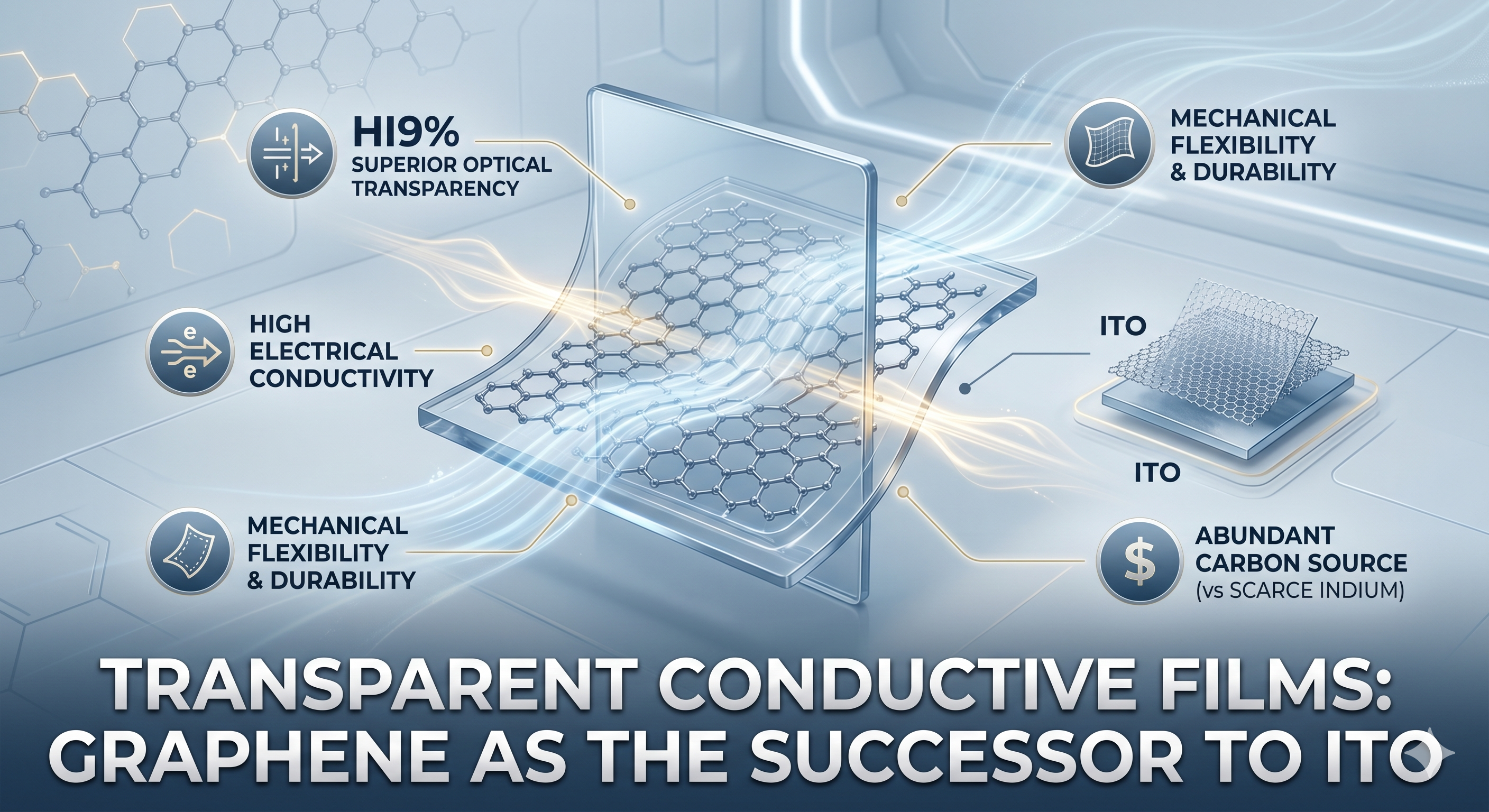
Every time you swipe your smartphone, look at a laptop screen, or see a modern solar panel, you are interacting with a Transparent Conductive Film (TCF). For decades, the undisputed king of this technology has been Indium Tin Oxide (ITO). However, as we move into an era of foldable phones, wearable electronics, and low-cost green energy, ITO is beginning to fail us.
The search for a successor has led scientists to Graphene. This single-atom-thick layer of carbon is not just a laboratory curiosity anymore; it is the primary candidate to revolutionize the display and energy industries.
1. The ITO Problem: Why Do We Need a Successor?
ITO has dominated the market because it offers a rare combination: it is electrically conductive and optically transparent. However, it has three fatal flaws that make it unsuitable for the next generation of tech:
-
Brittleness: ITO is essentially a ceramic. If you bend it, it cracks. This is the primary reason why “foldable” screens using ITO have struggled with durability.
-
Cost and Scarcity: Indium is a rare earth metal. Its supply is limited, and its price fluctuates wildly, making large-scale applications like “smart windows” prohibitively expensive.
-
Manufacturing Complexity: Depositing ITO requires high-vacuum environments and high temperatures, which consumes a vast amount of energy.
Graphene, by contrast, is flexible, made of abundant carbon, and can be applied using much simpler methods.
2. Graphene: The Perfect Atomic Mesh
Graphene’s structure—a hexagonal honeycomb of carbon atoms—gives it properties that seem like science fiction.
Optical Transparency
Graphene absorbs only 2.3% of visible light. This means a single layer is virtually invisible to the human eye, allowing more light to reach the pixels of a display or the active layer of a solar cell than traditional ITO.
Electrical Conductivity
Despite being thin, graphene has a higher electron mobility than any other material at room temperature. When “doped” with specific chemicals, its conductivity rivals that of metals, allowing it to carry the signals needed for high-speed touchscreens.
Mechanical Resilience
Graphene is the strongest material ever measured. More importantly for electronics, it is incredibly flexible. You can fold it, stretch it, and twist it millions of times without losing electrical connectivity.
3. Recent Research and Breakthroughs (2025-2026)
The transition from ITO to Graphene has accelerated in the last 18 months thanks to several key research milestones.
Hybrid Graphene-Silver Nanowire Films
One of the most exciting breakthroughs in 2025 involves “Hybrid Films.” Pure graphene sometimes struggles with high “sheet resistance” when scaled up. Researchers have developed a method to embed a mesh of silver nanowires between two layers of graphene. The graphene protects the silver from oxidation, while the silver provides a “super-highway” for electrons. These hybrid films have outperformed ITO in both transparency and conductivity for the first time in industrial-scale testing.
Roll-to-Roll (R2R) Manufacturing
In 2026, the primary focus has shifted to production. New Roll-to-Roll Chemical Vapor Deposition (CVD) machines are now capable of producing graphene films at speeds of several meters per minute. This brings the cost of graphene TCFs down to a level that is competitive with, and in some cases lower than, high-quality ITO.
4. Advantage vs. Risk Assessment: The Balanced View
The Advantages
-
Foldability: Enables truly flexible and rollable devices that don’t degrade over time.
-
Durability: Graphene films are much more resistant to impact than brittle ITO. If you drop a graphene-based phone, the conductive layer is much less likely to shatter.
-
Sustainability: Carbon is everywhere. Using graphene reduces our reliance on rare-earth mining and the geopolitical issues associated with Indium.
-
Broadband Transparency: Unlike ITO, which becomes less transparent in the infrared spectrum, graphene remains transparent across a much wider range of light, making it ideal for next-gen night-vision sensors and specialized solar panels.
The Risks and Challenges
-
Contact Resistance: Connecting a graphene film to the metal wires in a device remains a technical challenge. “Resistance at the junction” can lead to energy loss and heating.
-
Doping Stability: To make graphene highly conductive, chemicals are often added (doping). Ensuring these chemicals don’t evaporate or degrade over a 10-year device lifespan is a major focus of current “aging” studies.
-
Uniformity: Even a tiny defect in an atomic-scale sheet can cause a “dark spot” on a high-resolution screen. Maintaining 100% uniformity over large areas is the final hurdle for mass commercialization.
5. “Clinical” View: Toxicity and Environmental Lifecycle
In the electronics industry, “clinical” evaluation focuses on the safety of the material during manufacturing and its impact when it reaches a landfill.
Human and Environmental Safety
Current research indicates that graphene-based TCFs are safer for the environment than ITO. Indium is toxic if it leaches into groundwater. Graphene, being pure carbon, is inherently more biocompatible. Studies in 2025 have confirmed that “encapsulated” graphene (sandwiched between protective plastic layers in a screen) poses zero risk to consumers. Furthermore, the carbon in these screens is easier to reclaim during the recycling process than the complex oxides found in ITO.
6. The Transition: Who is Leading the Charge?
-
Smartphone Manufacturers: Leading brands in the foldable market are already integrating graphene-based touch sensors into their 2026 flagship models.
-
Solar Industry: Graphene TCFs are being used in Perovskite Solar Cells, where ITO’s high-temperature manufacturing would normally damage the delicate solar materials.
-
Smart Windows: Large-scale graphene films are being tested for windows that can change their opacity at the touch of a button, providing energy savings for modern skyscrapers.
7. The Future: Beyond the Screen
By 2030, we expect TCF technology to move beyond screens and into “Electronic Skin” and “Augmented Reality (AR) Contact Lenses.” Graphene’s biocompatibility and transparency make it the only material capable of sitting directly on the eye or skin while providing the conductivity needed for advanced sensors and displays.
Conclusion
The reign of Indium Tin Oxide is coming to an end. While it served the industry well during the era of rigid screens, the future is flexible, sustainable, and high-performance. Graphene has proven itself in the lab, and now, through manufacturing breakthroughs in 2025 and 2026, it is proving itself in the market. As the successor to ITO, graphene is not just changing how our screens look; it is changing what our devices can be.