
Recently added item(s)
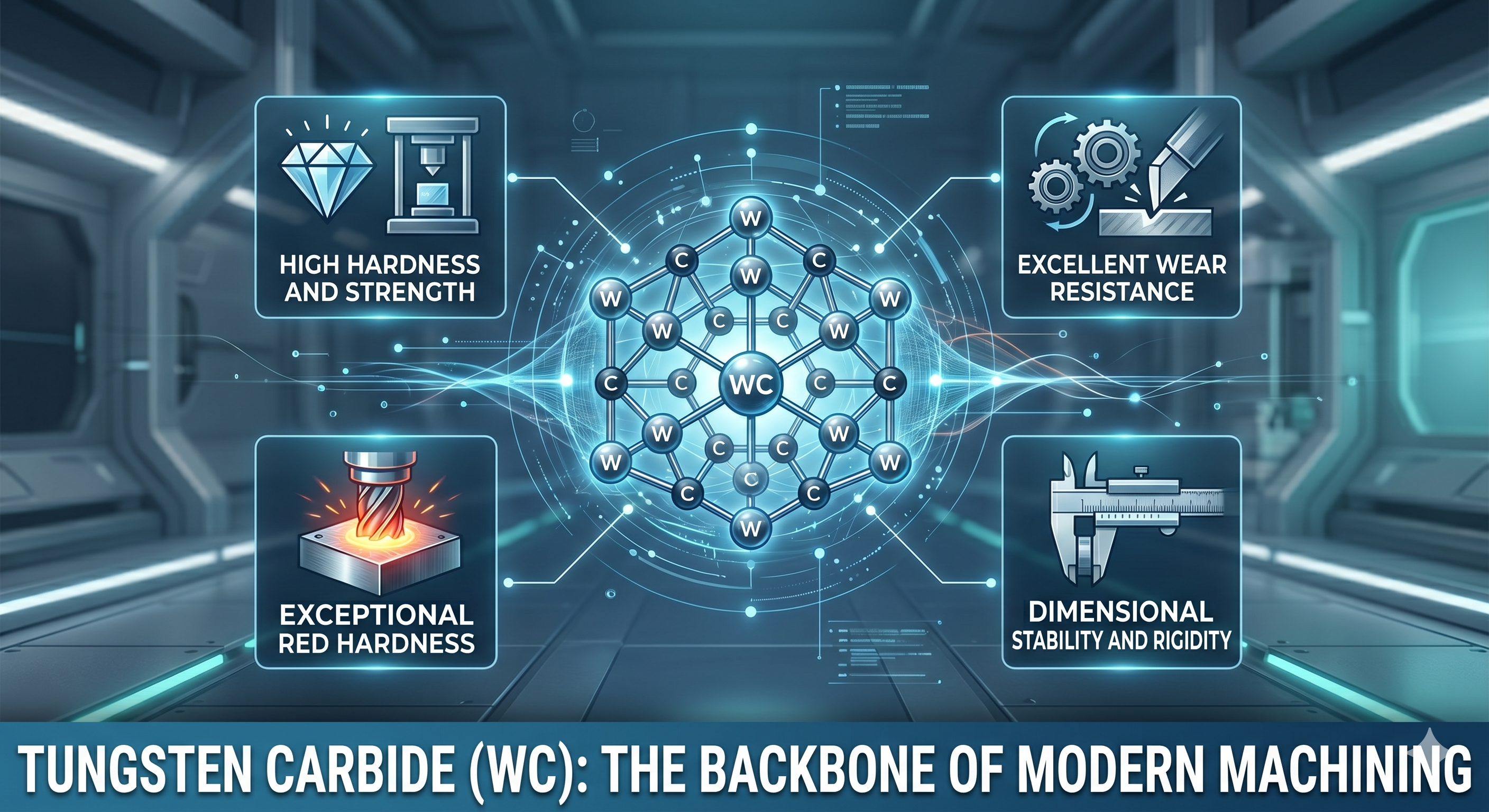
In the high-stakes world of industrial manufacturing, where precision is measured in microns and heat can melt ordinary steel like wax, one material reigns supreme. It isn’t a naturally occurring diamond, nor is it a traditional metal. It is Tungsten Carbide (WC). Often referred to simply as “carbide” in machine shops across the globe, this compound is the silent force behind everything from the engine in your car to the surgical tools used in life-saving operations.
As we navigate the demands of Industry 4.0 and the push for faster, more efficient production, understanding the science, the applications, and the future of Tungsten Carbide is no longer just for metallurgists—it is essential for anyone involved in the modern industrial landscape.
1. The Alchemy of Hardness: What is Tungsten Carbide?
At its core, Tungsten Carbide is a binary compound composed of equal parts tungsten and carbon atoms. In its most basic form, it is a fine grey powder. However, through a process called powder metallurgy, this powder is pressed and “sintered” to create one of the hardest and most durable materials known to man.
The Crystal Structure
Tungsten Carbide exists in a hexagonal structure. This atomic arrangement is what gives it its legendary “hot hardness.” Unlike High-Speed Steel (HSS), which loses its temper and softens when exposed to the extreme friction and heat of high-speed cutting, WC maintains its structural integrity at temperatures exceeding 700°C (1,292°F).
The Binder: The Role of Cobalt
Pure Tungsten Carbide is incredibly hard but also extremely brittle. To make it useful for machining, it is usually “cemented” using a metallic binder, most commonly Cobalt (Co). The cobalt acts as a glue, filling the gaps between the hard WC grains. By adjusting the ratio of WC to Cobalt and the size of the grains (from micronized to nano-sized), engineers can “tune” the material to be either incredibly hard for wear resistance or tougher for high-impact applications.
2. Why It Dominates Modern Machining
Before the widespread adoption of carbide, machining was a slow process. High-Speed Steel tools required constant sharpening and could only run at limited RPMs. The introduction of Tungsten Carbide changed the “backbone” of the factory floor for several key reasons:
-
Superior Cutting Speeds: Carbide tools can operate at speeds 3 to 10 times faster than HSS. This drastically reduces production cycles and labor costs.
-
Edge Retention: A carbide drill or end mill stays sharp significantly longer than steel. This leads to better surface finishes on the final product and fewer tool changes.
-
High Elastic Modulus: WC is roughly three times stiffer than steel. This rigidity is crucial in precision machining, as it prevents the tool from “deflecting” or bending under the heavy pressure of cutting hard metals like titanium or stainless steel.
3. Manufacturing Process: From Powder to Precision
The creation of a Tungsten Carbide tool is a feat of engineering that aligns perfectly with the expertise of advanced chemical procurement.
-
Milling and Mixing: Micronized tungsten powder is mixed with carbon black and cobalt.
-
Compaction: The mixture is placed in a mold and pressed under several tons of pressure to create a “green” body. At this stage, the material has the consistency of a stick of chalk.
-
Sintering: The green body is placed in a vacuum furnace and heated to temperatures between 1,400°C and 1,500°C. At this point, the cobalt melts and flows around the WC grains, shrinking the part by up to 20% and creating a solid, dense, and incredibly hard material.
-
Finishing: Because the material is so hard, it can only be finished using diamond-coated grinding wheels.
4. Current Research and Industrial “Clinical” Trials (2024–2026)
In the metallurgical world, “clinical” trials refer to controlled field tests where new alloys are put through millions of cycles to test for failure. Recent research has focused on three revolutionary areas:
Nano-Structured Carbides
Recent studies in 2025 have shown that by reducing the grain size of the Tungsten Carbide to the nanoscale (below 100 nanometers), the material achieves a rare “dual-win”: it becomes both harder and tougher simultaneously. This is a breakthrough for the aerospace industry, where tools must cut through tough “Inconel” alloys without shattering.
Binderless Tungsten Carbide
There is a growing push for “Binderless WC.” By removing the cobalt entirely and using advanced sintering techniques like Spark Plasma Sintering (SPS), researchers have created tools that are almost as hard as diamond. These are currently being trialed in the production of high-end optical lenses and smartphone glass molds, where even a tiny amount of cobalt binder could react with the glass and cause imperfections.
Additive Manufacturing (3D Printing)
One of the most exciting research fronts is the 3D printing of Tungsten Carbide. Traditionally, you could only make shapes that could be pressed or ground. Now, using “Binder Jetting” technology, complex internal cooling channels can be printed directly into a carbide tool, allowing for better heat management during heavy-duty milling.
5. Advantage vs. Risk Assessment
Like any high-performance material, Tungsten Carbide is a study in trade-offs.
The Advantages (The Pros)
-
Extreme Longevity: In many wear-resistant applications, WC can outlast steel by a ratio of 100 to 1.
-
Chemical Stability: It is highly resistant to corrosion and oxidation, making it suitable for oil and gas drilling in harsh undersea environments.
-
High Density: Its weight (similar to gold) makes it excellent for balancing weights in aerospace and even high-end watch rotors.
The Risks and Limitations (The Cons)
-
Brittleness: While hard, WC does not like “shock.” A dropped carbide tool will often shatter like glass. It requires stable machine setups with minimal vibration.
-
Cost: Tungsten is a “critical raw material.” Its extraction is expensive, and global supply chains can be volatile.
-
Cobalt Sensitivity: In the “clinical” or health sense, long-term exposure to cobalt dust (during the grinding process) can lead to “Hard Metal Lung Disease.” Modern factories must use advanced filtration and wet-grinding systems to mitigate this risk.
6. The Circular Economy: Recycling Tungsten Carbide
As a business owner in the chemical and nanotechnology sector, the sustainability of raw materials is a top priority. Tungsten is not infinite. Fortunately, Tungsten Carbide is one of the most recyclable materials in the world.
Modern recycling processes, such as the Zinc Process, allow for the separation of WC and Cobalt without losing the original properties of the powders. Today, nearly 35–40% of all new carbide tools contain recycled content. This not only reduces the environmental impact of mining but also stabilizes the price for end-users in the automotive and medical sectors.
7. Applications Beyond the Workshop
While machining is its “backbone,” WC is essential in other high-tech fields:
-
Medical: Surgical bone saws and precision dental drills are almost exclusively carbide-tipped for clean, burr-free cuts.
-
Mining: The “teeth” of massive tunnel-boring machines that dig subways are made of large, tough grades of WC.
-
Consumer Goods: From the ball in your ballpoint pen to the studs on winter tires and high-end jewelry (wedding bands), WC is everywhere.
8. Conclusion: The Future is Refined
Tungsten Carbide has earned its title as the backbone of modern machining. Without it, the mass production of the components that define our modern life—smartphones, jet engines, and electric vehicle batteries—would be impossible or prohibitively expensive.
As we move toward 2026 and beyond, the focus is shifting toward smarter carbides. We are seeing the rise of “intelligent tools” where sensors are embedded during the sintering process to monitor wear in real-time. For industries relying on advanced materials, the evolution of Tungsten Carbide represents the perfect marriage of chemistry, physics, and industrial grit.