
Recently added item(s)
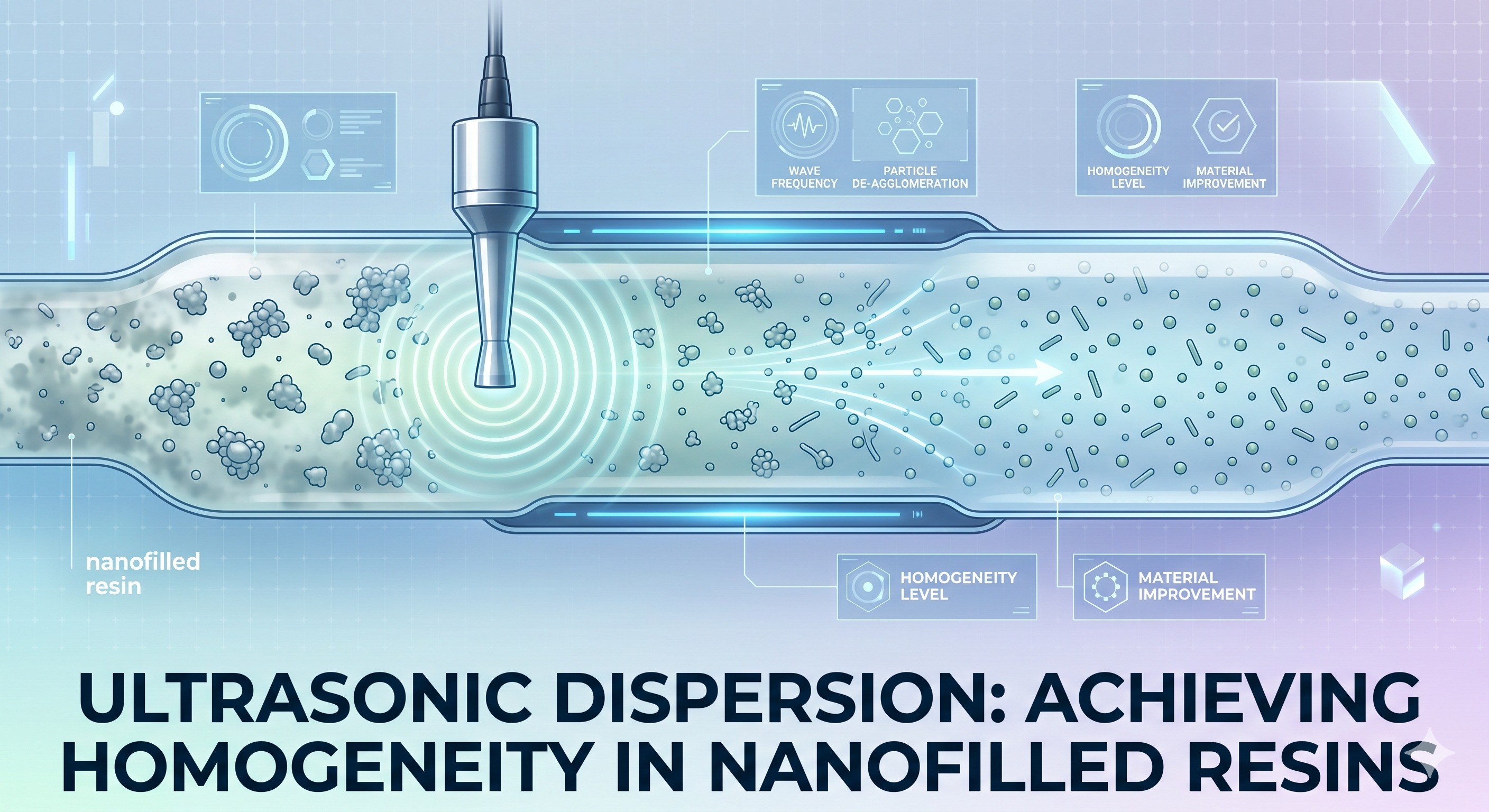
The integration of nanotechnology into polymer science has unlocked a new era of high-performance materials. Nanofilled resins—composites where a resin matrix is reinforced with particles smaller than 100 nanometers—are now essential in industries ranging from aerospace and automotive manufacturing to restorative dentistry and flexible electronics. However, the true potential of these “super-materials” is often hindered by a microscopic enemy: agglomeration.
Because nanoparticles possess an immense surface-area-to-volume ratio, they naturally tend to clump together due to Van der Waals forces. When these particles cluster, they create “weak spots” in the resin, leading to mechanical failure, reduced transparency, and inconsistent chemical properties. To solve this, Ultrasonic Dispersion has emerged as the gold standard for achieving a truly homogeneous mixture.
The Science of Sonication: Understanding Acoustic Cavitation
At the heart of ultrasonic dispersion lies a phenomenon known as acoustic cavitation. When high-frequency sound waves (typically 20 kHz to 100 kHz) are transmitted through a liquid resin, they create alternating high-pressure and low-pressure cycles.
-
Bubble Formation: During the low-pressure cycle, thousands of microscopic vacuum bubbles are formed within the liquid.
-
Growth and Collapse: These bubbles grow until they reach a critical size where they can no longer absorb energy.
-
Implosion: The bubbles collapse violently. This implosion generates localized “hot spots” with temperatures reaching thousands of degrees Kelvin and pressures of several hundred atmospheres—all occurring in microseconds at a microscopic scale.
-
Shear Forces: The collapse produces powerful liquid micro-jets and intense shear forces. These forces are what physically tear apart nanoparticle clusters (agglomerates), ensuring that each individual particle is “wetted” and surrounded by the resin matrix.
Why Homogeneity is Non-Negotiable
Achieving a uniform distribution of fillers like graphene, carbon nanotubes (CNTs), or metal oxides (such as Alumina or Zirconia) is not just a matter of “neatness.” It fundamentally changes how the material performs under stress.
1. Mechanical Strength and Fracture Toughness
In a poorly dispersed resin, clumps of nanoparticles act as “stress concentrators.” When the material is pulled or compressed, cracks originate at these clumps. Conversely, in a homogeneous dispersion, the nanoparticles are evenly spaced, allowing them to effectively bridge micro-cracks and redistribute mechanical loads across the entire matrix.
2. Thermal and Electrical Conductivity
For applications involving conductive resins (like EMI shielding or heat sinks), the nanoparticles must form a “percolation network.” If the particles are clumped, the network is broken, and the resin remains an insulator. Ultrasonic dispersion ensures that the fillers are spread out enough to touch and form continuous paths for electrons or heat to flow.
3. Optical Clarity
In dental resins or protective coatings, maintaining transparency is vital. Agglomerates are often large enough to scatter light, making the resin appear cloudy or opaque. Well-dispersed nanoparticles are smaller than the wavelength of visible light, meaning they remain invisible and the resin stays crystal clear.
Current Research Trends (2024–2026)
Recent studies have moved beyond simple mixing and are now focusing on the optimization of the nano-bio interface and automated process control.
The Rise of “Smart” Sonication
A 2025 study published in Advanced Functional Materials highlighted the use of AI-integrated ultrasonic systems. These systems use real-time acoustic feedback to detect the viscosity changes in the resin as dispersion progresses. By automatically adjusting the amplitude and frequency, these systems prevent “over-sonication,” which can damage the molecular chains of the resin itself.
Graphene and Carbon Nanotube Synergy
Researchers are currently exploring the “hybridization” of fillers. For instance, combining 1D carbon nanotubes with 2D graphene sheets. Research indicates that ultrasonic dispersion is the only viable method to prevent these two distinct geometries from “stacking” and becoming ineffective. Successful dispersion of these hybrids has resulted in resins with a 40% increase in tensile strength compared to single-filler systems.
Clinical Insights: Nanofilled Resins in Medicine and Dentistry
The most immediate impact of ultrasonic dispersion is felt in the clinical world, particularly in Restorative Dentistry and Orthopedic Implants.
Dental Nanocomposites
Clinical trials conducted in late 2025 have shown that dental fillings created with ultrasonically dispersed zirconia nanoparticles exhibit a 25% lower wear rate over three years. Because the particles are perfectly distributed, the “polishing” effect of chewing happens at a molecular level, maintaining a smooth surface that prevents bacterial adhesion and secondary cavities.
Bio-Active Bone Cements
In orthopedics, resins used to anchor joint replacements are being infused with hydroxyapatite nanoparticles. Clinical studies indicate that when these particles are homogeneously dispersed via sonication, they promote faster “osseointegration” (the bond between bone and implant), significantly reducing the recovery time for hip and knee replacement patients.
Advantage vs. Risk Assessment
While ultrasonic dispersion is powerful, it is not without its challenges. A balanced approach is necessary for industrial and lab safety.
| Feature | Advantages | Risks & Mitigation |
| Dispersion Quality | Achieves true de-agglomeration down to the primary particle size. | Risk: Over-processing can break polymer chains. Mitigation: Use pulsed sonication. |
| Speed | Significantly faster than magnetic stirring or high-shear mixing. | Risk: Rapid heat buildup. Mitigation: Use water-cooled jackets during the process. |
| Scalability | Can be used for small lab samples or high-volume flow-through systems. | Risk: Noise pollution and aerosolization. Mitigation: Enclosed acoustic chambers and HEPA filtration. |
| Versatility | Works with high-viscosity resins and various filler types. | Risk: Probe erosion (titanium particles entering the mix). Mitigation: Regular probe maintenance and use of ceramic tips. |
Strategic Parameters for Successful Dispersion
To achieve the best results, three variables must be carefully managed:
-
Amplitude: This is the “intensity” of the vibration. High-density fillers (like tungsten carbide) require higher amplitudes, while sensitive organic fillers require a gentler touch.
-
Frequency: Most resins respond best to 20 kHz. However, for ultra-fine nanoparticles (sub-10nm), higher frequencies may be more effective at inducing the necessary cavitation.
-
Temperature Control: Cavitation generates heat. Since resins are often thermally sensitive, the process should be performed in a cooling bath or using a “pulse” mode (e.g., 10 seconds on, 5 seconds off) to maintain a stable environment.
The Future of Industrial Resins: 2026 and Beyond
As we look toward the end of the decade, the focus is shifting toward continuous flow sonication. Instead of processing resin in “batches,” industrial facilities are implementing flow-through cells where the resin is ultrasonically treated as it moves through a pipe. This allows for the production of thousands of liters of nanofilled resin per day with total consistency.
Furthermore, the development of “self-healing” resins—which contain nanocapsules of repair agent—relies entirely on ultrasonic dispersion. If the capsules are clumped, the self-healing mechanism fails. Proper dispersion ensures that these capsules are “on standby” throughout the entire material, ready to pop and repair micro-cracks as they appear.
Conclusion
Ultrasonic dispersion is the bridge between the theoretical benefits of nanotechnology and the practical reality of high-performance manufacturing. By harnessing the power of acoustic cavitation, we can overcome the natural tendency of nanoparticles to aggregate, creating resins that are stronger, clearer, and more functional than ever before. Whether you are developing the next generation of aerospace composites or a more durable dental filling, the homogeneity provided by sonication is the key to unlocking true material potential.