
Recently added item(s)
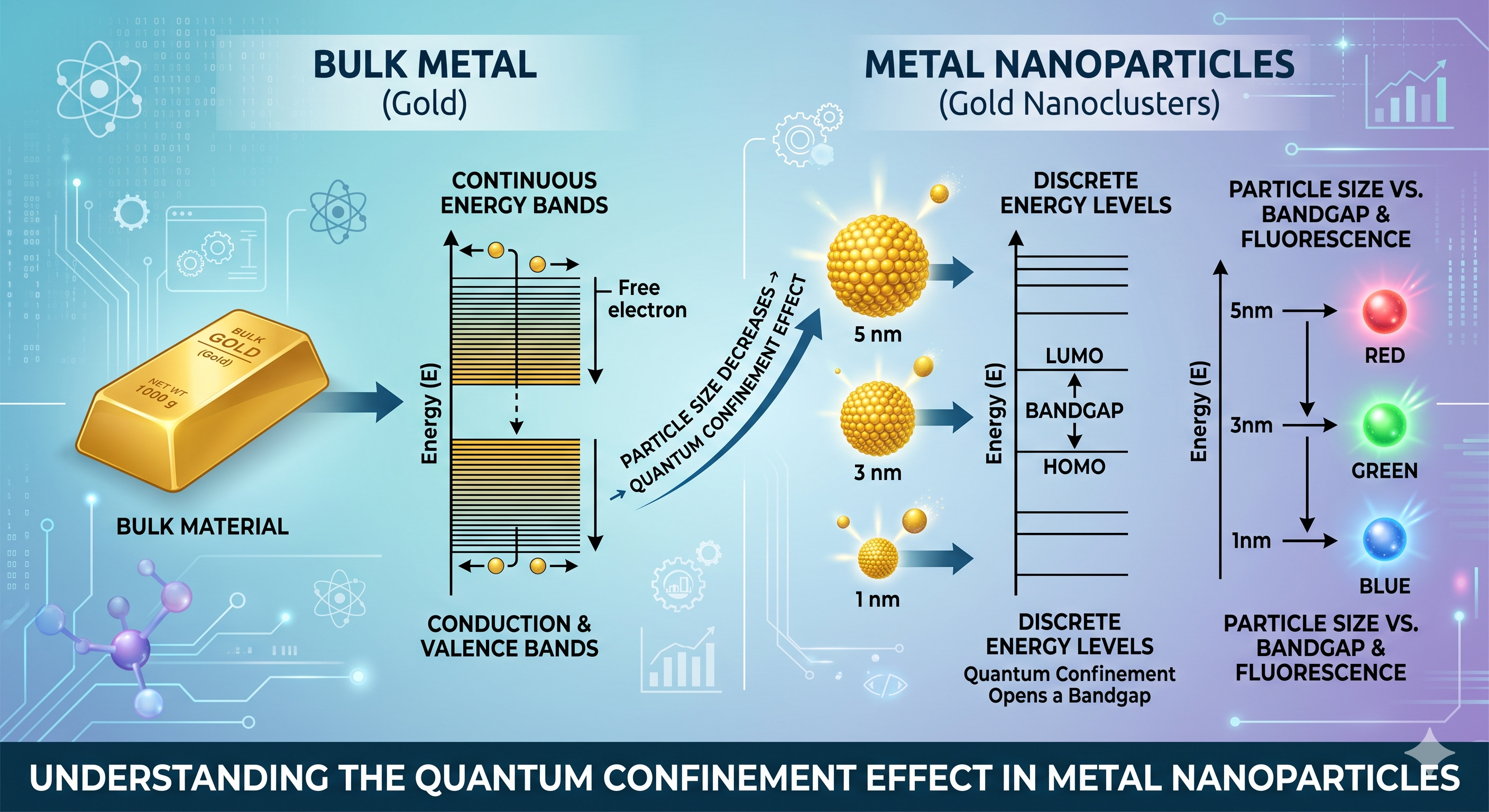
When we look at the physical world around us, we expect matter to behave in predictable ways. A block of iron is hard, conductive, and magnetic; a piece of gold is shiny, inert, and yellowish. For centuries, our understanding of materials science was rooted in these bulk properties. However, as modern technology has allowed us to slice matter into infinitesimally small pieces, we have discovered a realm where the classical laws of physics begin to break down, giving way to the strange and fascinating rules of quantum mechanics.
At the frontier of this microscopic revolution are metal nanoparticles, and the most profound phenomenon governing their behavior is the Quantum Confinement Effect. When a metal is reduced to just a few dozen or hundred atoms, it ceases to behave like a metal at all. In this comprehensive guide, we will explore the science behind quantum confinement in metal nanoparticles, examine groundbreaking current research, delve into clinical medical studies, and provide a critical advantage-risk assessment of this transformative technology.
The Science of Shrinking: What is Quantum Confinement?
To understand quantum confinement, we must first look at how electrons behave in standard, bulk metals. In a regular piece of copper or silver, billions of atoms share their outermost electrons. These electrons are not tethered to any single atom; they flow freely in a vast, continuous “sea” or “band” of energy. Because these energy levels are continuous, electrons can absorb and emit almost any wavelength of energy, which is why metals conduct electricity so well and reflect light to create a shiny, mirror-like surface.
However, when you shrink that piece of metal down to a size smaller than the natural wavelength of its electrons (typically under 2 to 3 nanometers, often referred to as metal nanoclusters), a radical shift occurs.
Imagine electrons as energetic children running freely across a massive open field. They can move anywhere and possess any amount of kinetic energy they desire. Now, imagine taking those same children and placing them inside a very small, walled room. Their movement is suddenly restricted. In quantum physics, this “room” is the physical boundary of the tiny nanoparticle.
Because the electrons are confined to a space smaller than their natural wave-like spread, their energy levels can no longer form a continuous sea. Instead, the energy band splinters into distinct, separated steps or “discrete energy levels.” Think of it as transforming a smooth ramp into a steep staircase. An electron can stand on one step or the next, but it cannot exist in the empty air between the steps. This gap between the highest occupied energy level and the lowest unoccupied energy level is known as a bandgap.
When this bandgap opens up, the metal fundamentally changes its identity. It loses its traditional metallic properties—such as standard electrical conductivity and bulk reflectivity—and begins to act more like a semiconductor or even a single, giant molecule.
When Metals Stop Behaving Like Metals
The transition from continuous bands to discrete energy staircases unlocks a host of unique physical and chemical properties that scientists are heavily exploiting today.
-
Fluorescence and Optical Tuning: While slightly larger metal nanoparticles (like 10-50 nanometers) interact with light via Surface Plasmon Resonance (absorbing and scattering specific colors), ultra-small, quantum-confined metal nanoclusters do something entirely different: they fluoresce. When light hits these discrete energy levels, an electron jumps up a “stair” and then falls back down, emitting a highly specific color of light. By simply adding or removing a single atom from the nanocluster, scientists can change the size of the “staircase,” precisely tuning the emitted light from bright blue to deep red.
-
Hyper-Catalytic Activity: In chemistry, a catalyst speeds up a reaction by providing a favorable surface for molecules to interact. Because quantum-confined metal nanoparticles have distinct, high-energy electron states and massive surface areas, they become incredibly eager to share or accept electrons from other molecules. Materials that are completely unreactive in their bulk form suddenly become aggressive catalysts when reduced to quantum-confined nanoclusters.
Current Research and Industrial Breakthroughs
The industrial implications of quantum confinement are reshaping how we approach manufacturing, chemistry, and energy storage.
Advanced Powder Metallurgy and Sintering
In the realm of advanced industrial manufacturing, transitioning from standard metal powders to nanoscale powders dramatically alters processing dynamics. For instance, when high-energy ball milling is used to reduce metal powders down to standard microscopic sizes (such as 44 microns), the material retains its bulk properties. However, when advanced synthesis pushes these particles into the quantum-confined nanoscale, their thermodynamic stability plummets.
Because of the altered electron states, these quantum-confined metal powders exhibit drastically lowered melting and sintering temperatures. Current research is highly focused on utilizing these ultra-fine metallic powders to create highly complex, sintered alloys and composites at fractions of the traditional energy cost, allowing for the creation of incredibly strong, lightweight materials used in aerospace and next-generation automotive frames.
Next-Generation Energy Catalysts
As the world pivots away from fossil fuels, the hydrogen economy is heavily reliant on efficient catalysts to split water into hydrogen and oxygen. Traditionally, platinum has been the go-to metal for this job, but it is prohibitively expensive. Researchers are currently using the quantum confinement effect to engineer ultra-small clusters of cheaper transition metals. By tuning the discrete energy levels of these non-precious metals, scientists are creating synthetic catalysts that mimic or even surpass the efficiency of bulk platinum, paving the way for affordable hydrogen fuel cells and advanced battery chemistries.
Clinical Studies and Biomedical Miracles
The unique physical properties born from quantum confinement are exceptionally well-suited for biological applications. Because these ultra-small metal nanoclusters are less than 3 nanometers in diameter, they are comparable in size to single proteins and DNA strands, allowing them to navigate the human body in unprecedented ways.
Ultra-Precise Bio-Imaging
Historically, the medical field has relied on toxic chemical dyes or larger, potentially dangerous semiconductor quantum dots for cellular imaging. Today, clinical researchers are turning to highly biocompatible, quantum-confined gold and silver nanoclusters.
Because these metal nanoclusters fluoresce brilliantly under specific lights due to their discrete energy gaps, they act as perfect molecular flashlights. In recent clinical studies, researchers have attached these glowing gold nanoclusters to tumor-seeking antibodies. When injected into a patient, the nanoclusters hunt down and bind to cancer cells. Under a specialized scanner, the tumor glows intensely, allowing surgeons to see the exact margins of the cancerous tissue down to the cellular level. Crucially, because these clusters are under 5 nanometers, they bypass the liver and are easily cleared by the human kidneys, effectively solving the bio-persistence problem that plagues larger nanoparticles.
Targeted Antibacterial and Therapeutic Agents
Beyond imaging, the discrete electron states of quantum-confined metals make them highly reactive with biological molecules. Clinical trials are currently investigating ultra-small silver nanoclusters as a weapon against antibiotic-resistant bacteria. The altered electron configuration of the confined silver atoms allows them to efficiently produce reactive oxygen species (ROS) when they encounter bacterial cell walls. This localized oxidative burst destroys the bacteria’s membrane and DNA without harming the surrounding healthy human tissue, offering a vital new tool in the fight against superbugs.
Advantage-Risk Assessment: The Double-Edged Sword of Confinement
Harnessing the power of quantum mechanics in metal nanoparticles requires a delicate balancing act. The very physics that make these materials so useful also introduce highly specific engineering and safety challenges.
The Advantages
-
Tunable Precision: The ability to literally engineer the energy states of a metal by adding or removing single atoms provides unprecedented control over optical, electrical, and chemical properties.
-
Unmatched Catalytic Efficiency: Quantum-confined metals offer the highest possible ratio of reactive surface atoms to interior atoms, meaning complex chemical reactions (like water splitting or industrial chemical synthesis) can be achieved using vastly smaller amounts of raw material.
-
Enhanced Biocompatibility: Unlike traditional heavy-metal semiconductor quantum dots, ultra-small nanoclusters made from noble metals like gold are highly tolerated by the human body and small enough to be excreted naturally, revolutionizing diagnostic imaging.
The Risks and Challenges
-
Extreme Thermal Oxidation and Combustion Risks: The most significant danger in handling quantum-confined metal nanoparticles is their extreme reactivity. Because their electrons are in highly energetic, discrete states, these tiny particles are desperately seeking chemical stability. If hyper-reactive metal powders are exposed to ambient oxygen or moisture without stringent environmental controls, they undergo rapid thermal oxidation. This can instantly generate massive amounts of heat, leading to spontaneous combustion or explosive dust reactions during the manufacturing and storage processes.
-
Agglomeration and Stability: The universe naturally wants to reduce high energy states. Consequently, quantum-confined nanoclusters desperately want to stick together (agglomerate) to form larger, more stable bulk metals. Preventing this requires complex chemical “capping” agents to coat the particles, adding significant difficulty and cost to the synthesis process.
-
Unknown Long-Term Biological Impact: While ultra-small clusters can be cleared by the kidneys, the intermediate breakdown products or the effects of chronic exposure to aerosolized metal nanoclusters on lung tissue are still the subject of intensive toxicological research. Their ability to easily cross the blood-brain barrier demands extreme caution in both industrial handling and medical application.
Conclusion
The quantum confinement effect in metal nanoparticles represents a breathtaking bridge between abstract quantum physics and tangible, real-world technology. By forcing electrons into spaces so small that their fundamental behavior changes, we are essentially rewriting the periodic table—turning inert gold into brilliant fluorescent markers, and transforming standard metal powders into hyper-efficient, energy-saving catalysts.
As research continues to accelerate from the laboratory to industrial production floors and clinical trial phases, the potential to solve critical challenges in renewable energy, heavy manufacturing, and oncology is immense. However, unlocking the quantum realm requires an absolute respect for the physical forces at play. Managing the severe risks of thermal oxidation and ensuring long-term biological safety will be the defining challenges of this era. As we master the art of the invisibly small, quantum-confined metals are poised to illuminate the future of materials science.