
Recently added item(s)
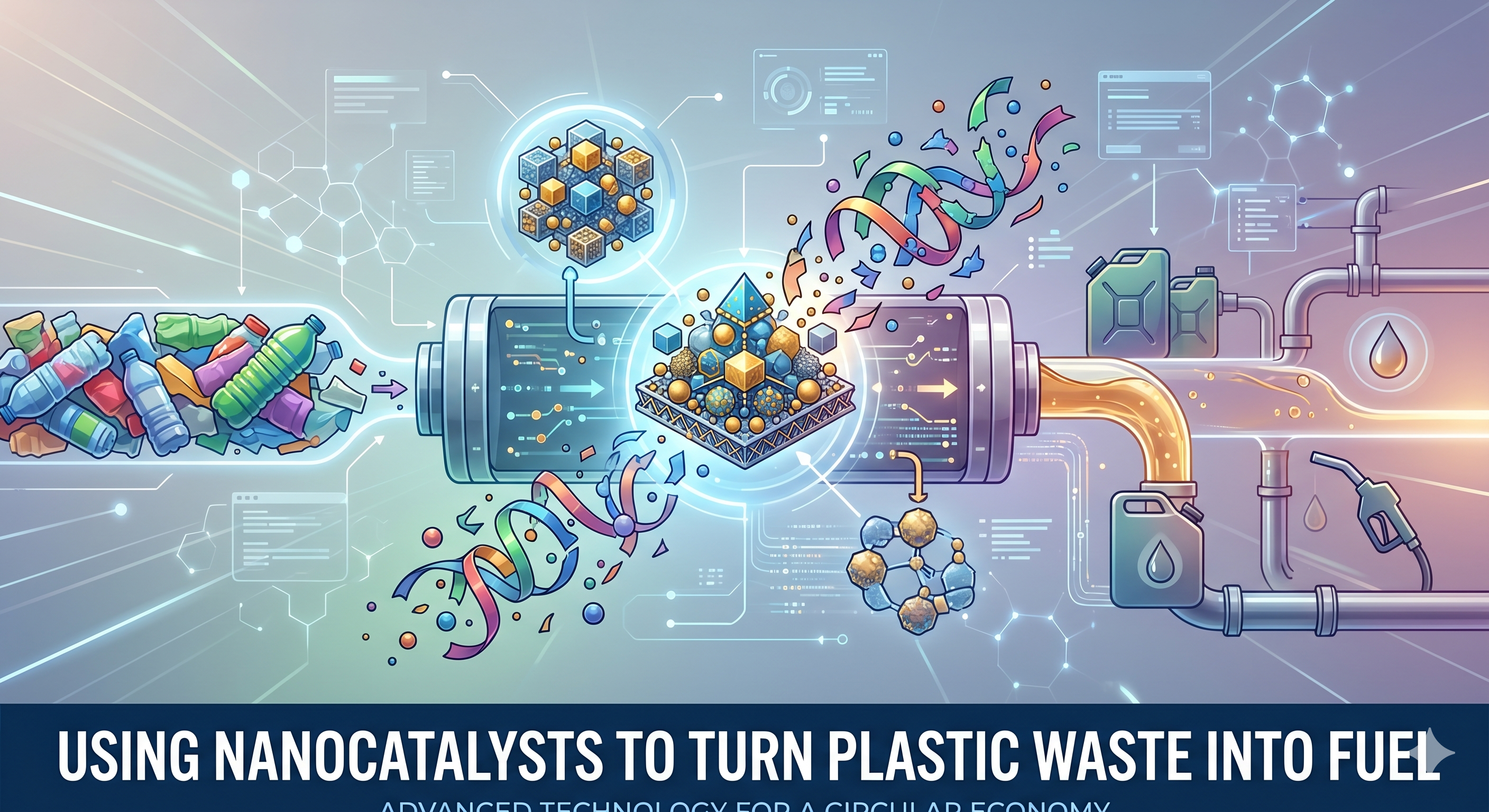
The world is currently drowning in a sea of synthetic polymers. Since the 1950s, humanity has produced over 8 billion tons of plastic, and a staggering 90% of it has never been recycled. While traditional mechanical recycling—chopping plastic up and melting it down—has its place, it often results in “downcycling,” where the material loses quality and eventually ends up in a landfill anyway.
Enter the world of nanotechnology. By operating at the atomic and molecular levels, scientists are now developing nanocatalysts that can dismantle the sturdy carbon chains of plastic waste and reassemble them into high-quality liquid fuels. This isn’t just recycling; it’s chemical upcycling. It represents a pivot toward a truly circular economy where “waste” becomes a strategic resource.
The Invisible Workforce: What Are Nanocatalysts?
At its core, a catalyst is a substance that speeds up a chemical reaction without being consumed by it. In the context of plastic-to-fuel conversion, catalysts are used to break the incredibly strong carbon-carbon bonds that make plastics so durable (and so environmentally problematic).
Nanocatalysts take this a step further. Because they are engineered at the nanoscale (1 to 100 nanometers), they possess an incredibly high surface-area-to-volume ratio. Imagine the difference between trying to dissolve a large sugar cube versus a spoonful of fine powdered sugar; the powder reacts much faster because more of it is in contact with the liquid. In the same way, nanocatalysts provide a massive amount of “active sites” where plastic molecules can be broken down efficiently.
These catalysts can be tailored with surgical precision. By adjusting their size, shape, and chemical composition, researchers can “program” them to produce specific types of fuel, such as high-octane gasoline, diesel, or even aviation kerosene.
The Chemical Alchemy: How the Conversion Works
Turning a plastic bottle into diesel fuel involves several complex processes, but the most common method assisted by nanotechnology is Catalytic Pyrolysis.
1. Pyrolysis: The Foundation
Pyrolysis is the thermal decomposition of materials at high temperatures in an oxygen-free environment. Without oxygen, the plastic doesn’t burn; instead, the heat causes the long-chain polymers to vibrate so violently that they snap into smaller hydrocarbon chains.
2. The Role of the Nanocatalyst
Without a catalyst, pyrolysis requires extreme temperatures—often exceeding 500°C to 700°C—and produces a messy “pyrolysis oil” that contains many impurities. When we introduce nanocatalysts into the mix:
-
Lower Energy Threshold: The reaction can happen at much lower temperatures (sometimes under 300°C), significantly reducing energy costs.
-
Selectivity: The nanocatalyst acts like a pair of chemical scissors, cutting the chains at specific lengths. This ensures that the end product is a high-grade fuel rather than a low-value sludge.
-
Contaminant Removal: Advanced nanocatalysts can simultaneously “scrub” the reaction, removing chlorine or sulfur that might be present in mixed plastic waste.
Recent Breakthroughs and Current Research
The field of nanocatalysis is moving at a breakneck pace. Several high-profile studies have recently demonstrated that we are on the cusp of a commercial breakthrough.
The “Single-Atom” Catalyst Innovation
Researchers at various institutions, including recent work published in Nature Communications, have been experimenting with single-atom catalysts (SACs). By dispersing individual metal atoms (like Platinum or Ruthenium) onto a carbon or metal-oxide support, they have achieved nearly 100% efficiency in converting polyethylene—the most common plastic used in grocery bags—into liquid lubricants or fuels.
Rutgers University and the “Low-Temp” Miracle
A team at Rutgers University developed a unique catalyst based on a combination of iridium and a specialized support material. Their research showed that they could break down polyolefins (the plastic found in everything from food packaging to car parts) into high-quality liquid fuel at temperatures as low as 225°C. This is a game-changer for industrial scalability, as it drastically lowers the “energy debt” of the recycling process.
NTU Singapore: From Plastic to Hydrogen
Beyond liquid fuels, Nanyang Technological University (NTU) in Singapore has made strides in using nanocatalysts to turn plastic waste into hydrogen fuel. By using a light-driven nanocatalyst (photocatalysis), they can break down plastics in water at room temperature to release hydrogen, which is widely considered the “fuel of the future” for zero-emission transportation.
The Leading Contenders: Types of Nanocatalysts
Not all nanocatalysts are created equal. Depending on the target plastic and the desired fuel, different materials are employed:
-
Zeolites: These are porous aluminosilicate minerals. At the nanoscale, zeolites act as molecular sieves. Their tiny pores allow only certain molecules to enter and exit, giving scientists incredible control over the “octane rating” of the resulting fuel.
-
Carbon Nanotubes (CNTs): Due to their exceptional thermal conductivity and strength, CNTs are often used as supports for metal catalysts, ensuring that heat is distributed evenly throughout the plastic mass.
-
Metal-Organic Frameworks (MOFs): These are “designer” structures that can be customized to have the highest surface area of any known material. They are currently being tested for their ability to capture and convert CO2 emissions during the plastic-to-fuel process, making the cycle even greener.
-
Bimetallic Nanoparticles: By combining two metals (like Nickel and Cobalt) at the nanoscale, researchers create a “synergistic effect” where the catalyst is more resistant to “poisoning” (becoming clogged by impurities in the plastic).
Advantage–Risk Evaluation
While the technology sounds like a panacea for the plastic crisis, a balanced view is essential for industry professionals and investors.
The Advantages
-
Economic Viability: It turns a liability (waste) into a high-value commodity (fuel). As oil prices fluctuate, having a localized source of fuel derived from trash provides significant energy security.
-
Environmental Impact: It keeps plastics out of oceans and landfills. Furthermore, the fuels produced often have lower sulfur content than traditional crude oil-derived fuels.
-
Space Efficiency: Unlike mechanical recycling plants that require massive sorting facilities, nanocatalytic plants can be more compact and modular, potentially allowing for “localized” waste processing.
The Risks and Challenges
-
Catalyst Poisoning: Mixed plastic waste often contains food scraps, paper labels, and dyes. These impurities can coat the surface of the nanocatalyst, rendering it useless (a process called “deactivation”).
-
High Initial Capex: Engineering nanocatalysts requires sophisticated equipment and high-purity raw materials, making the initial setup cost of these plants higher than traditional waste management.
-
Scaling Issues: While the technology works beautifully in a 5-liter laboratory reactor, maintaining the same precision in a 5,000-liter industrial tank is a significant engineering hurdle.
-
Emissions Management: If not managed correctly, the pyrolysis process can release volatile organic compounds (VOCs). Sophisticated filtration and carbon capture are necessary to ensure the plant itself remains “green.”
The Industrial Outlook: Scaling for the Future
We are currently moving from the “Proof of Concept” phase to “Pilot Plant” operations. Companies globally are looking at how to integrate these nanocatalytic reactors into existing petrochemical infrastructure.
One promising strategy is “Co-processing,” where pyrolysis oil derived from plastic waste is mixed with traditional crude oil in existing refineries. This allows for a gradual transition to circular feedstocks without requiring a total overhaul of the world’s energy grid.
Furthermore, the integration of AI and Machine Learning is helping scientists discover new nanocatalyst compositions faster than ever before. Instead of years of trial and error in the lab, AI can simulate how different nanostructures will interact with different types of plastic, shortening the R&D cycle from years to months.
Conclusion
The transition from a “take-make-waste” society to a circular one is perhaps the greatest challenge of the 21st century. Nanocatalysis offers a bridge between these two worlds. By utilizing the unique properties of matter at the smallest scales, we can solve one of our largest environmental problems.
Turning plastic into fuel is not just a scientific curiosity; it is a technical necessity. As the efficiency of nanocatalysts continues to rise and the cost of production falls, the day is coming when the plastic in your recycling bin will be seen as a “barrel of oil” waiting to be unlocked.