
Recently added item(s)
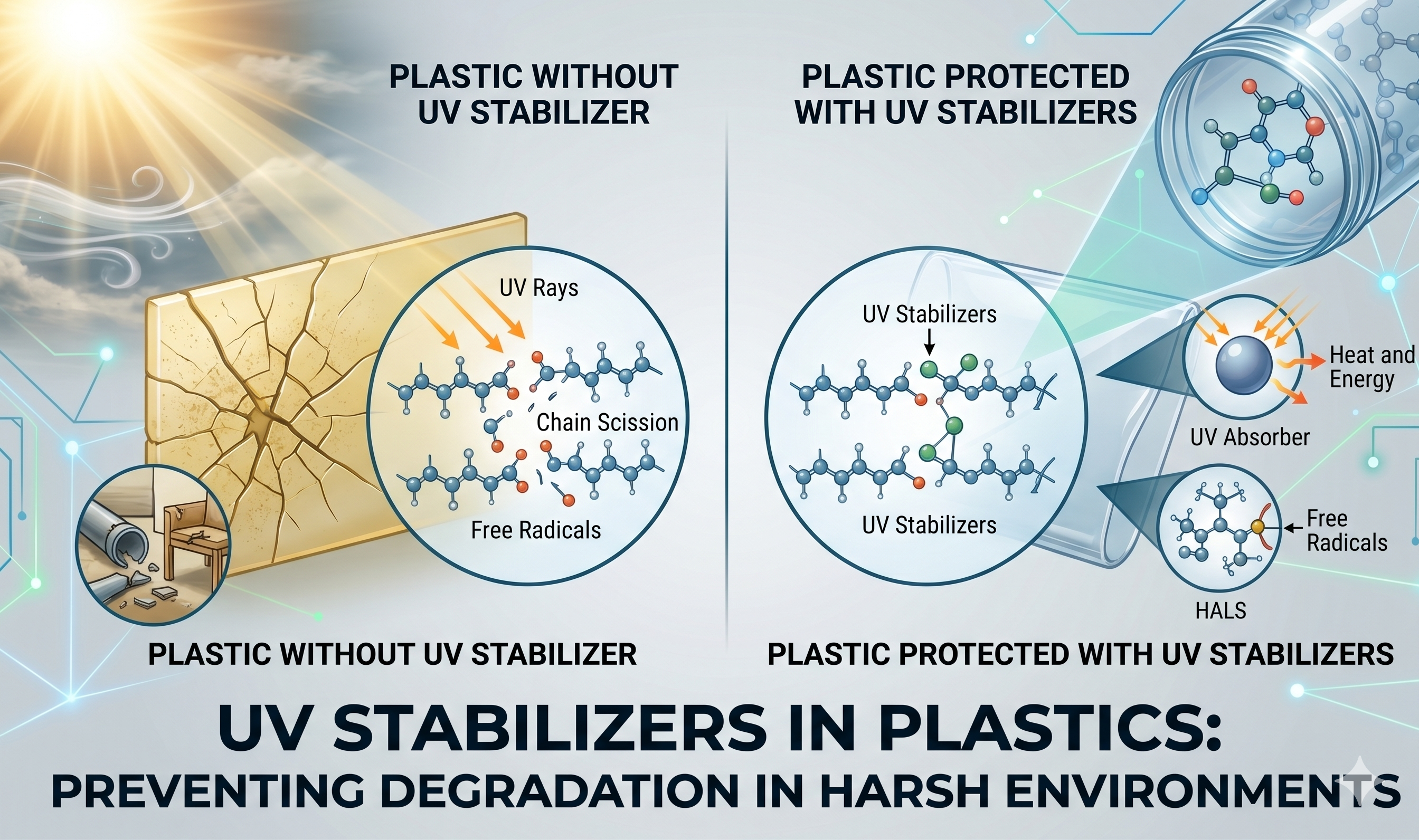
The modern world is built on polymers. From the soaring blades of wind turbines and the intricate irrigation systems of industrial farms to the sleek components of electric vehicles and the protective coatings of aerospace technology, plastics are everywhere. However, these versatile materials face a relentless, invisible enemy: Ultraviolet (UV) radiation. Without intervention, UV light acts as a catalyst for destruction, turning durable structures into brittle, discolored, and ultimately failing fragments.
In harsh environments—characterized by high solar intensity, extreme temperatures, and corrosive conditions—the stakes are even higher. This article explores the science behind UV degradation, the innovative chemical shields known as UV stabilizers, and the cutting-edge research ensuring that the plastics of tomorrow can withstand the most punishing conditions on Earth.
1. The Invisible Enemy: Understanding Photodegradation
To understand why UV stabilizers are necessary, we must first understand the process of photodegradation. When plastics are exposed to sunlight, they absorb photons, particularly those in the UV spectrum ($290$ to $400$ nanometers). While this range makes up only a small fraction of total sunlight, it carries enough energy to break the chemical bonds within polymer chains.
The Mechanism of Destruction
The process typically begins through a series of radical reactions. When a polymer like polypropylene (PP) or polyethylene (PE) absorbs UV light, it triggers chain scission. This creates “free radicals”—highly reactive molecules with unpaired electrons. These radicals quickly react with atmospheric oxygen to form hydroperoxides.
These hydroperoxides further decompose, creating even more radicals in a self-perpetuating cycle known as autoxidation. The physical results are unmistakable:
-
Chalking: A powdery white residue on the surface.
-
Discoloration: Yellowing or fading of pigments.
-
Loss of Mechanical Properties: Brittleness, cracking, and a significant drop in tensile strength.
2. The Mechanics of Protection: Types of UV Stabilizers
To combat this decay, material scientists employ “chemical sunscreens” known as UV stabilizers. These additives are generally categorized into four primary groups, each utilizing a different mechanism to neutralize the threat of UV radiation.
A. UV Absorbers (UVAs)
UV absorbers are the most common type of stabilizer. They function by competing with the polymer for UV light. They absorb the harmful radiation and convert it into harmless thermal energy (heat), which is then dissipated through the plastic.
-
Common Chemistries: Benzotriazoles, Benzophenones, and Cyanoacrylates.
-
Best Use: Effective for protecting the bulk of thick plastic parts and coatings.
B. Quenchers
Unlike absorbers, quenchers do not compete for the light itself. Instead, they “quench” the excited state of the polymer molecules before the chemical bonds can break. They take the excess energy from the polymer and release it as heat or long-wavelength radiation.
-
Note: Many quenchers contain nickel-based compounds, which are highly effective but are increasingly being replaced due to environmental and color considerations.
C. Hindered Amine Light Stabilizers (HALS)
HALS are arguably the most revolutionary development in polymer stabilization. They do not absorb UV radiation. Instead, they act as radical scavengers. Once a free radical is formed by UV light, HALS neutralizes it, stopping the autoxidation cycle in its tracks.
-
The Regenerative Advantage: One of the most significant benefits of HALS is that they are not consumed in the process. They undergo a complex chemical cycle that allows them to be regenerated, providing long-term protection even in extremely thin films or fibers.
D. Screeners and Pigments
These are physical barriers. Pigments like Carbon Black or Titanium Dioxide ($TiO2$) reflect or absorb UV light before it can reach the polymer matrix.
-
Carbon Black: Remains one of the most effective UV stabilizers for outdoor applications (like cable jacketing) because it provides a near-total block of UV rays, though it limits the product to black color.
3. Plastics in Harsh Environments: The Ultimate Test
Standard stabilizers might work for a garden chair in a temperate climate, but “harsh environments” demand more sophisticated chemistry.
Marine and Coastal Regions
In marine environments, UV radiation is intensified by reflection off the water. Furthermore, the presence of salt spray can catalyze degradation. Modern research has focused on synergistic blends—combining UVAs and HALS—to ensure that marine-grade plastics (like those used in hulls or buoys) maintain structural integrity against both light and salinity.
High-Altitude and Aerospace
At high altitudes, the atmosphere is thinner, and UV intensity is significantly higher. Aerospace components face rapid temperature fluctuations alongside intense radiation. Here, researchers are utilizing high-molecular-weight HALS, which have lower volatility, ensuring the stabilizer doesn’t migrate out of the plastic when exposed to the vacuum of space or high-altitude heat.
Solar Energy Infrastructure
The solar industry relies heavily on polymers for backsheets and encapsulants. Since these materials are designed to be in the sun for 25+ years, the demand for “ultra-stabilization” is paramount. Any degradation in the polymer layer can lead to moisture ingress, causing the entire solar panel to fail.
4. Current Research and Innovations
The field of UV stabilization is currently undergoing a “Green Revolution” and a “Nano-Transition.”
Bio-Based and Sustainable Stabilizers
Traditional stabilizers are often derived from petroleum and can pose toxicity risks during manufacturing. Recent clinical and laboratory studies have explored the use of Lignin—a natural polymer found in wood—as a UV stabilizer. Lignin possesses natural phenolic structures that mimic commercial UV absorbers. Research published in 2024 suggests that modified lignin can replace up to 50% of synthetic stabilizers in certain packaging applications without losing performance.
The Role of Nanotechnology
Nanomaterials are opening new doors. Carbon nanotubes ($CNTs$) and graphene-based additives are being studied for their “multi-functional” properties. Not only do they provide incredible mechanical reinforcement, but they also act as highly efficient UV screeners.
-
Nano-Synergy: Studies have shown that adding just 0.5% of specific metal-oxide nanoparticles can enhance the effectiveness of HALS by 40%, creating a secondary layer of protection at the molecular level.
Smart Coatings
Innovative “self-healing” UV stabilizers are in development. These materials contain micro-capsules that rupture when a crack begins to form due to UV stress, releasing fresh stabilizing agents into the affected area to halt further degradation.
5. Advantage vs. Risk: A Critical Assessment
While UV stabilizers are essential, they are not without trade-offs.
Advantages:
-
Longevity: Extends the lifespan of plastic products from months to decades.
-
Safety: Prevents structural failure in critical infrastructure like bridges (fiber-reinforced polymers) and automotive safety parts.
-
Sustainability: By making plastics last longer, we reduce the frequency of replacement and the total volume of plastic waste generated.
Risks and Challenges:
-
Migration and Leaching: Over time, low-molecular-weight stabilizers can “bloom” or migrate to the surface of the plastic. This can lead to the stabilizer leaching into the environment or coming into contact with food in packaging applications.
-
Toxicity: Certain older classes of stabilizers, particularly some benzotriazoles, have come under regulatory scrutiny for being persistent in the environment and potentially acting as endocrine disruptors in aquatic life.
-
Recycling Interference: When different stabilized plastics are mixed during recycling, the chemical additives can sometimes react, leading to “gels” or inconsistencies in the recycled resin.
6. Selection Criteria: Choosing the Right Shield
Selecting the right UV stabilizer is a complex engineering task. It depends on:
-
Polymer Type: PP and PE are highly UV-sensitive, while polymers like Fluoropolymers are naturally UV-resistant.
-
Geometry: Thin films require HALS because they don’t depend on thickness to be effective. Thick parts benefit from UV absorbers.
-
End-Use Temperature: If the plastic will be used in an engine bay, the stabilizer must have high thermal stability.
-
Color Requirements: If transparency is needed, Carbon Black is off the table, and high-performance Benzotriazoles are preferred.
7. The Future: Circularity and Stability
As the world moves toward a circular economy, the role of UV stabilizers is shifting. We are no longer just looking for “long life”; we are looking for “reusable life.” Future research is focusing on stabilizers that can survive the recycling process, ensuring that a plastic bottle can be turned into a car part without losing its UV resistance.
The integration of AI in materials science—the creation of “Digital Twins” for polymer formulations—is accelerating this process. By simulating years of UV exposure in a digital environment, researchers can identify the perfect “cocktail” of stabilizers for any specific harsh environment in a fraction of the time.
Conclusion
UV stabilizers are the unsung heroes of the materials world. They allow us to harness the benefits of plastics in the most extreme corners of our planet. From the bottom of the ocean to the edge of our atmosphere, these chemical guardians ensure that our infrastructure remains strong, our energy systems remain efficient, and our technology remains durable. As we move toward bio-based and nano-enhanced solutions, the “shield” protecting our modern world is only getting stronger.