
Recently added item(s)
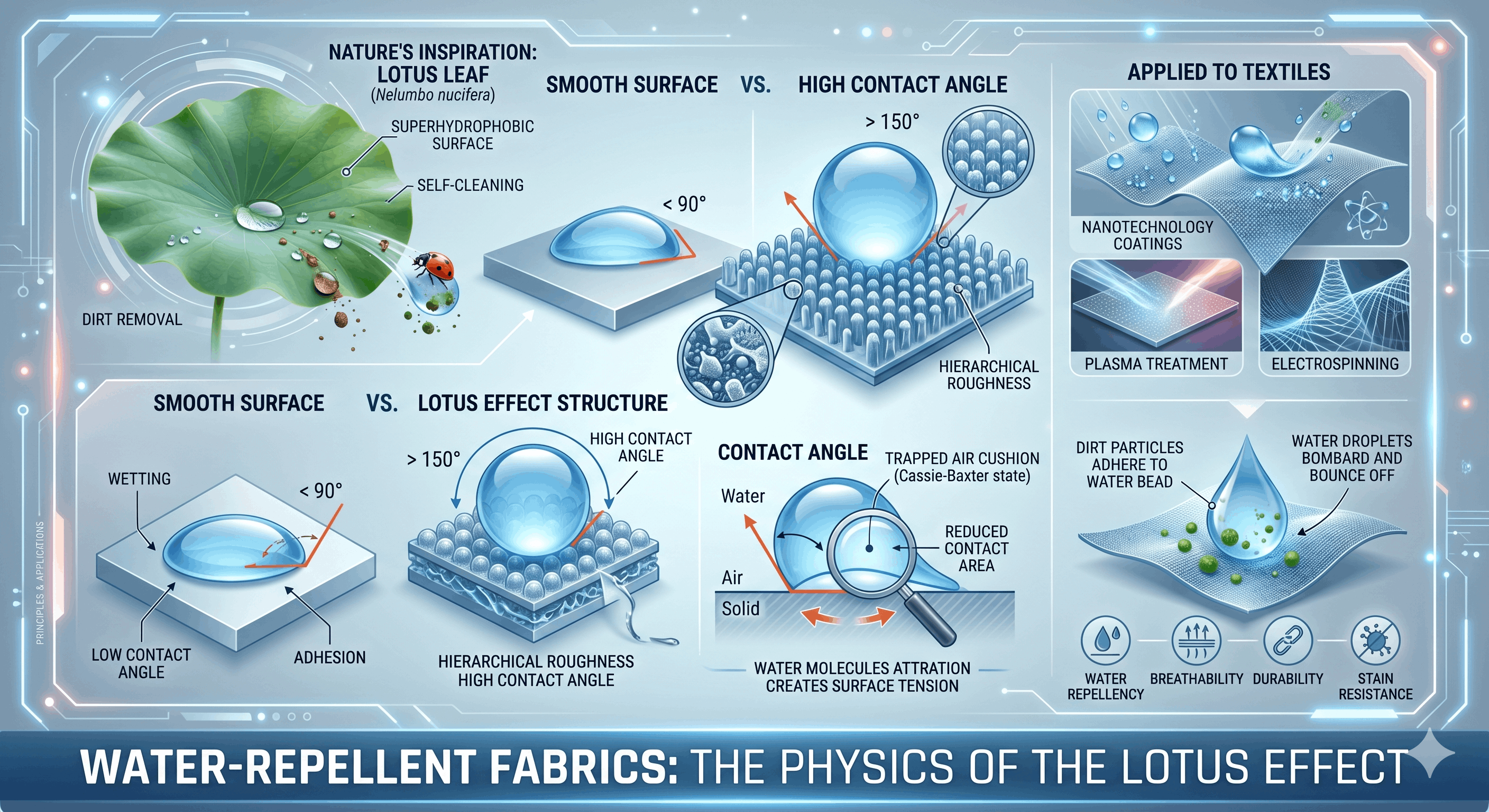
We have all seen it: a rainshower beads up on a well-waxed car, or dew forms perfect spheres on a cabbage leaf. This striking natural phenomenon, where water seems to defy gravity and refuses to wet a surface, is not just a visual curiosity. It is the foundation of a technological revolution in textiles. Famously known as the Lotus Effect, this principle of superhydrophobicity is changing how we dress, how we protect our gear, and how we interact with our environment.
But what exactly is happening at the molecular level? How does a delicate flower leaf keep itself pristine while growing in muddy water? This blog post will explore the sophisticated physics behind the Lotus Effect and how scientists are mimicking nature to create the next generation of water-repellent fabrics.
1. What is the Lotus Effect?
The Lotus Effect refers to the remarkable self-cleaning properties observed on the leaves of the lotus plant (Nelumbo nucifera). While these leaves appear smooth to the naked eye, they possess an incredibly complex, hierarchical surface architecture. This structure, combined with surface chemistry, causes water droplets to maintain a nearly spherical shape. Rather than spreading out and “wetting” the surface, the droplets roll off easily, collecting dust, dirt particles, and even bacteria along the way.
This behavior is categorized as superhydrophobicity. While a “hydrophobic” surface repels water to some degree (like most synthetic rain jackets), a “superhydrophobic” surface does so excessively, with water contact angles exceeding 150 degrees.
2. The Physics of Surface Tension and Wettability
To appreciate the Lotus Effect, we must first understand two fundamental concepts in physics: surface tension and wettability.
Surface Tension: The “Skin” of Water
Water molecules are cohesive; they like to stick together. Inside a drop of water, every molecule is surrounded by other water molecules, pull ing it evenly in all directions. However, the molecules at the surface have fewer neighbors. They are pulled inward, creating an internal pressure that forces the liquid into the smallest possible surface area—a sphere. This pull is surface tension. It makes the surface of the water act like a stretchy, elastic skin.
Wettability: The Battle of Attractions
When a water droplet lands on a solid surface, a battle of attractions begins.
-
Cohesive Forces: Water molecules attracting each other.
-
Adhesive Forces: Water molecules attracting the solid surface.
If adhesive forces are stronger than cohesive forces, the water spreads out, maximizing its contact with the solid. We say the surface is “wettable” or hydrophilic (water-loving). If cohesive forces are stronger, the water beads up, minimizing contact. This surface is hydrophobic (water-fearing).
The degree of wetting is measured by the contact angle ($\theta$). It is the angle formed where the liquid interface meets the solid interface.
-
Hydrophilic: $\theta < 90^{\circ}$ (Water spreads).
-
Hydrophobic: $90^{\circ} < \theta < 150^{\circ}$ (Water beads).
-
Superhydrophobic: $\theta > 150^{\circ}$ (Water forms spheres).
3. The Secret Recipe: Roughness + Chemistry
The lotus leaf achieves superhydrophobicity by masterfully combining two features: surface chemistry and surface roughness.
1. Low Surface Energy (Chemistry)
The surface of the lotus leaf is covered in a layer of epicuticular wax. Wax is composed of hydrophobic hydrocarbon chains. These chains have very low “surface energy,” meaning they don’t have strong attractive forces to pull the water molecules down. This chemistry is the base level of hydrophobicity.
2. Hierarchical Roughness (The Micro and Nano Structure)
Chemistry alone isn’t enough to reach superhydrophobicity. The lotus leaf’s true genius lies in its architecture.
Scanning Electron Microscopy (SEM) reveals that the leaf surface is not flat. It is a rugged landscape of microscopic bumps (papillae) that are 10–20 micrometers tall. Furthermore, each of these microscopic bumps is covered in a secondary layer of even smaller, nanometric wax crystals.
The Cassie-Baxter State
The result of this rough structure is that a water droplet never actually touches the “floor” of the leaf surface. It rests only on the very peaks of the microscopic bumps, supported by a cushion of trapped air. This state is known as the Cassie-Baxter state.
Because the droplet is touching mostly air (which is extremely hydrophobic), the cohesive forces within the water are dominant. The droplet remains spherical, has almost no adhesion to the leaf, and can roll off at a tilt angle of less than 10 degrees.
4. Mimicking Nature: Manufacturing Water-Repellent Textiles
Engineers are using biomimicry to recreate this hierarchical roughness on fabric. This isn’t easy, as fabrics are already rough due to the weaving of fibers. The challenge is adding the nanometric roughness and low-surface-energy chemistry permanently.
Several methods are used to manufacture lotus-effect textiles:
Nanocoating and Chemical Finishing
This is the most common commercial approach. Fabrics are dipped in or sprayed with a solution containing hydrophobic nanoparticles (like silica, zinc oxide, or carbon nanotubes) embedded within a polymer matrix. The polymer binds the nanoparticles to the fibers, creating the necessary dual-scale roughness. The polymer itself often provides low surface energy.
Plasma Treatment
In this high-tech method, the fabric is exposed to a plasma (an ionized gas). The plasma “etches” the surface of the fibers at the nanoscale, creating roughness. Simultaneously, hydrophobic gases can be introduced to chemically modify the surface, depositing a low-energy layer.
Sol-Gel Process
This chemical process involves creating a “sol” (a colloidal solution of solid nanoparticles) that undergoes a gelation process to form a solid network. When applied to fabric, this gel creates a durable, porous, nanostructured coating.
Electrospinning
Instead of coating existing fabric, electrospinning creates new non-woven mats of extremely thin (nanometric) fibers. The innate roughness of these nanofiber mats can provide superhydrophobic properties, especially when the polymer used is inherently hydrophobic.
5. Recent Research and Advances (2024–2026)
The field of superhydrophobic textiles is rapidly evolving, focusing on durability, sustainability, and multi-functionality.
1. Durability is the Holy Grail
The biggest challenge for lotus-effect fabrics is mechanical durability. The delicate nanostructures that create superhydrophobicity are easily worn away by abrasion, laundering, and UV exposure. When the roughness is lost, the Cassie-Baxter state collapses into the Wenzel state, where water fills the valleys and wets the surface. Recent research is focusing on self-healing coatings or coatings where the nanostructures are “grown” directly within the fiber matrix, making them much more robust.
2. The Move to Fluorine-Free Chemistry
Traditionally, the most effective low-surface-energy chemicals were perfluorinated chemicals (PFCs) or PFAS (per- and polyfluoroalkyl substances). These are known as “forever chemicals” because they do not degrade easily in the environment and accumulate in living organisms, posing serious health risks. Current research (2024-2026) is heavily prioritized toward developing PFC-free or fluorine-free hydrophobic agents, utilizing biodegradable polymers, silicones, or natural waxes as sustainable alternatives.
3. Smart and Responsive Textiles
Scientists are developing “smart” superhydrophobic fabrics that can change their properties in response to external stimuli. These are known as stimuli-responsive surfaces. For example, a fabric could be superhydrophobic in rain (restricting water intake) but become breathable when the wearer sweats (allowing vapor to escape), triggered by changes in humidity or temperature.
6. Clinical Studies and Biocompatibility (Analogous Studies)
While “clinical studies” in the strict medical sense are primarily for drugs or medical devices, analogous performance and safety studies are crucial for advanced textiles.
Medical and Surgical Textiles
The Lotus Effect is being explored for medical textiles to prevent germ adhesion. Standard surgical gowns or bandages can become saturated with fluids, allowing bacteria to migrate. Studies on superhydrophobic medical fabrics have shown significant reductions in bacterial adhesion compared to traditional materials. This has the potential to lower hospital-acquired infections (HAIs).
Biocompatibility and Cytotoxicity
Any textile intended for close skin contact must undergo cytotoxicity testing (studies to ensure they don’t kill cells). Studies on nanoparticle-coated fabrics are vital to ensure the nanoparticles do not leach out and enter the skin, posing toxicity risks. Research in this area emphasizes the use of stable, non-toxic nanoparticles, such as biocompatible silica or zinc oxide, bound firmly to the fabric.
7. Advantages vs. Risks: An Assessment
The adoption of lotus-effect technology presents a classic balance of remarkable benefits and significant management challenges.
Advantages
| Advantage | Description |
| Superior Water Repellency | Keeps wearers dry in the heaviest rain, far exceeding standard hydrophobic coatings. |
| Self-Cleaning Properties | Water droplets collect dust and dirt, requiring less frequent washing. This saves water, energy, and extends the garment’s life. |
| Stain Resistance | Repels water-based stains like coffee, juice, and mud. (Oil repellency requires oleophobicity, a related but distinct property). |
| Breathability | Because the water “floats” on an air cushion, the fabric pores remain open, allowing sweat vapor to escape, unlike standard impervious waterproof coatings (like PU). |
| Medical/Hygienic Uses | Prevents fluid and bacterial saturation in medical or protective wear. |
Risks and Challenges
| Risk | Description |
| Environmental/Health Risks of Chemistries | Traditional PFAS/PFC chemistries are persistent environmental pollutants. Their phase-out is a high priority. |
| Mechanical Durability | The delicate nanostructures are susceptible to abrasion, washing, and wear, leading to a loss of repellency over time. |
| Cost of Manufacturing | Advanced manufacturing methods (like plasma or sol-gel) are currently more expensive than standard chemical finishing. |
| Breathability-Repellency Trade-off | While the principle allows breathability, the binding polymers used to adhere nanoparticles can sometimes block pores if not managed carefully. |
| Nanoparticle Leaching | Potential for nanoparticles to detach from the fabric during washing or wear, creating environmental e-waste or potential health risks if inhaled/absorbed. |
8. Conclusion
Water-repellent fabrics based on the Lotus Effect represent a masterpiece of applied physics and biomimicry. By combining low-surface-energy chemistry with dual-scale surface roughness, scientists are unlocking the Cassie-Baxter state on everyday textiles.
While the benefits of superior repellency, breathability, and self-cleaning are profound, the technology faces a critical juncture. The environmental impact of “forever chemicals” demands an expedited transition to fluorine-free alternatives. Furthermore, the longevity of these delicate structures must be improved for the technology to become truly ubiquitous.
The future of advanced textiles lies at this intersection of sustainability and material science. If we can solve the durability puzzle using ecological chemistries, we won’t just be dressing smarter; we will be utilizing nature’s brilliant engineering to create a cleaner, drier, and more efficient world.