
Recently added item(s)
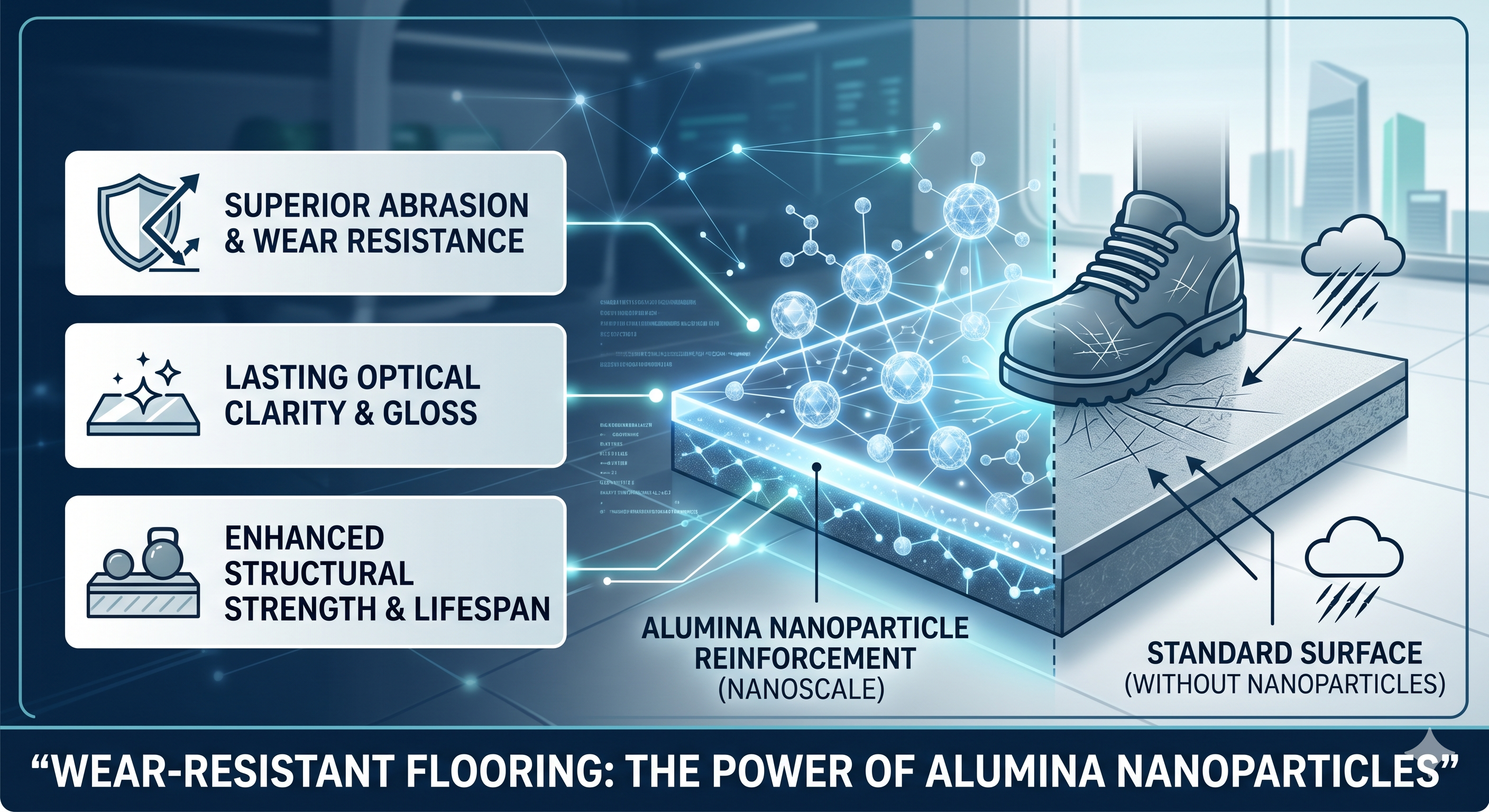
In the world of interior design and architecture, flooring is literally the foundation of every space. It endures the heaviest traffic, bears the weight of furniture, and faces the constant onslaught of scuffs, scratches, and abrasions. For decades, home and business owners have been caught in a cycle of installing beautiful floors, watching them degrade over time, and eventually facing the costly process of refinishing or replacement.
Traditional flooring solutions—polyurethane coatings, laminates, vinyl, and even hardwood—have limitations. While they offer initial beauty and a degree of durability, their lifespan is finite. The primary culprit is “friction wear,” a complex process where countless micro-scratches add up, causing surfaces to lose their luster and become susceptible to staining and structural failure.
Enter materials science. We are now on the cusp of a flooring revolution driven by nanotechnology. Specifically, the integration of Alumina Nanoparticles (Aluminum Oxide, $Al_2O_3$) into flooring wear layers is reshaping our expectations of durability. This isn’t just a incremental improvement; it is the fundamental “reinvention” of wear resistance, bringing industrial-grade strength to residential and commercial environments without sacrificing aesthetics.
Understanding the Problem: The Science of Wear and Tear
To appreciate the solution, we must first understand the battlefield. The field of “tribology” studies the science of friction, wear, and lubrication. When a shoe scuffs across a floor or a chair drags, a three-body abrasion process often occurs. Dust particles (often hard silica) act as a abrasive medium trapped between two surfaces (the floor and the object moving across it). At a microscopic level, this isn’t just one smooth movement.
Traditional clear topcoats, often made of polymers like acrylic or polyurethane, act as a sacrificial layer. Under the friction of traffic, these polymers undergo micro-fracturing. Initially, these fractures are too small to see. Over time, they multiply and merge, causing a surface that was once transparent to scatter light (appearing “dull” or “foggy”). Once the wear layer is sufficiently compromised, the decorative layer beneath (the wood grain image or the actual wood) becomes exposed and quickly disintegrates.
Introducing the Hero: Alumina Nanoparticles ($Al_2O_3$)
Alumina is aluminum oxide. In its natural crystalline form, it is known as corundum. On the Mohs scale of mineral hardness (where diamond is a 10), corundum ranks as a 9. It is incredibly hard, chemically inert, and thermally stable. Industrially, it is used to create sandpapers, grinding wheels, and even high-strength ceramics.
The magic happens when we transition from macro to “nano.” A nanometer is one-billionth of a meter. A sheet of paper is about 100,000 nanometers thick. When alumina is processed into particles sized between 1 and 100 nanometers, its physical properties change dramatically.
The primary reason for this is the massive increase in the surface-area-to-volume ratio. In simple terms, a large surface area creates more opportunities for chemical and physical interaction with the materials it is embedded within. When introduced into a polymer coating, Alumina Nanoparticles act as a structural framework, creating an invisible, molecular-level chainmail.
How It Works: The Invisible Armor Mechanism
The fundamental breakthrough of Alumina Nanotechnology in flooring is maintaining optical clarity while maximizing hardness. In the past, if you wanted a harder wear layer, you had to add thick, opaque abrasive materials, which would ruin the appearance of wood or decorative laminate. Alumina Nanoparticles are smaller than the wavelength of visible light. This means visible light passes through them without significant scattering, making the coating appear transparent.
1. The “Molecular Chainmail” Structure
When Alumina Nanoparticles are dispersed into a wet UV-cured polymer coat, they don’t just sit there. Because of their high surface energy, they bond with the polymer chains. Think of it as mixing extremely hard, invisible, tiny stones throughout a soup of flexible glue. When the coating cures, these nanoparticles are locked in place, creating an extremely hard lattice structure that traditional friction forces cannot easily penetrate.
2. Crack Arresting
Most flooring coatings fail not because they are “scratched away,” but because they fail structurally under load. When a sharp object impacts the floor, it creates a micro-crack. Traditional coatings allow this crack to propagate unimpeded. In an Alumina-reinforced coating, the micro-crack quickly encounters a nanoparticle. Alumina’s hardness is so immense that it absorbs the stress and forces the crack to stop or “arrest.” This prevents small scuffs from becoming deep, visible gashes.
Current Research and Technological Advancements
This technology is no longer theoretical; it is actively transforming the industry. A significant amount of research is focused on optimizing the relationship between particle size, particle dispersion, and the type of host polymer.
Optimization of Particle Dispersion
The single biggest technical challenge is aggregation (clumping). If Alumina Nanoparticles clump together, they form larger structures that do scatter light (making the floor appear dull) and create weak points. Current state-of-the-art research utilizes chemical dispersants and ultrasonic techniques to ensure every nanoparticle is perfectly isolated and evenly spread throughout the coating. Studies have shown that floors with perfectly dispersed Alumina can show a 200% to 500% increase in wear resistance (measured by Taber abrasion tests) with a minimal loss of transparency.
Hybrid Nanoparticle Systems
Recent advancements are looking into hybrid systems. Instead of only using Alumina for hardness, researchers are combining it with silica (for better chemical resistance) or silver nanoparticles (for antimicrobial properties). This “multi-functional nanotechnology” is paving the way for floors that are not just invincible, but also self-cleaning and healthier. This hybrid approach allows for the creation of coatings that are tailored specifically for extreme environments like hospitals (where hardness and sterility are both vital) or commercial kitchens (where slip resistance, chemical durability, and impact hardness are required).
Integration into Resilient Flooring (LVT)
Initially, this technology was pioneered for laminate flooring (where durability was always the weak point). It is now becoming standard for Luxury Vinyl Tile (LVT) and Luxury Vinyl Plank (LVP). Traditional vinyl is soft. Embedding Alumina into the 20mil or 22mil wear layer of an LVT product creates a surface that looks like natural wood but resists traffic damage better than commercial-grade sheet vinyl.
Real-World Case Studies and Industrial Tests
While material science isn’t typically studied via “clinical trials” in the medical sense, it undergoes rigorous industrial testing and field trials (case studies) to prove its effectiveness.
-
Laminate Flooring: The Taber Abrasion Test: The industry standard test for wear resistance involves a rotating machine with abrasive wheels called the Taber Abrader. Traditional laminate wear layers might withstand 1,000 to 2,000 “revolutions” before the underlying decorative paper is reached. State-of-the-art laminate flooring with Alumina-infused coatings consistently reaches 4,000 to 8,000 revolutions, often categorized as AC4 or AC5 for heavy commercial use. This directly correlates to a life expectancy increase of 10 to 20 years.
-
Commercial Applications: Retail and Airports: In numerous field trials conducted in high-traffic commercial environments (such as retail store entryways and airport terminals), flooring samples with Alumina Nanotechnology were installed alongside traditional polyurethane-coated alternatives. After one year of heavy traffic, the Alumina-reinforced sections retained 90% of their gloss and transparency, whereas the control sections had visibly dull “traffic paths” and numerous micro-scratches. These results prove that the technology moves beyond lab conditions to solve real durability problems.
The Advantage-Risk Assessment: A Balanced View
The deployment of Alumina Nanotechnology is not a simple “plug-and-play” solution; it involves a complex matrix of benefits and potential trade-offs that must be critically evaluated.
The Clear Advantages
-
Massive Lifespan Extension: This is the primary driver. An Alumina-reinforced floor can last two to three times longer than a traditional floor, dramatically improving the return on investment.
-
Lasting Aesthetics: Hardness is only half the battle. This technology keeps the surface clear, allowing the floor’s intended look (wood, stone, dynamic pattern) to remain beautiful for decades without looking “foggy” or worn down in traffic areas.
-
Reduced Maintenance: A harder, clearer surface is often smoother at a microscopic level, attracting less dust and making cleaning (mopping, vacuuming) more efficient. Furthermore, the molecular density makes the surface more resistant to deep, permanent stains.
-
Enhanced Impact and Chemical Resistance: While designed for friction wear, Alumina’s structural integration also enhances the floor’s resilience against impacts (dropped objects) and chemical resistance (spilled cleaners, acidic foods).
The Risks and Challenges
-
Higher Upfront Cost: Developing, processing (into nano-size), perfectly dispersing, and applying Alumina Nanoparticles is a costly, energy-intensive process. Consumers must weigh the higher initial cost against the significantly longer lifespan.
-
Aggregation Weak Spots: As mentioned, perfect dispersion is critical. If manufacturing quality control is not flawless, microscopic aggregations can create weak points where micro-cracks can merge, leading to a brittle failure rather than gradual wear. Brittle wear can manifest as chipping or surface delamination.
-
Potential Aesthetic Change: While optically clear, the addition of many hard particles can slightly change the “gloss” index of a surface. Achieving a perfectly flat “matte” look with high nanoparticle content is exceptionally difficult and can result in an unintentional slight sheen.
-
Environmental and Health Concerns in Manufacturing: While the final cured floor is non-toxic and non-leaching, the handling of nanoclays and nanopowders during the manufacturing phase requires specialized safety equipment and containment systems. Free-floating nanoparticles can be respiratory hazards. This makes manufacturing more complex and creates an environmental “cost” that must be managed.
Conclusion
Wear-resistant flooring with Alumina Nanoparticles represents the most significant advance in surface protection of the last quarter-century. It marks the transition from “macro-protection” (applying a slightly harder plastic bag on top) to “molecular-protection” (re-engineering the structure of the plastic itself to act like crystal chainmail).
By bringing the immense hardness of aluminum oxide corundum to the nano level, materials science has solved the age-old dilemma of durability versus design. We can now have invisible, bulletproof protection that preserves the rich texture of hardwood or the beautiful designs of laminate for decades. As manufacturing techniques become more standardized and costs gradually decrease, we will see this technology transition from a premium feature to a standard component of all resilient flooring. The era of nanoflooring is here, promising a future of enduring beauty and unmatched strength underfoot.