
Recently added item(s)
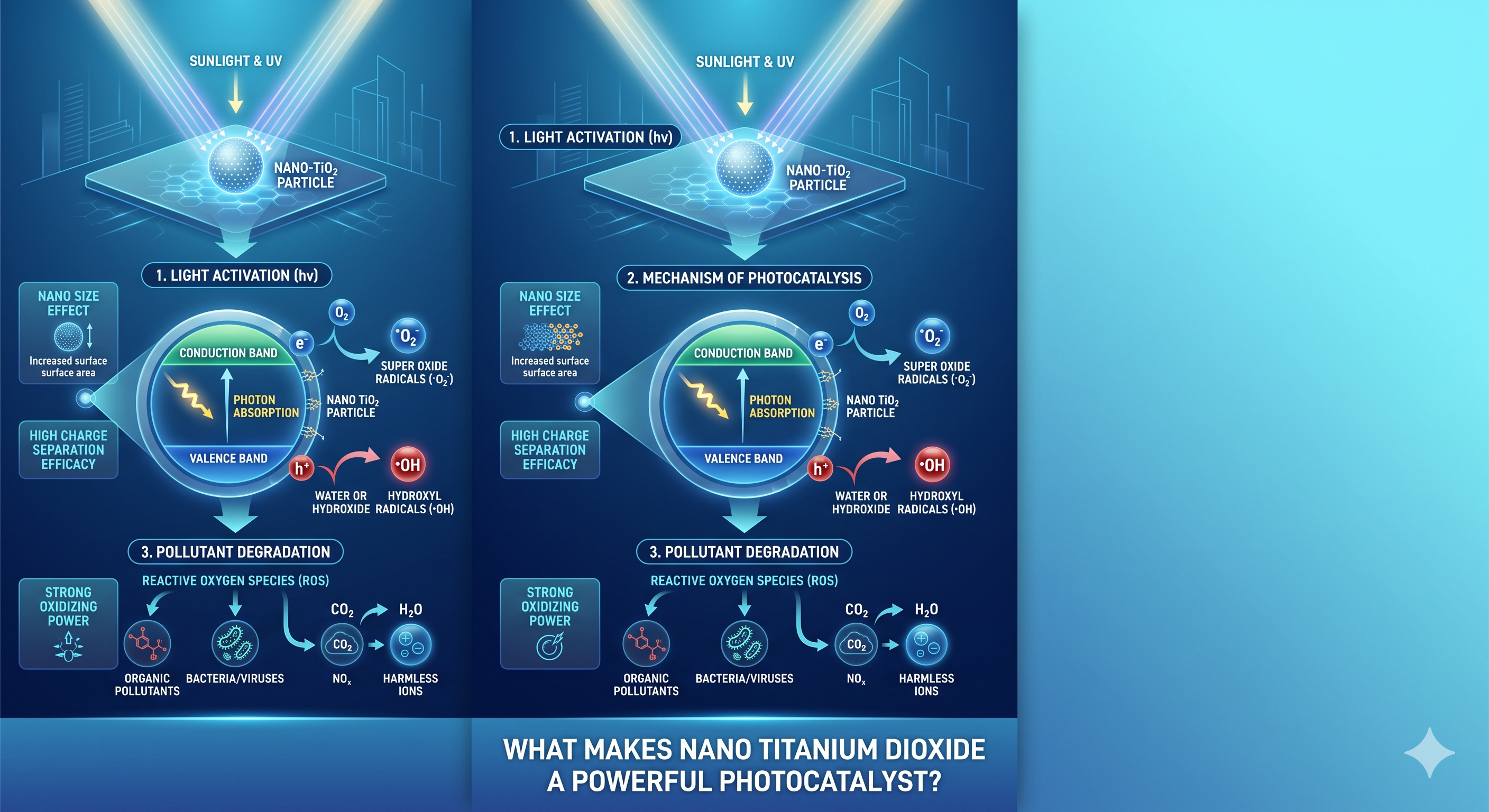
Imagine a world where building windows clean themselves, urban smog is neutralized by the very sidewalks we walk on, and hospital surfaces actively destroy dangerous superbugs using nothing but room lighting. This might sound like science fiction, but it is rapidly becoming our reality. The driving force behind this technological leap? A microscopic marvel known as Nano Titanium Dioxide (TiO2).
While you might not recognize the name immediately, you interact with regular titanium dioxide every single day. It is the brilliant white pigment used in wall paint, the UV-blocking ingredient in your favorite sunscreen, and even the whitening agent in some powdered donuts and toothpastes. In its bulk form, it is stable, safe, and relatively mundane.
However, when scientists shrink this common mineral down to the nanoscale—creating particles thousands of times smaller than the width of a single human hair—it undergoes a radical transformation. It stops being just a simple white powder and becomes one of the most powerful photocatalysts known to science.
In this comprehensive guide, we will explore the science behind nano titanium dioxide, how it harnesses the power of light to destroy pollutants, the groundbreaking clinical research surrounding its medical applications, and the vital balance between its incredible advantages and potential risks.
The Basics: What Exactly is a Photocatalyst?
To understand the magic of nano titanium dioxide, we first need to break down the word “photocatalyst.”
A catalyst is a substance that speeds up a chemical reaction without being consumed or altered in the process. It is like a matchmaker that brings two people together but does not join the marriage itself. Photo refers to light. Therefore, a photocatalyst is a material that uses the energy from light to accelerate chemical reactions.
Nature has been using photocatalysis for billions of years. Photosynthesis in plants is the most famous example, where chlorophyll uses sunlight to convert carbon dioxide and water into glucose and oxygen. Nano TiO2 does something similar, but instead of creating food, it creates microscopic “cleaning agents” that tear apart harmful organic matter, pollutants, and microbes.
The Physics of the Spark: How Nano TiO2 Works
The process begins when light—specifically ultraviolet (UV) light—hits the surface of the nano titanium dioxide particle.
In the language of physics, TiO2 is a semiconductor. This means its electrons rest in a calm, low-energy state called the “valence band.” When a photon (a packet of light energy) strikes the material, it acts like a microscopic cue ball hitting a billiard ball. If the photon has enough energy, it knocks an electron out of the valence band and pushes it up into a higher energy state called the “conduction band.”
When the negatively charged electron leaps up, it leaves behind an empty space known as a “hole,” which acts as a positive charge. This creates an electron-hole pair.
This is where the magic happens:
-
The Electrons react with oxygen in the surrounding air to create superoxide ions.
-
The Holes react with moisture (water molecules) in the air to create hydroxyl radicals.
These superoxide ions and hydroxyl radicals are collectively known as Reactive Oxygen Species (ROS). Think of ROS as molecular Pac-Men. They are highly unstable and intensely eager to react with anything they touch. When they encounter organic pollutants, smog particles, viruses, or bacteria, they ruthlessly attack them, breaking their chemical bonds. Eventually, the dangerous pollutants are completely dismantled and turned into harmless byproducts: microscopic amounts of carbon dioxide and water.
Why “Nano”? The Power of Shrinking Down
If bulk titanium dioxide is so common, why do we need to shrink it to the nanoscale to get these cleaning properties? The answer lies in surface area and quantum mechanics.
Imagine you have a solid block of ice. If you drop it in a glass of warm water, it will melt slowly because only the outside of the block is touching the water. Now, imagine you crush that same block of ice into a fine powder. It melts almost instantly. By crushing it, you have drastically increased the surface area exposed to the water, even though the total amount of ice is exactly the same.
The same principle applies to chemical reactions. Photocatalysis can only happen on the surface of the material. A single gram of bulk titanium dioxide might have the surface area of a small piece of paper. But a single gram of nano titanium dioxide can have a surface area equal to an entire tennis court!
By breaking the material down into nanoparticles (usually measuring between 1 and 100 nanometers), we create billions of new reaction sites. More surface area means more light absorption, more electron-hole pairs, and a massive army of reactive oxygen species ready to clean the environment. Furthermore, at the nanoscale, quantum confinement effects alter the optical and electrical properties of the material, making electron transfers much more efficient and reducing the chance of the electron simply falling back into the hole before a reaction can occur.
Current Research and Real-World Applications
The leap from the laboratory to the real world is already well underway. Researchers and engineers are actively embedding nano TiO2 into our infrastructure to solve severe environmental problems.
1. Air Purification and Smog Reduction
In major cities globally, nitrogen oxides (NOx) emitted by car exhausts are a primary component of dangerous smog. Urban planners are now mixing nano TiO2 into concrete, asphalt, and exterior building paints. When sunlight hits these treated surfaces, the photocatalytic reaction breaks down the toxic NOx gases into harmless nitrates, which are simply washed away by the next rainstorm. Cities in Europe and Asia have already tested “smog-eating” sidewalks with highly promising reductions in local air pollution.
2. Water Treatment and Desalination
Clean drinking water is becoming one of our most precious global resources. Traditional water treatment struggles to remove certain industrial dyes, pharmaceutical residues (like antibiotics flushed into waterways), and microplastics. Nano TiO2 powders and filters are being deployed in wastewater treatment plants. Under UV light, the aggressive hydroxyl radicals can completely mineralize these stubborn chemical pollutants, turning toxic wastewater into clean, safe water without the need for harsh chemicals like chlorine.
3. Self-Cleaning and Anti-Fogging Surfaces
Nano TiO2 possesses another fascinating trait: it is highly hydrophilic (water-loving). When light hits a TiO2-coated glass, it alters the surface tension. Instead of water beading up into droplets (which leave dirt spots when they dry), the water forms a flat, uniform sheet. This sheet slides down the glass, taking dirt, grime, and dead bacteria with it. This technology is already being used in high-rise building windows, car windshields, and solar panels, drastically reducing maintenance costs.
Clinical and Medical Breakthroughs
Beyond environmental engineering, some of the most exciting current research involving nano titanium dioxide is happening in the medical field. The ability to generate targeted destruction via light is a goldmine for clinical researchers.
Combating Hospital-Acquired Infections
Superbugs—bacteria that have grown resistant to multiple antibiotics—are a major crisis in healthcare. Nano TiO2 is being aggressively researched as an antibacterial coating for hospital surfaces, surgical tools, and even textiles (like doctor uniforms and bed sheets). When activated by specific lighting, the reactive oxygen species tear through the outer cell walls of bacteria (a process called lipid peroxidation), effectively destroying the microbe’s DNA and respiratory system. Because this is a physical destruction rather than a chemical one, bacteria cannot develop a resistance to it.
Advancements in Orthopedic Implants
When patients receive titanium bone implants (like a knee or hip replacement), there is always a risk of postoperative bacterial infection. Scientists are currently testing nanoscale TiO2 coatings on these titanium implants. Before closing the surgical site, doctors can use a specific wavelength of light to activate the coating, instantly sterilizing the implant surface and promoting better integration with the surrounding bone tissue (osseointegration).
Photodynamic Therapy (PDT) for Cancer
Perhaps the most groundbreaking clinical research involves cancer treatment. In targeted Photodynamic Therapy, specially engineered nano TiO2 particles are injected into the bloodstream, designed to accumulate specifically in tumor tissues. Once the nanoparticles are gathered inside the cancer cells, doctors shine a highly focused light onto the tumor site. The nano TiO2 activates, generating a localized explosion of hydroxyl radicals that kill the cancer cells from the inside out, leaving the surrounding healthy tissue completely unharmed. While largely still in the in vitro and animal testing phases, early clinical trials show immense promise for treating deep-tissue tumors with fewer side effects than traditional chemotherapy.
Advantage and Risk Assessment: The Double-Edged Sword
Like all powerful technologies, the widespread adoption of nano titanium dioxide requires a careful evaluation of its benefits versus its potential dangers.
The Advantages
-
Highly Sustainable: TiO2 acts as a catalyst; it triggers the reaction but is not consumed by it. A coating of nano TiO2 can continue to clean the air or water for years without needing to be replenished.
-
Cost-Effective: Titanium dioxide is naturally abundant and relatively cheap to synthesize, making it a viable solution for large-scale urban projects.
-
Broad-Spectrum Efficacy: Unlike specific chemicals that target one type of pollutant, the hydroxyl radicals generated by Nano TiO2 are indiscriminate. They will destroy viruses, bacteria, mold, volatile organic compounds (VOCs), and heavy metals alike.
The Risks and Challenges (Nanotoxicity)
-
The Inhalation Risk: The very thing that makes nano TiO2 powerful—its microscopic size—makes it potentially dangerous to human biology. If nanoparticles become airborne and are inhaled, they are small enough to bypass the lung’s natural clearing mechanisms. They can enter the deepest parts of the lungs (the alveoli) and potentially cross into the bloodstream. The International Agency for Research on Cancer (IARC) has classified inhaled TiO2 as a Group 2B carcinogen (possibly carcinogenic to humans) based on animal studies showing lung inflammation and tumor growth after heavy dust exposure.
-
Environmental Accumulation: If nano TiO2 from sunscreens and self-cleaning paints constantly washes into the ocean, what happens to marine life? Current research indicates that high concentrations of nanoparticles can cause oxidative stress in fish gills and disrupt aquatic food chains.
-
Cellular Damage: In medical applications, ensuring that the generated ROS only attack the intended targets (like tumors) and do not cause collateral oxidative stress to healthy human DNA is a major clinical hurdle.
The Future: Overcoming the UV Bottleneck
Despite its incredible power, nano titanium dioxide has one major limitation: its “bandgap.” To kick an electron into the active state, pure TiO2 requires high-energy ultraviolet light. UV light only makes up about 4 to 5 percent of the solar spectrum that reaches Earth, and it is almost non-existent in standard indoor lighting.
This means pure nano TiO2 is highly efficient outdoors on a sunny day but practically useless indoors or at night.
To solve this, materials scientists are currently focusing on a technique called Doping. By introducing foreign atoms—such as nitrogen, carbon, sulfur, or even precious metals like silver and gold—into the crystal structure of the nano TiO2, scientists can artificially lower the energy required to activate the material.
This breakthrough, known as “Bandgap Engineering,” allows the modified nano TiO2 to absorb and react to visible light. This is the holy grail of photocatalysis. Visible-light-active nano TiO2 means we can create hospital room paints that kill bacteria under standard LED lighting, and home air filters that continuously destroy allergens using the ambient light coming through a living room window.
Conclusion
Nano titanium dioxide represents a fascinating intersection of chemistry, physics, and environmental science. By harnessing the basic energy of light, this nanomaterial offers elegant, sustainable solutions to some of our most pressing modern problems—from urban air pollution and water scarcity to antibiotic-resistant bacteria and cancer treatments.
However, the transition to a nano-powered world must be handled with scientific rigor and regulatory caution. By continuously researching its toxicological impacts and developing safer application methods, we can ensure that the risks are minimized. As researchers perfect visible-light activation and improve targeted medical therapies, nano titanium dioxide is poised to be not just a powerful photocatalyst, but a cornerstone of 21st-century green technology and modern medicine.