
Recently added item(s)
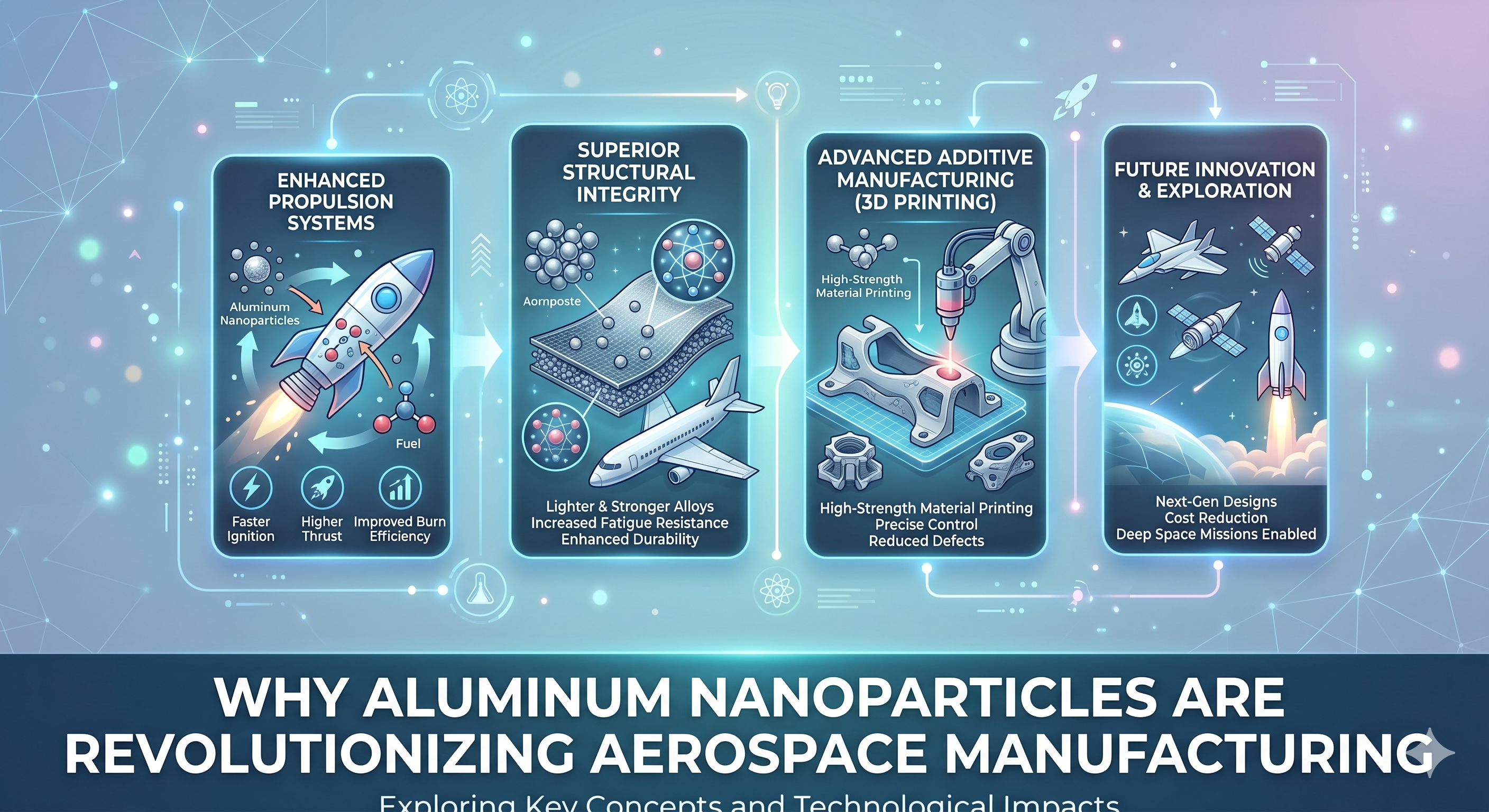
Since the dawn of aviation, the aerospace industry has been locked in an eternal battle against a single, invisible enemy: gravity. From the wood and canvas biplanes of the early 20th century to the sleek, carbon-fiber composite jets of today, engineers have relentlessly searched for materials that offer the perfect, elusive combination of being incredibly light yet unimaginably strong. Every gram saved on an aircraft or a spacecraft translates directly into reduced fuel consumption, increased payload capacity, and extended range.
Today, we are standing on the precipice of a new era in aerospace engineering, and the catalyst for this revolution is invisibly small. Welcome to the world of nanotechnology, where aluminum nanoparticles (AlNPs) are fundamentally rewriting the rulebook of aerospace manufacturing.
This article will explore the science behind these microscopic marvels, dive into current applied research, weigh the advantages against the risks, and reveal why aluminum nanoparticles are the key to humanity’s future among the stars.
The Magic of the Nanoscale: What Are Aluminum Nanoparticles?
To understand the revolution, we first must understand the scale. A nanometer is one-billionth of a meter. To put that into perspective, a single strand of human hair is roughly 80,000 to 100,000 nanometers thick. Aluminum nanoparticles are engineered clusters of aluminum atoms that typically measure between 1 and 100 nanometers in diameter.
But why does shrinking a metal change its properties? When you take a block of everyday aluminum—the same material used in soda cans and traditional airplane wings—and break it down to the nanoscale, its physical and chemical properties shift dramatically. The secret lies in the surface-area-to-volume ratio. In a nanoparticle, a vastly larger percentage of the atoms are located on the surface rather than hidden inside the core of the material. This immense surface area makes aluminum nanoparticles highly reactive, incredibly strong, and capable of blending with other materials in ways that macroscopic aluminum simply cannot.
By harnessing these unique quantum and molecular behaviors, scientists are engineering materials that defy the traditional limits of metallurgy.
Supercharging Space Exploration: The Propulsion Revolution
One of the most thrilling and extensively researched applications of aluminum nanoparticles is in the realm of rocket propulsion. For decades, traditional aluminum powder has been a staple additive in solid rocket propellants. It burns hot and provides a massive amount of thrust, famously powering the solid rocket boosters of the Space Shuttle.
However, traditional aluminum powder has limitations. It can ignite unevenly and leave behind unburned slag, which wastes energy and adds dead weight. Enter aluminum nanoparticles.
Current applied studies and aerospace testing facilities have demonstrated that replacing traditional aluminum powder with AlNPs in solid and hybrid rocket fuels drastically increases the burn rate. Because of their immense surface area, AlNPs ignite faster and burn much more completely. Recent testing by aerospace agencies and defense contractors has shown that nano-aluminum-based propellants can increase the burning rate by up to five to ten times compared to conventional micro-aluminum powders.
This means rockets can generate explosive amounts of thrust in a fraction of the time, allowing for the design of smaller, more efficient launch vehicles. In an industry where launching a single pound of payload into low Earth orbit can cost thousands of dollars, the efficiency brought by AlNPs is nothing short of a paradigm shift.
Next-Generation Structural Integrity: Metal Matrix Composites
While getting into space requires better fuel, staying in the air safely requires better structures. Commercial aviation is heavily focused on materials that can withstand extreme temperature fluctuations, high stress, and constant aerodynamic pressure over decades of use.
Researchers are currently developing Advanced Metal Matrix Composites (MMCs) infused with aluminum nanoparticles. By embedding AlNPs into other metals or carbon-based structures, engineers can create a reinforcing network at the microscopic level. Think of it like adding steel rebar to concrete, but on an atomic scale.
When microscopic cracks begin to form in an aircraft’s fuselage due to metal fatigue—a natural consequence of an airplane pressurizing and depressurizing over thousands of flights—the dispersed nanoparticles act as molecular roadblocks. They intercept the micro-cracks, absorbing the stress and preventing the crack from propagating. Applied material fatigue studies indicate that integrating AlNPs into aerospace alloys can improve tensile strength by over 20 percent and vastly increase the thermal stability of the fuselage.
Breakthroughs in Additive Manufacturing (3D Printing)
Perhaps the most significant current research involving AlNPs is their application in aerospace 3D printing. Additive manufacturing allows engineers to print complex, highly optimized aerospace parts—like rocket engine nozzles or intricate internal wing structures—that would be impossible to machine using traditional methods.
However, 3D printing high-strength aluminum alloys has historically been a nightmare. During the laser melting process, traditional aluminum alloys tend to crack as they cool, a phenomenon known as “hot tearing.”
Recent breakthrough studies from leading technical universities have solved this issue by coating standard metal powders with aluminum nanoparticles. When the 3D printer’s laser melts the powder, the nanoparticles act as nucleation sites—tiny seeds that help the metal crystalize smoothly and uniformly as it cools. This totally eliminates hot tearing. For the first time, aerospace companies can reliably 3D print ultra-strong, lightweight aluminum parts, cutting manufacturing time from months to mere days and drastically reducing material waste.
Environmental Impact and the Push for Sustainable Aviation
The aerospace industry is under immense global pressure to reduce its carbon footprint. Commercial aviation accounts for a significant portion of global greenhouse gas emissions. The math here is simple: lighter aircraft burn less jet fuel, and burning less jet fuel means fewer emissions.
By replacing heavier structural components with ultralight, nanoparticle-enhanced alloys, aircraft manufacturers can strip thousands of pounds off a commercial airliner. Over the lifespan of a single commercial jet, this translates to millions of gallons of aviation fuel saved and a massive reduction in carbon dioxide emissions. Therefore, aluminum nanoparticles are not just an engineering luxury; they are a vital component in the quest for green, sustainable aviation.
Advantage vs. Risk Assessment
As with any disruptive technology, the use of aluminum nanoparticles in aerospace is not without its hurdles. A responsible, scientific approach requires a strict evaluation of the benefits versus the inherent risks.
The Advantages
-
Unprecedented Weight Reduction: Allows for lighter aircraft, increasing payload capacity and fuel efficiency.
-
Enhanced Structural Durability: Nanoparticles prevent metal fatigue and micro-cracking, leading to safer, longer-lasting aircraft components.
-
Propulsion Efficiency: Creates hyper-reactive rocket fuels that provide massive thrust and reduce the required volume of propellant.
-
Manufacturing Innovation: Enables flawless 3D printing of complex aluminum aerospace parts, reducing supply chain bottlenecks and material waste.
The Risks and Challenges
-
High Costs and Scalability: Synthesizing uniform, high-quality aluminum nanoparticles is currently an energy-intensive and highly expensive process. Scaling this from the laboratory to mass industrial production remains a significant economic barrier.
-
Pyrophoric Dangers: The very thing that makes AlNPs great for rocket fuel—their extreme reactivity—makes them incredibly dangerous to handle. In their pure powder form, aluminum nanoparticles are pyrophoric, meaning they can spontaneously ignite or explode when exposed to oxygen in the air. Manufacturing facilities require highly specialized, inert environments (like argon-filled chambers) to prevent catastrophic accidents.
-
Occupational Health and Toxicity: This is where the equivalent of “clinical” safety studies comes into play. Because nanoparticles are so small, they can easily be inhaled, bypassing the body’s natural respiratory filters and entering the bloodstream or accumulating in the lungs. Chronic exposure to metal nanoparticles poses unknown long-term health risks, requiring aerospace workers to wear advanced protective gear and factories to implement rigorous filtration systems.
-
Environmental Accumulation: If not properly managed during the manufacturing or disposal processes, nanomaterials can leach into the environment, potentially harming aquatic ecosystems due to their high reactivity.
Future Horizons: Where Do We Go From Here?
Despite the manufacturing and safety challenges, the trajectory of aluminum nanoparticles is set firmly upward. As nanotechnology fabrication methods mature and become cheaper, we will see these materials transition from experimental, high-end spacecraft down to everyday commercial airliners, and eventually into the automotive industry.
Looking further ahead, AlNPs will be critical for deep space exploration. Missions to Mars and beyond require spacecraft that can carry heavy life-support systems while remaining light enough to escape Earth’s gravity. The hyper-efficient propulsion and lightweight structural resilience offered by aluminum nanoparticles make them the foundation upon which the next generation of interplanetary vessels will be built.
Conclusion
Aluminum nanoparticles are proving that the biggest leaps in aerospace engineering are no longer about building bigger engines, but rather about mastering the microscopic world. By fundamentally altering the strength, weight, and reactivity of one of our most common metals, scientists are pushing the boundaries of what is possible in flight. While the industry must carefully navigate the high costs and safety risks associated with handling nanomaterials, the rewards—faster rockets, greener airplanes, and safer space travel—are revolutionizing the way we explore the skies and the stars.