
Recently added item(s)
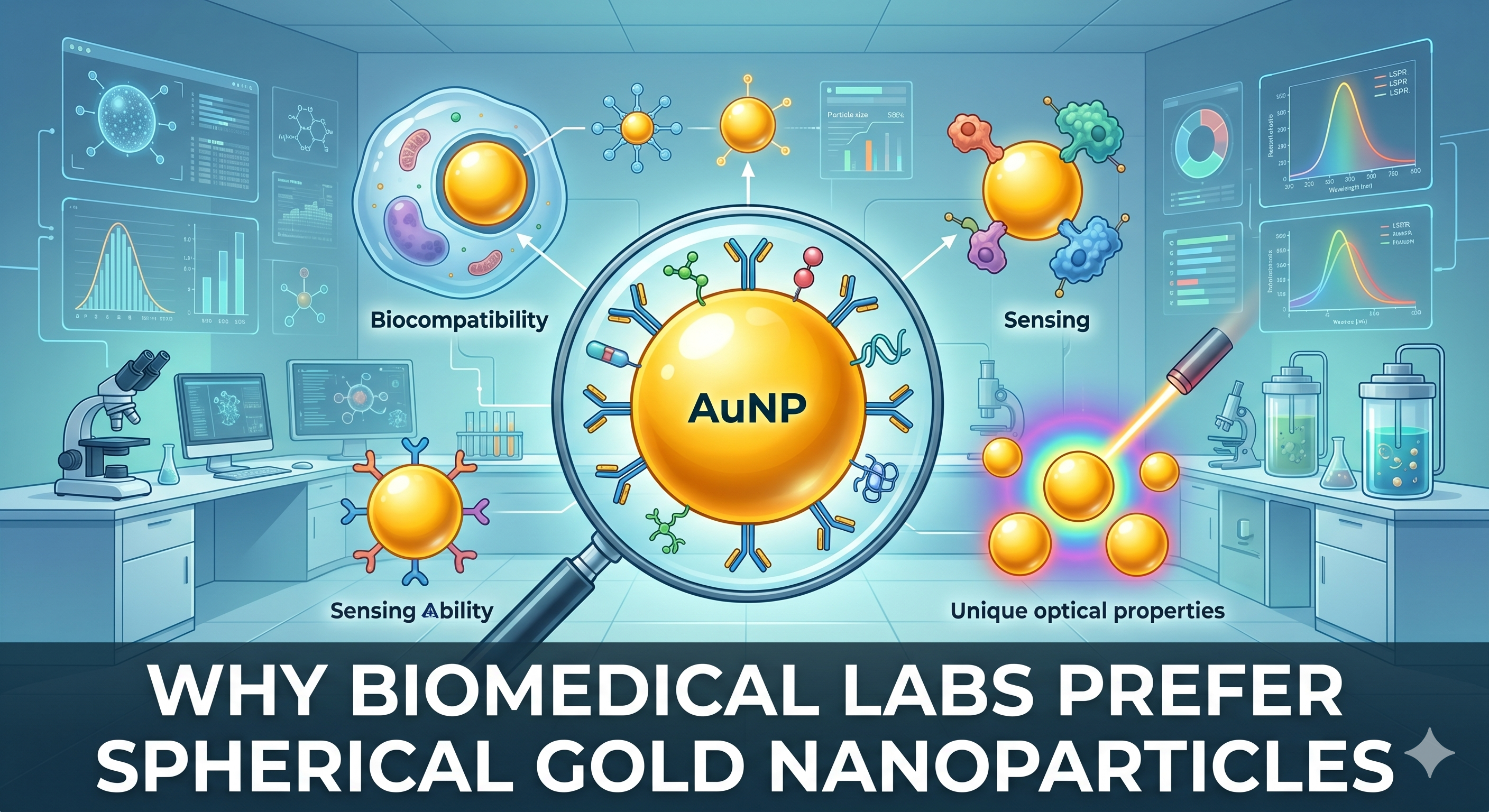
Humanity’s fascination with gold has spanned millennia. From ancient Egyptian pharaohs to modern-day economies, this precious metal has always been a symbol of wealth, beauty, and endurance. However, in the 21st century, the true value of gold is not found in bank vaults or jewelry stores. Instead, it is found inside cutting-edge biomedical laboratories, operating at a scale thousands of times smaller than the width of a single human hair.
Welcome to the world of nanomedicine, where spherical gold nanoparticles are quietly revolutionizing how we diagnose diseases, deliver life-saving drugs, and treat aggressive cancers. But of all the shapes and materials available to modern scientists—from carbon nanotubes to silver stars—why do researchers consistently prefer the simple, spherical gold nanoparticle?
This comprehensive guide will explore the science behind this microscopic gold rush, detailing current research, real-world clinical trials, and a thorough assessment of the advantages and risks associated with these tiny medical marvels.
What Exactly Are Spherical Gold Nanoparticles?
To understand their impact, we first have to understand their size. A nanometer is one-billionth of a meter. To put that in perspective, a standard sheet of paper is about 100,000 nanometers thick. Spherical gold nanoparticles are tiny, globe-like structures made of pure gold atoms, typically ranging from 10 to 100 nanometers in diameter.
When gold is shrunk down to this microscopic size, the rules of classical physics begin to blur, and quantum mechanics take over. At the macro level, gold is an inert, shiny, yellow metal. But at the nanoscale, spherical gold nanoparticles are not yellow at all. Depending on their exact size, they suspend in liquids as vibrant ruby red, deep purple, or even blue solutions. This color change is due to a phenomenon called “Localized Surface Plasmon Resonance” (LSPR). When light hits the nanoscale gold spheres, the electrons on their surface oscillate in perfect harmony, absorbing certain colors of light and reflecting others. As we will see, this unique optical trick is a massive advantage in modern diagnostics.
The Geometry of Success: Why Shape Matters
Biomedical engineers can create gold in many microscopic shapes: rods, stars, cages, and triangles. Yet, the classic sphere remains the undisputed favorite in most laboratories. The reasons for this preference are deeply rooted in chemistry, thermodynamics, and practical lab mechanics.
1. Predictability and Ease of Synthesis In biomedical research, consistency is everything. If a lab cannot create the exact same nanoparticle every single time, the clinical results will be useless. Spherical gold nanoparticles are incredibly easy to synthesize uniformly. Using a process developed in the 1950s called the Turkevich method, scientists simply boil gold salts in water and add a chemical called sodium citrate. The citrate acts as both a reducing agent and a stabilizer, reliably yielding perfectly spherical nanoparticles in a matter of minutes. This ease of manufacturing saves time, reduces costs, and ensures global standardization across different laboratories.
2. Thermodynamic Stability In nature, the sphere is the ultimate shape of stability. It offers the lowest possible surface-to-volume ratio, meaning it requires the least amount of energy to maintain its structure. While spiky gold “nanostars” or elongated “nanorods” might degrade, melt, or alter their shape over time or when exposed to the harsh environment of the human bloodstream, spheres remain highly stable.
3. The Ultimate Biological Canvas The surface of a spherical gold nanoparticle acts like microscopic Velcro. Scientists can easily attach (or “functionalize”) various molecules to the gold surface. By coating the sphere in specific antibodies, DNA strands, or synthetic polymers, researchers can turn a simple gold ball into a highly targeted medical drone. The uniform curvature of the sphere ensures that these therapeutic molecules are distributed evenly across the surface.
Current Research and Groundbreaking Applications
The theoretical benefits of spherical gold nanoparticles have already transitioned into active, life-changing laboratory research. Here are the primary areas where these tiny spheres are making the biggest impact.
Transforming Diagnostics: The Rapid Test Revolution
You have likely already benefited from spherical gold nanoparticles without even knowing it. Have you ever taken an at-home pregnancy test or a rapid antigen test for COVID-19? If so, you have seen gold nanoparticles in action.
These tests rely on lateral flow assay technology. When the test detects a specific biomarker (like the pregnancy hormone hCG or a viral protein from the coronavirus), the biological sample binds to antibodies that are tethered to spherical gold nanoparticles. As these particle clusters build up on the test strip, their collective Localized Surface Plasmon Resonance turns them visible to the naked eye. The familiar bright red or purple line that appears on a positive test is literally a microscopic cluster of gold spheres.
Next-Generation Drug Delivery: The Trojan Horse
One of the greatest challenges in oncology is delivering toxic chemotherapy drugs to cancer cells without poisoning the rest of the patient’s body. Spherical gold nanoparticles are being engineered as microscopic delivery vehicles.
Scientists coat the gold spheres with chemotherapy agents and attach targeting molecules that only recognize cancer cells. Because tumors often have leaky, poorly formed blood vessels—a phenomenon known as the Enhanced Permeability and Retention (EPR) effect—the small gold nanoparticles easily slip out of the bloodstream and accumulate directly inside the tumor tissue. Once inside, they release their toxic payload, destroying the cancer while leaving healthy surrounding tissue largely unharmed.
Photothermal Therapy: Frying Cancer Cells
Perhaps the most futuristic application of gold nanoparticles is Photothermal Therapy (PTT). Because gold nanoparticles act as tiny, highly efficient antennas for light, researchers can use them to physically cook cancer cells from the inside out.
The process is remarkably elegant. First, the targeted gold spheres are injected into the patient and allowed to accumulate inside the tumor. Next, doctors shine a specialized near-infrared laser at the tumor site. Human skin and tissue are mostly transparent to near-infrared light, so the laser passes harmlessly through the body. However, when the light hits the gold nanoparticles, they absorb the energy intensely, vibrating and rapidly converting the light into localized heat. The temperature of the tumor spikes, melting the cancer cells away while the healthy tissue a few millimeters away remains safe.
Real-World Clinical Trials: Moving from Lab to Patient
While the science sounds like science fiction, it is currently being validated in rigorous human clinical trials. The journey from a petri dish to a hospital bed is long, but spherical gold nanoparticles are paving the way.
Aurimune (CYT-6091) One of the most famous clinical trials involving spherical gold nanoparticles is the development of a nanodrug called Aurimune. Tumor Necrosis Factor-alpha (TNF) is a powerful, naturally occurring protein that can obliterate solid tumors. However, it is too toxic to be injected freely into the human bloodstream. Researchers successfully tethered TNF to spherical gold nanoparticles, allowing the drug to safely bypass the immune system and accumulate strictly in tumors. Early phase clinical trials demonstrated that patients could tolerate massive doses of TNF without severe side effects when it was delivered via gold nanoparticles, proving the safety and efficacy of the platform.
Spherical Nucleic Acids (SNAs) and NU-0129 At Northwestern University, researchers developed a groundbreaking therapy utilizing gold nanoparticles to treat glioblastoma, a highly aggressive and deadly form of brain cancer. The therapeutic drug, named NU-0129, consists of perfectly spherical gold nanoparticles densely packed with specialized DNA/RNA strands. This unique, spherical arrangement allows the particles to achieve the impossible: crossing the highly selective blood-brain barrier. In early human clinical trials, researchers confirmed that these gold-based SNAs successfully reached the human brain and accumulated in the tumor cells, turning off the genes responsible for cancer growth.
Advantage vs. Risk Assessment: The Double-Edged Sword
Despite the overwhelming enthusiasm surrounding spherical gold nanoparticles, the biomedical community must maintain a rigorous balance between innovation and patient safety. An objective look at the advantages and risks reveals a complex landscape.
The Advantages
-
Exceptional Biocompatibility: At a fundamental chemical level, gold is an inert, non-toxic noble metal. Unlike certain synthetic polymers or heavy metals like lead and cadmium, pure gold does not trigger a severe immune response or rapidly poison human cells.
-
Tunable Optical Properties: As mentioned earlier, their interaction with light makes them unparalleled tools for imaging, diagnostics, and photothermal treatments.
-
Surface Functionalization: The ease with which scientists can attach drugs, genetic material, and stealth coatings (like Polyethylene glycol, or PEG) makes them the most versatile delivery platforms in nanomedicine.
-
Green Synthesis Potential: Recent advancements have allowed laboratories to synthesize spherical gold nanoparticles using non-toxic plant extracts (like tea leaves or fruit peels) instead of harsh chemicals, making production more environmentally friendly.
The Risks and Challenges
-
Biodistribution and Clearance: The human body is not naturally equipped to process heavy metals. While small nanoparticles (under 5 nanometers) can be filtered out by the kidneys and excreted in urine, larger spherical nanoparticles often end up trapped in the liver and spleen. The long-term effects of gold accumulation in these organs over decades remain a topic of intense scientific debate and caution.
-
Unpredictable Nanotoxicity: While bulk gold is safe, nanoscale materials can sometimes interact unpredictably with cellular membranes, DNA, or proteins in the blood. Rigorous, long-term human toxicity data is still lacking compared to traditional pharmaceuticals.
-
Production Costs and Scalability: Making small batches of spherical gold nanoparticles in an academic lab is easy. However, scaling up production to manufacture tons of clinical-grade, perfectly sterile nanoparticles under strict Good Manufacturing Practice (GMP) guidelines is incredibly expensive and technologically challenging.
-
Regulatory Hurdles: The FDA and other global health authorities do not have long-standing frameworks for evaluating entirely new classes of nanomedicine. The regulatory pathway for approval is slow, cautious, and highly demanding, which can delay life-saving treatments from reaching the market.
Conclusion
Spherical gold nanoparticles represent a beautiful synergy between ancient elements and futuristic medicine. Their perfect geometric shape, predictable chemistry, and remarkable ability to manipulate light and carry complex drugs have earned them their status as the darling of biomedical laboratories worldwide.
As we continue to navigate the intricate biological hurdles of cancer treatment, gene therapy, and rapid diagnostics, these microscopic golden spheres are poised to lead the charge. While the challenges of long-term biological clearance, high manufacturing costs, and strict regulatory approvals still loom large, the ongoing clinical trials provide a beacon of hope. The microscopic gold rush is not just about finding a new way to utilize a precious metal; it is about fundamentally rewriting the future of human healthcare, one nanometer at a time.