Recently added item(s)
In the quest to redefine modern medicine, scientists have moved beyond traditional chemistry and into the realm of nanotechnology. Among the plethora of nanomaterials discovered in the last few decades, one stands out for its transformative potential in healthcare: Graphene Oxide (GO).
While its “parent” material, graphene, won the Nobel Prize for its incredible physical and electrical properties, Graphene Oxide is the version that is actually “winning” in the biological world. Because it is easier to produce, highly soluble in water, and chemically versatile, GO has become the cornerstone of next-generation drug delivery, tissue engineering, and rapid diagnostics.
This article explores why Graphene Oxide is no longer just a laboratory curiosity but an essential pillar of advanced biomedical applications.
1. Understanding Graphene Oxide: The Biological “Hook”
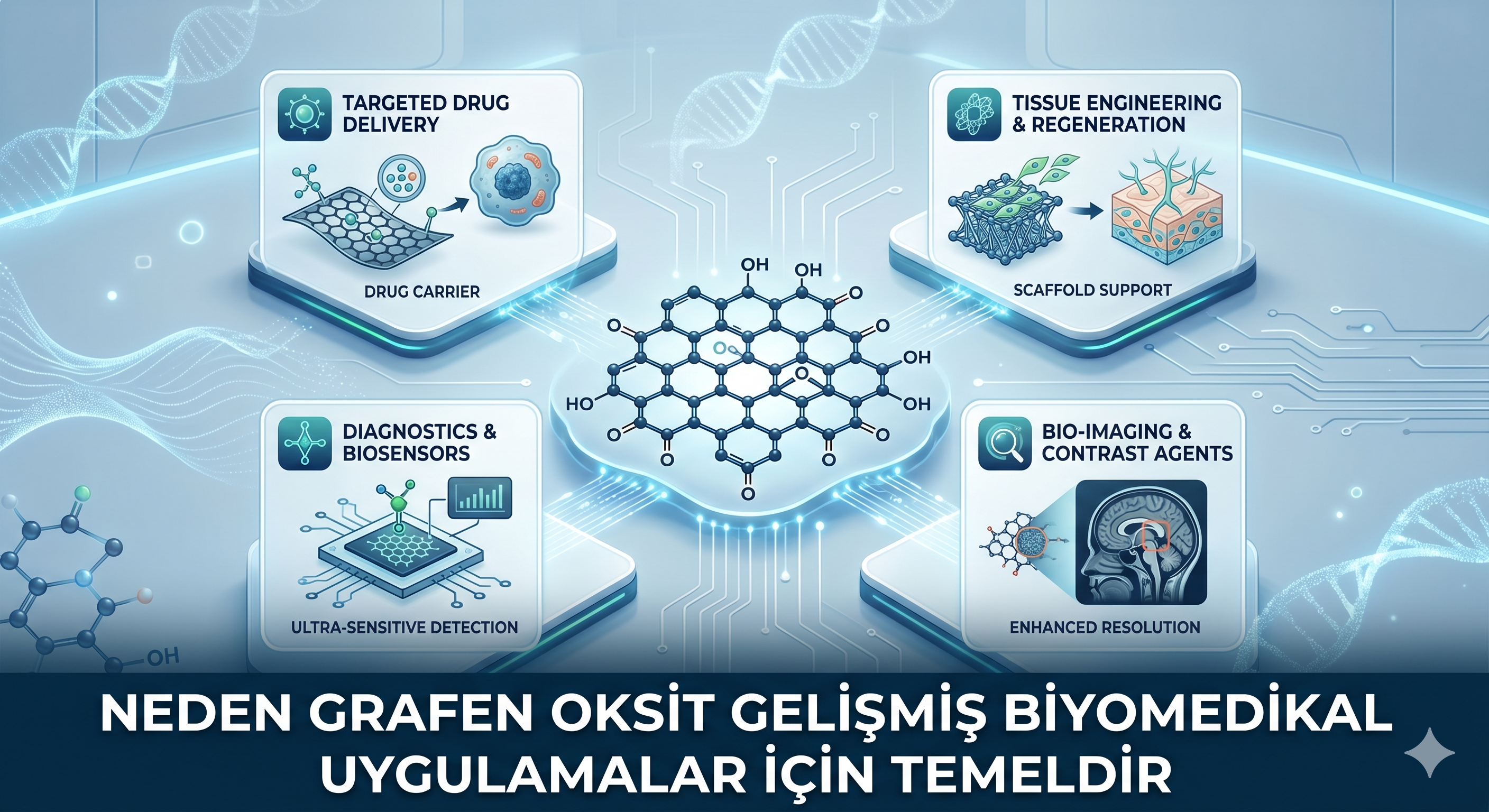
To understand why GO is essential, we must first look at its structure. Unlike pure graphene, which is a hydrophobic (water-hating) sheet of pure carbon, Graphene Oxide is peppered with oxygen-containing functional groups like hydroxyl, epoxy, and carboxyl groups.
Think of these oxygen groups as “molecular hooks.” They allow GO to:
-
Dissolve in biological fluids: Essential for any material entering the human body.
-
Bind with drugs: It can carry proteins, DNA, or chemotherapy drugs with ease.
-
Be modified: Scientists can “decorate” the surface of GO to target specific cells, such as tumors, while leaving healthy cells untouched.
2. Targeted Drug Delivery: The Precision Sniper of Oncology
One of the most significant challenges in medicine, particularly in cancer treatment, is “collateral damage.” Traditional chemotherapy kills cancer cells, but it also harms healthy ones, leading to debilitating side effects. Graphene Oxide is changing this dynamic.
High Loading Capacity
Because GO is a two-dimensional sheet, it has a massive surface area on both sides. This allows it to carry a much higher payload of medicine compared to spherical nanoparticles. In recent studies, GO has shown the ability to carry up to 200% of its own weight in certain anti-cancer drugs.
pH-Responsive Release
Cancerous tumors often have a slightly more acidic environment than healthy tissue. Researchers have developed GO-based carriers that only release their toxic cargo when they encounter this specific acidity. This “smart” delivery ensures that the drug is activated only where it is needed most.
Crossing the Blood-Brain Barrier (BBB)
Recent research in 2025 and 2026 has focused on using functionalized GO to cross the notoriously difficult blood-brain barrier. This opens the door for treating neurodegenerative diseases like Alzheimer’s and brain tumors (gliomas) that were previously hard to reach with standard medication.
3. Regenerative Medicine and Tissue Engineering
Imagine a world where damaged organs can be regrown or repaired using a “scaffold” that mimics human tissue. Graphene Oxide is a leading candidate for these scaffolds.
-
Bone Regeneration: GO provides mechanical strength to biocompatible polymers. Studies have shown that adding small amounts of GO to bone grafts significantly accelerates the rate at which osteoblasts (bone-forming cells) grow and mineralize.
-
Neural Repair: Because GO can be made slightly conductive, it is being tested as a bridge for damaged nerve cells. It provides both a physical path for the nerve to grow along and an electrical environment that encourages signal transmission.
-
Cardiac Patches: Following a heart attack, the heart muscle often scars and loses its ability to pump effectively. GO-infused hydrogels are being used to create “cardiac patches” that help conduct electrical impulses across scarred tissue, synchronized with the heart’s natural rhythm.
4. The Future of Diagnostics: Ultra-Sensitive Biosensors
Early detection is the key to surviving almost any disease. Graphene Oxide’s unique electrical and optical properties make it the perfect “sensor.”
Detection of Biomarkers
GO-based biosensors can detect incredibly low concentrations of disease markers in blood, saliva, or sweat. Whether it is detecting specific proteins associated with early-stage cancer or identifying viral RNA (like COVID-19 or Influenza), GO sensors provide results that are both faster and more accurate than traditional lab tests.
Fluorescence Quenching
In the lab, GO is used in “Turn-On” sensors. GO naturally “silences” (quenches) the light of fluorescent molecules. When a specific target—like a strand of viral DNA—binds to the GO, the fluorescent molecule is released and starts to glow. This allows for instant, visual confirmation of a pathogen’s presence.
5. Antimicrobial and Antiviral Properties: The “Nano-Knife”
As antibiotic resistance becomes a global crisis, GO offers a non-chemical way to kill bacteria.
Graphene Oxide flakes are incredibly thin and sharp at the molecular level. When bacteria come into contact with GO, these “nano-knives” can physically rupture the bacterial cell membrane. Furthermore, GO induces oxidative stress within the bacteria, essentially neutralizing it without the need for traditional antibiotics.
In recent clinical trials involving wound dressings, GO-coated bandages have shown a 99.9% success rate in preventing infections in chronic wounds, such as diabetic ulcers, which are notoriously difficult to treat.
6. Recent Research and Clinical Progress (2024–2026)
While much of the work remains in the pre-clinical phase, the transition to human applications is accelerating.
-
Vaccine Adjuvants: Researchers are currently testing GO as an “adjuvant”—a substance that boosts the body’s immune response to a vaccine. Because GO interacts so effectively with immune cells, it could lead to vaccines that require smaller doses and provide longer-lasting protection.
-
Photothermal Therapy (PTT): Clinical studies are exploring the use of GO in PTT. In this process, GO is injected into a tumor. When hit with near-infrared light (which passes harmlessly through human skin), the GO heats up, “cooking” and destroying the tumor from the inside out without surgery.
-
Bio-Imaging: GO is being used as a contrast agent in MRI and CT scans. Because it can be tracked easily, it provides much higher resolution images of internal structures compared to traditional iodine-based dyes.
7. The Dual-Edged Sword: Advantages vs. Risks
No revolutionary material comes without questions. To use Graphene Oxide essentially and safely, we must weigh its benefits against its potential risks.
The Advantages (The Pros)
-
Biocompatibility: When properly functionalized (coated with substances like PEG), GO is highly compatible with human cells.
-
Versatility: It can be a liquid, a solid coating, or a 3D scaffold.
-
Cost-Effectiveness: Compared to gold or silver nanoparticles, GO is relatively inexpensive to produce in large quantities.
-
Multi-functionality: It can diagnose, treat, and monitor a disease simultaneously (often called “Theranostics”).
The Risks and Challenges (The Cons)
-
Long-term Toxicity: While short-term studies are promising, we are still learning how the body clears GO over many years. Does it accumulate in the liver or lungs?
-
Oxidative Stress: In its “raw” form, GO can be too aggressive, damaging healthy cells by creating reactive oxygen species.
-
Standardization: Because “Graphene Oxide” can refer to many different sizes and oxidation levels, creating a standardized “medical grade” GO is a hurdle for regulatory bodies like the FDA.
Mitigation Strategy: Scientists are currently focusing on “Surface Engineering.” By coating GO in natural proteins or lipids, they can “hide” it from the immune system until it reaches its target, significantly reducing toxicity.
8. Conclusion: A New Era of Nanomedicine
Graphene Oxide is more than just a material; it is a platform. Its unique ability to interface with biological systems at the molecular level makes it essential for the future of medicine. Whether it is through “smart” drug delivery that eliminates the side effects of chemo, or scaffolds that help a paralyzed patient walk again, the potential is limitless.
As we move toward 2030, the focus will shift from “can we use it?” to “how do we use it perfectly?” With continued investment in clinical trials and safety research, Graphene Oxide is poised to transition from the laboratory bench to the patient’s bedside, ushering in an era of truly personalized and precision healthcare.