Recently added item(s)
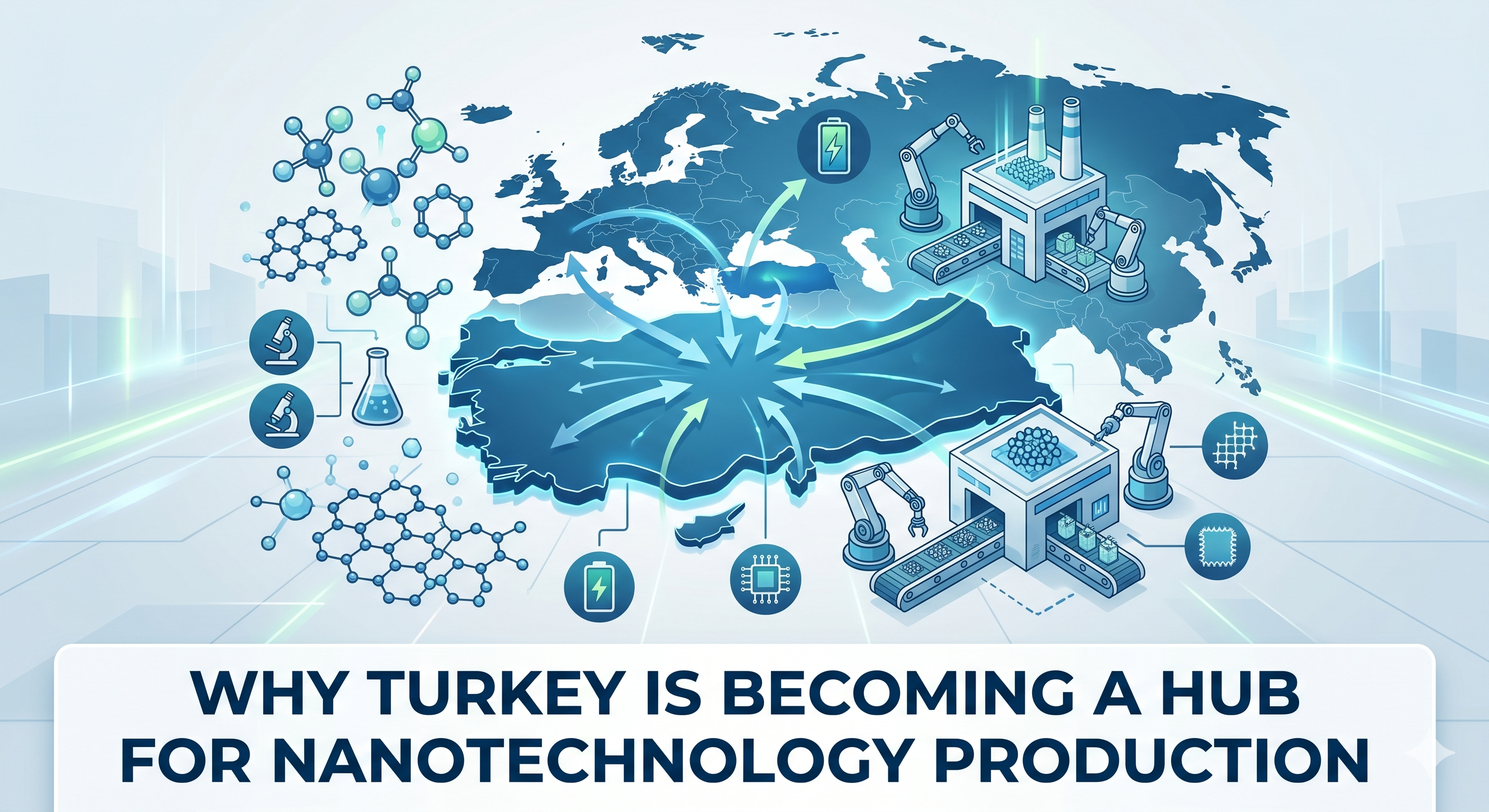
The global industrial landscape is undergoing a profound transformation. We are moving away from an era defined solely by “bigger is better” and entering one defined by the “power of the small.” Nanotechnology—the manipulation of matter at the atomic and molecular scale—is the engine driving this change. While traditional tech giants have long dominated this space, a new player has emerged as a formidable contender on the world stage: Turkey.
Over the last decade, Turkey has strategically pivoted from being a traditional manufacturing base for textiles and automotive parts to becoming a sophisticated hub for “Deep Tech” and advanced material science. This shift isn’t accidental; it is the result of a unique intersection between academic excellence, aggressive industrial investment, and a geographic location that serves as the ultimate logistics bridge between East and West.
1. The Graphene Gold Rush: Anatolia’s New Frontier
If there is one material that defines Turkey’s ascent in the nano-world, it is graphene. Often called the “wonder material,” graphene is a single layer of carbon atoms arranged in a hexagonal lattice. It is 200 times stronger than steel, more conductive than copper, and incredibly flexible.
Turkey is currently home to one of the world’s largest graphene production facilities, signaling a move toward industrial-scale synthesis rather than just laboratory-level experimentation. The ability to produce high-purity graphene and carbon nanotubes (CNTs) at volume has allowed Turkish industries to integrate these materials into:
-
Aerospace and Defense: Creating ultra-lightweight, impact-resistant composites for drones and aircraft.
-
Energy Storage: Developing next-generation batteries and supercapacitors with faster charging cycles.
-
Textiles: Producing “smart fabrics” that can regulate temperature or provide electromagnetic shielding—a natural evolution of Turkey’s historic textile prowess.
2. Advanced Metal Powders and the 3D Printing Revolution
Beyond carbon-based materials, Turkey has made significant strides in the production of micronized and nano-sized metal powders. Metals like tungsten, nickel, and aluminum are being engineered at the nanoscale to enhance their properties for Additive Manufacturing (3D Printing).
This is particularly relevant for the automotive and medical sectors. In the automotive industry, nano-enhanced metal powders allow for the creation of engine components that can withstand higher temperatures and friction, directly leading to better fuel efficiency and lower emissions. In the medical field, these powders are used to 3D-print customized implants that have “bio-active” surfaces, encouraging faster bone growth and reducing the risk of rejection.
3. The Academic-Industrial Synergy: Techno-Parks and R&D
One of the primary reasons for Turkey’s success is the “Triple Helix” model: a tight collaboration between the government, universities, and the private sector. Major cities like Istanbul, Ankara, and Kocaeli are now surrounded by “Techno-Parks” (Teknoparks) that act as incubators for nano-startups.
Institutions such as Middle East Technical University (METU), Istanbul Technical University (ITU), and Sabancı University have established world-class nanotechnology centers (like SUNUM). These centers do not just publish papers; they file patents and spin off companies that produce everything from nano-paints that prevent hospital-acquired infections to nano-coatings that protect solar panels from desert sand. This transition from “lab to market” is the secret sauce of Turkey’s hub status.
4. Sustainability and the “Green Deal” Compliance
As the European Union moves forward with the “European Green Deal,” Turkish exporters face pressure to reduce the carbon footprint of their products. Nanotechnology has become the primary tool to meet these stringent requirements.
Nano-Materials in Green Architecture
Turkish construction firms are increasingly using nano-silica and nano-titanium dioxide in concrete and glass.
-
Self-Cleaning Buildings: Coatings that break down pollutants when exposed to sunlight.
-
Ultra-Insulation: Aerogels that provide superior thermal resistance with minimal thickness.
By adopting these technologies, Turkey is positioning itself as a leader in “Sustainable Architecture,” making its exports more attractive to the eco-conscious European market.
5. Advantage-Risk Assessment: The Strategic Balance
For any nation aiming to be a high-tech hub, there are significant rewards and equally significant hurdles.
| Feature | Advantage of the Turkish Hub | Risk and Challenge Factor |
| Geopolitics | Direct access to EU, Middle East, and CIS markets. | Vulnerability to regional political volatility. |
| Labor Force | A young, highly educated, and tech-savvy engineering pool. | Risk of “Brain Drain” to Western Europe or the US. |
| Cost Efficiency | Lower operational and production costs compared to Western Europe. | Fluctuations in currency can impact raw material imports. |
| Infrastructure | Advanced logistics, modern ports, and specialized Techno-Parks. | Need for continuous, high-level capital investment. |
| Regulatory | Rapid alignment with international ISO and REACH standards. | Navigating the complexities of intellectual property (IP) law. |
6. Clinical and Industrial Case Studies: Nano-Silver and Health
Turkey’s nanotechnology sector gained significant visibility during the global health crises of the early 2020s. Research into nano-silver (AgNPs) and its antimicrobial properties led to the development of local sanitization products that were exported globally.
Clinical studies conducted in Turkish university hospitals have explored the use of nano-drug delivery systems. By encapsulating chemotherapy drugs in nano-lipids, researchers are finding ways to target cancer cells directly while sparing healthy tissue. While many of these are still in the trial phase, the sheer volume of “clinical” research coming out of Turkey has placed it among the top countries for biotechnology publications in the region.
7. Logistics: The Crossroad of Nano-Chemicals
The logistics of nanotechnology is a specialized field. Transporting “dangerous goods” like reactive metal powders or volatile chemical precursors requires strict compliance with international codes (ADR, IMDG, IATA).
Turkey’s investment in modern logistics infrastructure—such as the new Istanbul Airport and expanded Mediterranean ports—has made it a preferred transit point for hazardous chemical logistics. The ability to handle, store, and certify these materials according to GHS (Globally Harmonized System) standards has attracted international chemical giants to set up distribution centers within Turkish borders.
8. The Road to 2030: Challenges Ahead
While the momentum is strong, Turkey faces challenges in the “Silicon” side of nanotechnology. While the country excels in graphene and chemical synthesis, the manufacturing of high-end semiconductors (which rely on nanolithography) requires multi-billion dollar “fabs” that Turkey is only just beginning to plan.
To maintain its hub status, the focus must shift toward:
-
Domestic Semiconductor Capabilities: Reducing reliance on imported chips.
-
Quantum Computing Research: Leveraging nano-scale quantum dots.
-
Standardization: Leading the way in international “nano-safety” protocols to ensure that the production of these materials does not harm the environment.
Conclusion: From Atoms to Assets
Turkey is no longer just a bridge between continents; it is a bridge between the present and the future. By focusing on high-value, high-purity nanotechnology production, the nation is moving up the value chain. For entrepreneurs, scientists, and investors, the “Anatolian Tiger” is proving that in the modern economy, the most significant impact often comes from the smallest particles.
Whether it is through the graphene in a smartphone screen, the nano-coatings on a skyscraper, or the specialized metal powders in a jet engine, Turkey’s “nano-footprint” is expanding. The transition from a traditional manufacturing economy to a nanotechnology hub is well underway, promising a future that is stronger, cleaner, and infinitely more precise.