
Recently added item(s)
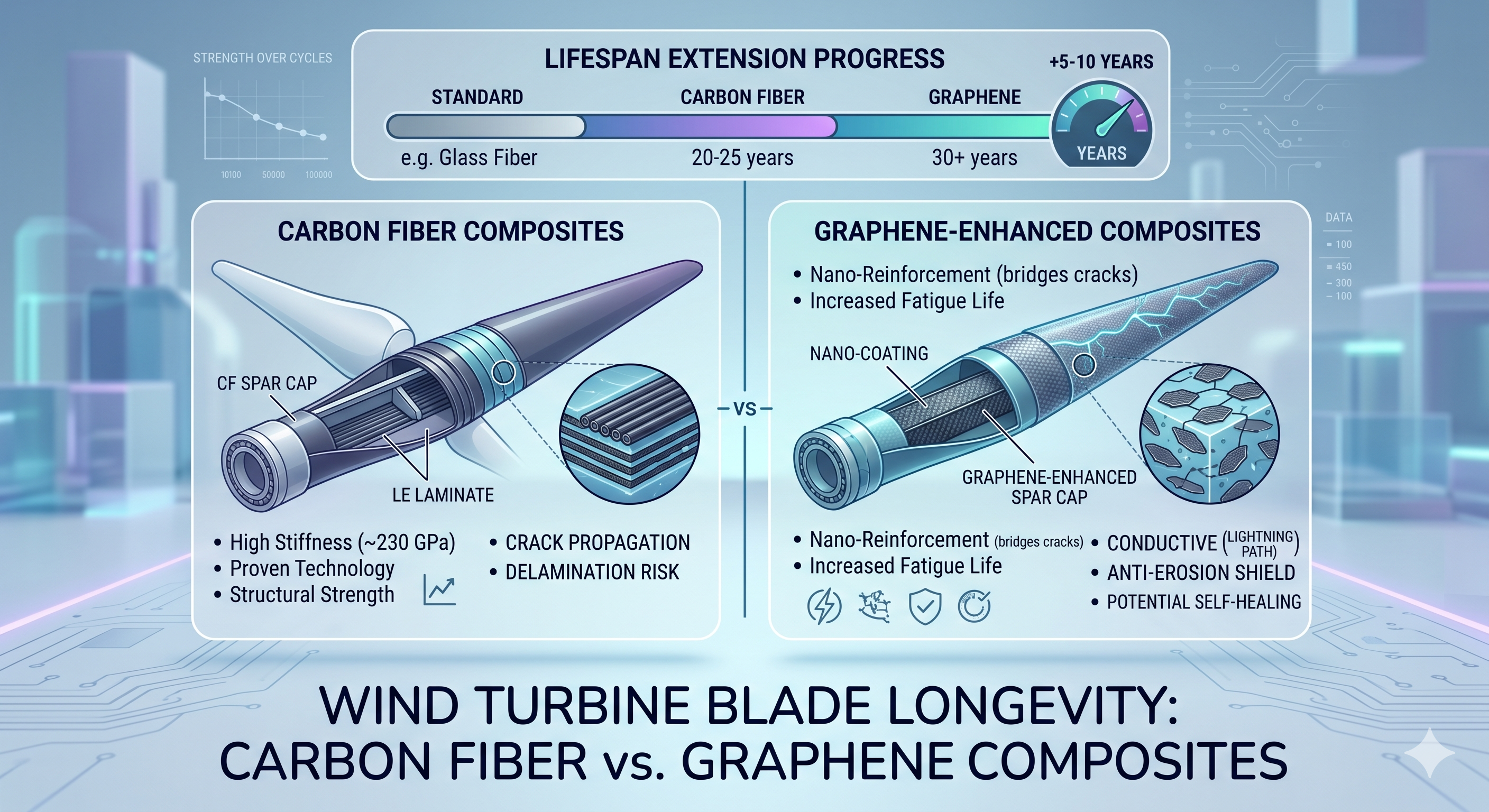
The global transition to renewable energy has positioned wind power as a cornerstone of a sustainable future. As wind turbines grow larger and are deployed in harsher environments—particularly offshore—the demands placed on their components increase exponentially. Among these components, the blades bear the brunt of operational stress. They are massive, complex engineering marvels that must survive decades of relentless fatigue, erosion, and extreme weather.
Ensuring blade longevity is not just an engineering challenge; it is an economic and environmental imperative. Premature blade failure or costly maintenance can undermine the viability of wind projects. For years, material scientists have relied on glass fiber composites. However, the push for larger, more efficient turbines has spurred an intense technological race between advanced materials: Carbon Fiber and the emerging challenger, Graphene Composites.
The Blade Longevity Crisis: Why Materials Matter
To understand the material science, one must understand the environment. A modern wind turbine blade, potentially exceeding 100 meters in length, is subjected to complex force dynamics:
-
Fatigue Loading: Blades endure millions of stress cycles as they rotate, facing turbulent winds and the force of gravity during every revolution. Over time, these cycles can cause microscopic cracks within the material structure, a process known as fatigue.
-
Leading Edge Erosion: Rain droplets, hailstones, insects, and salt spray strike the leading edge of the blade at speeds up to 300 km/h. This continuous bombardment wears away the protective surface, damaging the structural integrity and significantly reducing aerodynamic efficiency.
-
Lightning Strikes: As tall structures in open areas, wind turbines are frequent targets for lightning. A strike can flash-boil the moisture within a composite, causing catastrophic delamination (separation of material layers).
The ideal blade material must possess high stiffness (to prevent the blade from bending into the tower), low weight (to reduce loads on the hub and nacelle), and exceptional resistance to the forces listed above.
The Incumbent: Carbon Fiber Composites
Carbon fiber reinforced polymers (CFRPs) are the high-performance benchmark in aerospace and automotive industries. In wind energy, they are primarily used in the “spar caps”—the internal backbone of the blade that handles the major structural loads.
Advantages for Longevity
-
Exceptional Stiffness and Strength: CF is significantly stiffer and stronger per unit weight than glass fiber. This allows engineers to build longer, more slender blades that maintain their aerodynamic shape under load, boosting energy yield and reducing structural weight.
-
Superior Fatigue Resistance: CFRPs generally exhibit better long-term resistance to fatigue cycles than traditional glass fiber composites, crucial for the blade’s 20-30 year expected lifespan.
Risks and Limitations
-
Brittleness and Damage Tolerance: While strong, CF is relatively brittle compared to glass fiber. It does not tolerate impact loads well (e.g., severe hail). Once a CFRP structure is damaged, the cracks can propagate rapidly.
-
Manufacturing Complexity (Delamination Risk): Manufacturing very thick CFRP components for massive spar caps is challenging. If the resin does not perfectly saturate the fibers (forming “dry spots”), the layers can separate under stress (delamination), leading to sudden, premature structural failure.
-
Cost: CF remains expensive, which increases the capital cost of the turbine, although this is often offset by the increased efficiency and reduced weight of the larger blades.
The Challenger: Graphene Composites
Graphene, a single layer of carbon atoms arranged in a 2D hexagonal lattice, is often hailed as a “wonder material.” It is incredibly strong, conductive, and lightweight. When integrated into composite structures (typically as an additive to the resin matrix or as a coating), it transforms the material’s properties.
Current Research and Functional Mechanisms
The excitement around graphene in wind energy is driven by recent breakthroughs in the functionalization of graphene. Scientists are learning how to “treat” graphene platelets so they bond chemically with the surrounding polymer resin, preventing the graphene from clumping (a major early challenge) and maximizing its reinforcement potential.
Key mechanisms under investigation include:
-
Nano-Reinforcement: Graphene acts as a barrier at the molecular level, bridging microscopic cracks and preventing them from coalescing into macroscopic failures. Recent academic studies suggest that adding small percentages of graphene (less than 1% by weight) can improve fatigue resistance by over 30%.
-
Conductive Pathways (Lightning Protection): Lightning strikes can cook composite resins. Graphene is highly conductive. By integrating graphene throughout the composite or creating a conductive graphene coating, engineers can create a highly efficient path for lightning current to ground, preventing heat buildup and delamination.
-
Impermeability (Erosion Resistance): Graphene is impermeable to moisture and gases. Advanced graphene coatings are being tested for leading edges to create an incredibly tough, durable shield against rain erosion, extending the time between costly blade repairs.
“Engineering Trials”: Recent Research and Pilot Studies
While we do not have “clinical trials” in the medical sense, the engineering equivalent consists of standardized lab testing (e.g., ASTM standards for fatigue and erosion) followed by full-scale prototype testing on operational turbines.
A notable “engineering trial” was conducted by a European consortium (including material scientists and wind turbine OEMs). They developed a graphene-enhanced leading-edge protection coating. Lab testing using a high-velocity rain erosion simulator (whirling arm test) showed the graphene coating lasting twice as long as the state-of-the-art polyurethane solutions before significant material loss occurred.
Another area of active research is functionalized graphene composites. University research teams (e.g., at the University of Manchester and Rice University) are demonstrating multi-scale composites. In these systems, graphene is added to the resin that bonds carbon fiber spar caps. Preliminary results indicate that this creates a “best of both worlds” scenario: the macro-scale stiffness of carbon fiber is protected by the nano-scale crack resistance of graphene, leading to blades that are stiffer, stronger, and more damage-tolerant.
Head-to-Head: Longevity, Advantages, and Risks
| Feature | Carbon Fiber Composites | Graphene Composites (as additive/coating) |
| Longevity Impact | High stiffness extends blade length and reduces overall load, implicitly boosting turbine lifespan. Good fatigue resistance. Delamination is the major enemy. | Directly attacks micro-cracking and fatigue at the nano-level. Offers superior potential for lightning protection and erosion resistance, which are major external kill mechanisms. |
| Current Adoption | Mature but specialized. Used in the backbone (spar cap) of most offshore turbines. Manufacturing processes are stable but difficult at very large scales. | Emerging. Currently tested primarily as additives in coatings and resins. Full-scale functionalized composites are in the prototype/pilot phase. |
| Key Advantages | Decouples turbine size from weight; proven record of increasing energy capture; optimized structural performance. | Transformative multifunctional properties (crack resistance, conductivity, toughness); potential to solve lightning and erosion issues simultaneously. |
| Major Risks | Brittleness (poor impact tolerance); high cost; high delamination risk in manufacturing; difficult to recycle. | Dispersion challenges (clumping); complex functionalization required for performance; scaling manufacturing from lab to multi-ton industrial output; economic viability of large-scale integration. |
The Critical Assessment: Advantage-Risk Analysis
The technological trajectories for these materials are complementary rather than directly adversarial.
Carbon Fiber is essential for scaling wind turbines. Without it, the spar caps of 12-megawatt turbines would be prohibitively heavy. However, relying on CF alone leaves the blade vulnerable to impact damage and expensive manufacturing errors. The high risk of delamination is a constant operational concern.
Graphene Composites offer a paradigm shift towards truly resilient structures. Their multifunctional nature—addressing crack propagation, erosion, and lightning—provides a level of longevity assurance that neither glass nor carbon fiber can match individually.
The principal risk with graphene is not physics, but economics and scalability. The material science works at the lab scale, but producing thousands of tons of high-quality, functionalized graphene platelets reliably and dispersing them evenly throughout 100-meter blades is an immense engineering challenge.
Conclusion: The Multifunctional Future of Wind
Wind turbine blade longevity is critical for the decarbonization of our global energy grid. As we look to the next two decades of wind energy expansion, we are unlikely to see a winner-take-all scenario. Instead, we are entering an era of multi-material design.
While carbon fiber will remain the primary structural reinforcement (the macro-skeleton) of ultra-long blades, the true revolution in longevity will be driven by functional nanomaterials. Functionalized graphene composites will likely become the essential ingredient in resins and coatings (the micro-connective tissue and protective skin). By reinforcing carbon fiber structures at the nano-level and protecting them from the leading edge inward, graphene promises to deliver blades that are not just strong enough to function, but tough enough to endure, redefining the economics of wind power for a generation.