Graphene in Water Filtration: Solving the Global Water Crisis

The global water crisis is one of the most pressing challenges of the 21st century. As of 2026, nearly two billion people live in water-stressed regions, and that number is projected to rise. Traditional desalination and filtration methods, while effective, are often energy-intensive, expensive, and unable to filter out modern contaminants like “forever chemicals” (PFAS).


Read more 

The Impact of Graphene on Aerospace Fuel Efficiency

The aerospace industry is at a critical crossroads. With global travel rebounding and environmental regulations tightening, the pressure to reduce carbon emissions and improve fuel economy has never been higher. While traditional metallurgy and standard carbon fibers have served us well for decades, they are reaching their physical limits. Enter graphene—a single layer of carbon atoms arranged in a hexagonal lattice that is 200 times stronger than steel yet incredibly lightweight.

Read more 

How Graphene-Enhanced Concrete is Building the Cities of Tomorrow

The world is built on concrete. It is the second most consumed substance on Earth, surpassed only by water. However, our reliance on this gray foundation comes with a heavy price: the cement industry alone is responsible for nearly 8% of global CO2 emissions. To build the sustainable “Cities of Tomorrow,” we don’t just need new designs; we need a radical upgrade to the very atoms of our building blocks.

Read more 

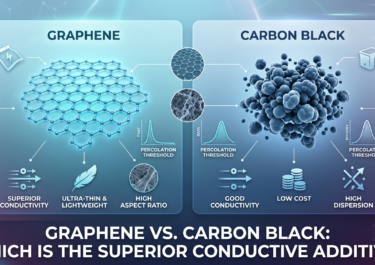
Graphene vs. Carbon Black: Which is the Superior Conductive Additive?

In the industrial world, electricity isn’t just something that flows through wires; it’s something we often need to embed directly into materials. From the touchscreens on our phones to the tires on our cars and the electrodes in our batteries, we rely on “conductive additives” to turn insulating plastics and rubbers into functional, electronic components.

Read more 

What is Molybdenum (Mo) Nanopowder/Nanoparticles?

Molybdenum (Mo) nanopowder and nanoparticles are finely divided particles of metallic molybdenum with nanoscale dimensions, typically less than 100 nm. These nanomaterials exhibit superior chemical reactivity, high surface area, excellent catalytic activity, and unique mechanical and electronic properties, making them suitable for advanced technological applications.

Read more 

What is Carbon Nanotube-TiO₂ Prepared by Electrostatic Adsorption?

Carbon Nanotube-TiO₂ composite materials prepared by electrostatic adsorption combine the excellent electrical, thermal, and mechanical properties of carbon nanotubes (CNTs) with the photocatalytic and semiconductor properties of titanium dioxide (TiO₂). This unique composite is typically synthesized by electrostatically attaching TiO₂ nanoparticles onto the surface of CNTs.

Read more 

What is Copper Indium (Cu-In) Alloy Nanopowder/Nanoparticles?

Copper Indium (Cu-In) alloy nanopowder/nanoparticles are nanoscale materials composed of copper (Cu) and indium (In) with precisely controlled compositions. These nanoparticles are widely recognized for their excellent electrical conductivity, optical properties, and catalytic efficiency, making them valuable in electronics, solar energy, and advanced technology applications.

Read more 

What is Carbon Nanotubes Doped with 52 wt% Silver (Ag) Nanopowder/Nanoparticles?

Carbon nanotubes doped with 52 wt% silver (Ag) nanoparticles are advanced composite materials combining the extraordinary mechanical and electrical properties of carbon nanotubes (CNTs) with the excellent electrical conductivity, antimicrobial activity, and catalytic capabilities of silver nanoparticles. These nanocomposites are extensively utilized across electronics, medical, catalytic, and advanced material applications.

Read more 

What is Aluminum Silicon (AlSi) Sputtering Target?

Aluminum Silicon (AlSi) sputtering targets are specialized alloy materials composed of aluminum (Al) and silicon (Si), widely utilized in thin film deposition techniques such as Physical Vapor Deposition (PVD). These targets facilitate the precise deposition of aluminum-silicon films, essential in the semiconductor, solar cell, optical coating, and electronics industries.

Read more 

What is Lithium Lanthanum Tantalum Zirconate (LLZTO)?

Lithium Lanthanum Tantalum Zirconate (LLZTO) is an advanced lithium-ion conductive ceramic electrolyte material known for its high ionic conductivity, chemical stability, and excellent electrochemical performance. LLZTO is primarily used as a solid-state electrolyte in next-generation lithium-ion and solid-state batteries, facilitating safer and higher-performance energy storage solutions.

Read more 

What are Aluminum Oxide (Al₂O₃) Sputtering Targets?

Aluminum Oxide (Al₂O₃) Sputtering Targets, also known as alumina sputtering targets, are high-purity ceramic materials widely utilized in thin-film deposition technologies. Alumina sputtering targets offer exceptional dielectric strength, thermal stability, chemical resistance, and mechanical robustness, making them essential for electronic, optical, semiconductor, and coating industries.

Read more 

What is WE43 Magnesium Alloy Average Particle?

WE43 Magnesium Alloy Average Particle is a magnesium-based metallic powder alloy, predominantly composed of magnesium (Mg) with alloying elements including yttrium (Y), rare earth elements (RE), and zirconium (Zr). Known for excellent strength-to-weight ratios, corrosion resistance, and biocompatibility, WE43 powder is frequently used in advanced lightweight structural components, biomedical implants, and additive manufacturing (3D printing) processes.

Read more 

What is Ni-Ti50 Alloy Powder / Solid Spherical Micron Powder?

Ni-Ti50 Alloy Powder, also known as Nickel-Titanium or Nitinol powder, is a spherical, micron-sized metallic alloy powder composed of approximately 50 atomic percent nickel and 50 atomic percent titanium. It exhibits unique shape memory properties, excellent biocompatibility, and superelasticity, making it ideal for applications in additive manufacturing, biomedical implants, actuators, sensors, and aerospace industries.

Read more 

What is Cobalt Chromium (Co-Cr) Alloy Powder?

Cobalt Chromium (Co-Cr) Alloy Powder is a high-performance metallic powder composed primarily of cobalt and chromium, known for its excellent mechanical properties, corrosion resistance, biocompatibility, wear resistance, and high-temperature stability. This alloy powder is widely utilized in additive manufacturing (3D printing), biomedical implants, aerospace components, dental prosthetics, and industrial applications.

Read more 

What is Titanium Dioxide (TiO₂) Nanopowder Dispersion in 2-Propanol?

Titanium Dioxide (TiO₂) Nanopowder Dispersion in 2-Propanol is a highly stable colloidal suspension of ultrafine titanium dioxide nanoparticles evenly dispersed in 2-propanol (isopropyl alcohol, IPA). Renowned for excellent photocatalytic properties, UV-blocking ability, chemical inertness, and strong stability, this dispersion is widely used in coatings, photovoltaics, electronics, and advanced materials research.

Read more 

What is Hafnium (Hf) Micron Powder?

Hafnium (Hf) Micron Powder is a fine metallic powder with micron-sized particles of high-purity hafnium metal. Known for its excellent corrosion resistance, high melting point, neutron absorption capability, and mechanical strength, hafnium micron powder is extensively used in advanced industries such as aerospace, nuclear, and electronics.

Read more 

What are Carbon Nanotube-Polystyrene Microspheres Prepared by Electrostatic Adsorption?

Carbon Nanotube-Polystyrene Microspheres are advanced composite materials created by the electrostatic adsorption of carbon nanotubes (CNTs) onto polystyrene microsphere surfaces. These hybrid microspheres combine the superior mechanical, electrical, and thermal properties of carbon nanotubes with the versatility of polystyrene microspheres, providing unique functionalities in various applications.

Read more